Economy 7 Water Tank - Timer Switch

I'm still pretty lost! ....

When all taps are closed, a small amount of water heated by the Willis heater will rise up into the expansion pipe, with the displaced cooler water moving downwards into the cylinder and/or the feed from the Willis heater. Since no water is being drawn, no water will be drawn from the bottom of the cylinder. So long as the taps remain closed, I cannot see why water at the top of the cylinder should get significantly heated - which would mean that there would be no significant heating of water in the cylinder whilst the taps remain closed.
The heated water doesn't go up the expansion pipe (ok the level might rise a bit) the cool water comes from the cylinder not the cold water feed tank, there will be no flow from the cold tank unless a tap is opened. thermosyphon is surprisingly effective, and the water will have no problems circulating around the cylinder. It has been used for cooling stationary engines for decades.
It seems no pumps. I can see how therm-syphon will move the water,
I'm not sure how the system in your photo works, the outlet pipe seems to route under the inlet pipe? All the ones I've seen have been piped as your diagram.
 
It seems no pumps. I can see how therm-syphon will move the water ...
I'mnot sure that I can! "Move the water" from where to where? With all taps closed, I can't see why heated water should move anywhere, other than into the expansion pipe - remembering that water will rise through cooler (more dense) water and fall through warmer (less dense) water.
... what I can't see is how there as any control as to how much water is heated.
I presume that more-or-less all of the water in the Willis heater (however much that is) will get heated to the temp dictated by it's thermostat (I presume it must have one?). When a tap is opened, it will draw water from that in the heater (diluted by cooler water from the cylinder). That sounds to me to be similar to (but a bit 'worse than', because of the dilution) an 'instant hot water' unit with a small (1-5 litre under-sink reservoir) - in which case, as soon as all the heated water from the small supply (in reservoir or Willis heater) has been drawn, one will just be left with 'real-time' heating, which would need to be many kW to achieve a reasonable temp and flow rate.

I continue to assume that, IF the system works reasonably (are we sure it does?) I must still be missing something fairly fundamental!
 
The heated water doesn't go up the expansion pipe (ok the level might rise a bit) ...
I'm not talking about additional water moving into the expansion pipe. Rather, I'm talking about standard convection, with warmer (less dense) water rising through cooler (more dense) water, thereby displacing the cooler water which hence ends up below the warmer water - but with still roughly the same amount of water in the pipe (other than, as you say, a slight expansion).
... the cool water comes from the cylinder not the cold water feed tank...
Why? ... particularly given that (as I've also said) ...
.... there will be no flow from the cold tank unless a tap is opened

... thermosyphon is surprisingly effective, and the water will have no problems circulating around the cylinder. It has been used for cooling stationary engines for decades.
I may need some educating here, since I was under the impression that a 'thermosyphon' was all about convection. As for it "having no problem circulating [water] around the cylinder", I agree that convection would have no problem in doing that IF some heated water were introduced into the cylinder - but my problem is in understanding how heated water from the Willis heater gets into the cylinder (seemingly contrary to the standard mechanism of convection)
'm not sure how the system in your photo works, the outlet pipe seems to route under the inlet pipe? All the ones I've seen have been piped as your diagram.
None of my photos here :-)
 
Last edited:
Maybe we need a thread on Willis immersion heaters? But we also have a problem with tariffs, I look at the host of tariffs on offer, many require so sort of control being given to the supplier, so for me at least non-starters, but we have off-peak starting at around 8.5p/kWh and raising to around 20p/kWh and the standard and peak supplies also vary and in the main the longer we have for off-peak, the less advantage we get. Because prices vary region to region not easy to say how it will work out, but seems my region e-on which was only one I could find that lists prices without the process of selection house etc. E7 off-peak 15.817p/kWh and E10 off-peak 21.179p/kWh both same peak price of 33.092p/kWh both higher than my 8.5p/kWh for 5 hours of off-peak, also the peak is higher than my peak.

It talks about the smart meter being able to work with E10, can't really work out why any couldn't? But it does seem some can only have E7, but as to any off-peak rate, it does depend on percentage of power drawn at each rate, and with batteries we are using over 50% off-peak 365 days of the year, but with storage heaters, in summer one can end up paying more using a split tariff in the summer.

At 1771597032025.pngI am sure it can pay for its self, but at 1771597223382.pngnot so sure and at 1771597325082.pngI am sure I made a mistake, can't see it ever paying for its self.

The same goes for the Willis, does not matter how good, it may be worth while as orignal installation, but unlikely to be worth changing to it.
 
Thanks all for the replies

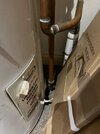
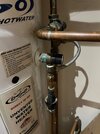
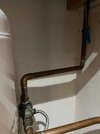
I’ll go through it all. Below are photos of my setup. No idea how it works to be honest. Just curious to know if a timer would help or if it’s controlled some other way.

The white wire at the bottom goes to an isolation switch. And the mcb is labelled B16

Cylinder Heater is 2003. Unvented water heater
 

Attachments

  • IMG_5273.jpeg
    IMG_5273.jpeg
    749.6 KB · Views: 6
  • IMG_5274.jpeg
    IMG_5274.jpeg
    735.7 KB · Views: 6
  • IMG_5275.jpeg
    IMG_5275.jpeg
    600.7 KB · Views: 6
I am now confused
1771605519953.png
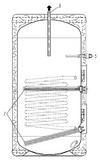
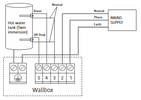
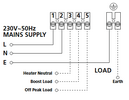
clearly an electrical connection, but does this power an immersion heater, or go to some thermostat? So hunted for instructions and found this diagram 1771605827956.pngwhich shows two immersion heaters.
Direct Units
Wiring instructions for the immersion heaters are located on the reverse side of the lid. Follow the wiring instructions connecting the live, neutral and earth as indicated. The electrical connection to the immersion heater must conform to current IEE wiring regulations. The unit must be permanently connected to the electrical supply through a double-pole linked switch with a minimum break capacity of 13 amps. All internal wiring is factory mounted. Each immersion heater has a working thermostat adjustable between 45°C - 75°C. A safety cut-out is also incorporated within the thermostat and will operate at 85°C ± 3°C. Should this happen, press the reset button.

Important: Before resetting the safety cut-out or altering the thermostat setting, isolate electrical supply to the unit prior to removal of the lid. Ensure the lid to the electrical box is replaced correctly and the retaining screw is fitted.

The lower immersion heater should be connected to the off peak supply (if available) whilst the top immersion heater can be connected to the day tariff. The immersion heater can be connected to the mains supply through a water heater controller (Contact your local electricity company if in doubt).

The diagram
1771606797316.png
does not really help, and the instructions clearly old as it refers to IEE, this is now IET, so would guess date back to around 2004?

So a single cable would need to be at least 6 core, and more likely 8 - 10 core, or more than one cable. So that cable at the bottom looks too small to have 8 x 1.5 mm² wires in it.
16 amps is the usual choice, example: https://www.screwfix.com/p/lap-digital-immersion-timer/1804r
A search for 'immersion timer' will reveal plenty of other options.

However before buying anything, you will need to determine how the E7 is configured, as some are switched via the meter or an external device, in which case a timer will be of no use.
There is also the question of whether the entire supply goes to the E7 rate, or whether it's just the supply for the heaters.
Whether the existing supply to this water heater is on 24/7 or is already switched via the metering equipment.
Is this a cylinder with a single element, or a cylinder with 2 elements, or a twin element in a single casing.

As normal @flameport early on realised the problems. The major problem is how many neutrals, we need to avoid a borrowed neutral, so it may need two independent neutrals, and this also impacts on the timer, each immersion heater is it seems 3 kW so you must not run both together, so a timer turning on the bottom immersion heater, also needs to turn off the top immersion heater, and when the off-peak and peak may come from independent distribution units, never mind different overloads within those units, all switching needs to be double pole.

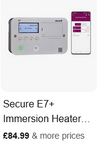
So Horstmann E7+ 1771608080731.pnguses one neutral, 1771608367620.png Timeguard the same, I remember years ago there were timers, but I have failed to find one. However before wasting too much time hunting, need to work out if required, I know I could fit a relay into an adaptable box to swap between the two immersion heaters if required, but it may not be required, in fact may not even need a timer.
Could you post a photo of your fuseboard and supplier meter?
As it stands, we are guessing as to what you might have.
 

If you need to find a tradesperson to get your job done, please try our local search below, or if you are doing it yourself you can find suppliers local to you.

Select the supplier or trade you require, enter your location to begin your search.


Are you a trade or supplier? You can create your listing free at DIYnot Local

 
Back
Top