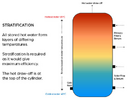
Willis Heating System

Joined
28 Jan 2011
Messages
61,690
Reaction score
4,796
Location
Buckinghamshire
Country
United Kingdom
The following comes from another current thread, which has somewhat 'drifted'. In a subsequent post to this one (please be patient :-) ), I'll attempt to move this discussion forwards!! ...
I think I must be dim, because I've always struggled to understand how the Willis system (as depicted in your diagram) can possibly work.
I cannot see why heated water from the Willis heater should travel downwards into the cylinder, which contains colder water. It will rise to the top of the column of water in the expansion/vent pipe, but I don't see why it should move downwards - and, since the connection to the taps comes off the expansion pipe below the connection to Willis heater, I would expect it to draw water (for the taps) from the colder water at the top of the cylinder.
What am I missing?
I assume it starts a flow, and the gate valve regulates the flow, but can't find the Willis website. I liked the idea, but I am not sure how it will work with varying output from the immersion heater?
The heated water will rise up through the heater via thermosyphon, as it does it draws cooler water from the bottom of the cylinder, heating the cylinder from the top down.
As I said, with a Willis system simply as shown in the diagram you posted, I cannot understand how heated water would/could ever get into the cylinder. Nor can I see how any valves could alter that. I find it hard to believe that anything other than a pump could force heated water(hence lower density) to travel downwards into/through cooler water, despite gravity and Mr Archimedes.
Maybe the system is significantly more complicated (perhaps including a pump) than your diagram (and most other diagrams one sees) suggests?
I'm still pretty lost! ....
When all taps are closed, a small amount of water heated by the Willis heater will rise up into the expansion pipe, with the displaced cooler water moving downwards into the cylinder and/or the feed from the Willis heater. Since no water is being drawn, no water will be drawn from the bottom of the cylinder. So long as the taps remain closed, I cannot see why water at the top of the cylinder should get significantly heated - which would mean that there would be no significant heating of water in the cylinder whilst the taps remain closed.
When tap(s) are opened, water flowing to them will be a mixture of that from the top of the cylinder (which I would expect to be pretty cold, if taps had previously been closed) and from the Willis heater, the proportions via those two routes being determined by the relative resistances to flow in the two routes. What comes out of the taps would therefore seemingly be a mixture of heated water in the Willis heater (until it runs out) and of the (I would think cooler) water in the cylinder.
So, if it works (which I assume it must do), I must still be missing something.
It seems no pumps. I can see how therm-syphon will move the water, what I can't see is how there as any control as to how much water is heated.
The heated water doesn't go up the expansion pipe (ok the level might rise a bit) the cool water comes from the cylinder not the cold water feed tank, there will be no flow from the cold tank unless a tap is opened. thermosyphon is surprisingly effective, and the water will have no problems circulating around the cylinder. It has been used for cooling stationary engines for decades.
I'mnot sure that I can! "Move the water" from where to where? With all taps closed, I can't see why heated water should move anywhere, other than into the expansion pipe - remembering that water will rise through cooler (more dense) water and fall through warmer (less dense) water.
I presume that more-or-less all of the water in the Willis heater (however much that is) will get heated to the temp dictated by it's thermostat (I presume it must have one?). When a tap is opened, it will draw water from that in the heater (diluted by cooler water from the cylinder). That sounds to me to be similar to (but a bit 'worse than', because of the dilution) an 'instant hot water' unit with a small (1-5 litre under-sink reservoir) - in which case, as soon as all the heated water from the small supply (in reservoir or Willis heater) has been drawn, one will just be left with 'real-time' heating, which would need to be many kW to achieve a reasonable temp and flow rate.
I continue to assume that, IF the system works reasonably (are we sure it does?) I must still be missing something fairly fundamental!
I'm not talking about additional water moving into the expansion pipe. Rather, I'm talking about standard convection, with warmer (less dense) water rising through cooler (more dense) water, thereby displacing the cooler water which hence ends up below the warmer water - but with still roughly the same amount of water in the pipe (other than, as you say, a slight expansion).

Why? ... particularly given that (as I've also said) ...
I may need some educating here, since I was under the impression that a 'thermosyphon' was all about convection. As for it "having no problem circulating [water] around the cylinder", I agree that convection would have no problem in doing that IF some heated water were introduced into the cylinder - but my problem is in understanding how heated water from the Willis heater gets into the cylinder (seemingly contrary to the standard mechanism of convection)
 
Is the system not just similar to a gravity fed hot water cylinder from a (solid fuel) back boiler?

That is - it just works because because that's what happens.
 
OK. I don't think I have get moved appreciably on for my position in not really understanding (for the reasons I have outlined) how/why the Willis system can possibly 'work' (in the sense of heating the water in the main cylinder).

Mr Google seems to know surprisingly little about the Willis system. Attempts to do searches result mainly in hits relating to 'heating businesses' all over the place run by various instances of "Mr Willis"!

A combination of that and the theoretical arguments I've presented therefore leave me wondering whether this concept is not really just a variant of the concept of the "under-sink gizmo", which provides a relatively very small amount of stored hot water, making the main HW cylinder pretty irrelevant, with hot water reduced to either a trickle or a low temp once the small amount of stored hot water has been used up?
 
Is the system not just similar to a gravity fed hot water cylinder from a (solid fuel) back boiler?
That is - it just works because because that's what happens.
Not in terms of what I currently understand - as I've been saying, I don't yet see how it can result in much more stored hot water than the (small) amount contained in the 'Willis heater' itself - as I've said, like the 'under-sink' things.

To my mind, to function like a "gravity fed hot water cylinder", the hot water coming from the Willis heater would have to be connected to the main cylinder lower down (ideally the bottom), not above the top of it!
 
Thank you for moving,
Is the system not just similar to a gravity fed hot water cylinder from a (solid fuel) back boiler?
1771609404621.png
I don't think so, remembering back to the side boiler in the Aga, it seemed to mix up the water, today we have a hot coil
1771609522609.png
so water does not mix anyway, but the Willis both electric and hot coil versions, the Heating is done in the external heat exchanger or immersion heater
1771609693180.png
and it puts water at a useable temperature into the top of the cylinder first, and as time goes by, the stratification layer goes further down the cylinder.

I know it works, but not sure how it works. I can find loads of pictures 1771610386536.pngshowing stratification and saying how to avoid it, but what we are looking at is how to control it. I think there has to be a stop tap
1771611379918.png
to control the speed the water transfers at, which is missing from diagrams I am finding. I have hunted and hunted for the Willis website, but it seems to have vanished.
 
Found on an Irish plumbing forum where there are a couple of threads about this, though nothing recent (2022)

"Because its external and connected to the top and bottom of the tank it sets up a very low powered thermal syphon so it pushes hot water out the top while sucking cold(er) water in from the bottom. Provided the water coming in at the bottom will keep the thermostat below the level its set at it will keep heating the water. It should work no matter what the height of the element in the Willis is in relation to the tank but the lower it is the better the thermosyphon will work so basically mount it a low as possible."

In essence It's operating in its own closed loop, so it will circulate and I suppose a bit like a ring main with a socket or a spur (acting as the hot water draw off point) the spur would draw current from both sides but in this case (water) more from the one with least resistance. Note that it is fitted "upside down" to ensure the element is completely covered and recommended to fit as low as possible to the feed/cylinder bottom & if possible 50/60cm above the draw off point at the cylinder top. Curved bends instead of right angles and full bore valves give best flow. Can be used in both vented/unvented systems with relevant safety pressure regulation

Haven't got one but considering it when I have my defunct combi replaced and re-install an immersion tank so I can have a bath for a change.
 
Not in terms of what I currently understand - as I've been saying, I don't yet see how it can result in much more stored hot water than the (small) amount contained in the 'Willis heater' itself - as I've said, like the 'under-sink' things.

To my mind, to function like a "gravity fed hot water cylinder", the hot water coming from the Willis heater would have to be connected to the main cylinder lower down (ideally the bottom), not above the top of it!

Seems perfectly obvious to me, it would work, and work well....

The element in the small Willis tank, heats the water in the small tank. Heated water rises, and flows into the top, of the main tank/cylinder, whilst at the same time drawing cold water in the small tank, from the larger one. The hot, will stay at the top, cold at the bottom.

The interface level, between hot at the cold, will gradually work its way down the cylinder, which means thermostats of various lengths, or sensor at various heights, could be used to preset an amount of hot water you needed, to then switch the element off.
 
Seems perfectly obvious to me, it would work, and work well....
It might be 'perfectly obvious' to you - but I nevertheless still need someone to explain to me why/how it 'works' ('well' or otherwise), despite what currently seems to me to be an 'obvious' conflict with the Laws of Physics.
The element in the small Willis tank, heats the water in the small tank. Heated water rises, ....
Indeed.
.... and flows into the top, of the main tank/cylinder, ...
As I've asked before, "why?". The heated water has a lower density than the colder water in the main cylinder - so, in a world with gravity (and Mr Archimedes, hence 'convection') why on earth should that lighter, heated, water move downwards ('against' gravity) into the main cylinder?
.... The interface level, between hot at the cold, will gradually work its way down the cylinder ...
As above, I cannot see why any hot water should defy gravity and move downwards into the main cylinder (i.e. 'convection').
 
As I've asked before, "why?". The heated water has a lower density than the colder water in the main cylinder - so, in a world with gravity (and Mr Archimedes, hence 'convection') why on earth should that lighter, heated, water move downwards ('against' gravity) into the main cylinder?

It rises in the small tank, if it rises in the small tank, it has to go somewhere, that somewhere is to exit to the large tank, whilst drawing cold in behind it. It is not defying physics at all. Imagine, sort of, how two tanks, open to atmosphere, joined by a pipe at their bases, might work, in levelling up the fluid? This is similar, except it uses thermo-syphonic action - the less dense warmer water, rises to the upper of both tanks, because they are joined by a pipe at the top.
 
It rises in the small tank, if it rises in the small tank, it has to go somewhere, that somewhere is to exit to the large tank ...
No. Convection does not require any water (or whatever) to "go somewhere". In a standard bottom-heated (or 'low-heated') DHW cylinder, convection is happening all the time, with warmer water rising and cooler water falling within the essentially unchanging volume of the cylinder; no water "goes anywhere". Similar for convection within a room containing an essentially unchanging volume of air.
... whilst drawing cold in behind it. It is not defying physics at all. Imagine, sort of, how two tanks, open to atmosphere, joined by a pipe at their bases, might work, in levelling up the fluid?
The levels would obviously remain the same in both tanks. However, no water will move downwards (into or within either tank) unless it is colder than the water below it in that tank.
This is similar, except it uses thermo-syphonic action - the less dense warmer water, rises to the upper of both tanks, because they are joined by a pipe at the top.
As I keep saying, in the main cylinder, there should be no 'less denser warmer water) lower down that could/mould 'move up'
 

If you need to find a tradesperson to get your job done, please try our local search below, or if you are doing it yourself you can find suppliers local to you.

Select the supplier or trade you require, enter your location to begin your search.


Are you a trade or supplier? You can create your listing free at DIYnot Local

 
Back
Top