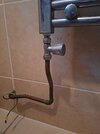
Earth cable for bathroom radiator

Joined
5 Aug 2010
Messages
98
Reaction score
2
Location
Buckinghamshire
Country
United Kingdom
Plumber left it like this and is not available now.

How do I attach it correctly and make the whole thing look nicer, painting copper pipes is not recommended as I understand?
 

Attachments

  • 17402298526202849728715362998292.jpg
    17402298526202849728715362998292.jpg
    193.2 KB · Views: 89
You need an earthing clamp like Screwfix item 57444. Toolstation sell similar singly.
Thanks. Is it how it is normally done, I don't recall seeing such clamps in other people's bathrooms or on Rightmove pictures?

Also, is it definitely needed, this cable is most likely from previous radiator installation?

The idea of having sharp metal edges on ankle level in the bathroom makes me uneasy, I was hoping I could cut it off or tape it to the back side of radiator somehow.
 
Thanks. Is it how it is normally done, I don't recall seeing such clamps in other people's bathrooms or on Rightmove pictures?
Yes, usually a clamp.
Also, is it definitely needed, this cable is most likely from previous radiator installation?
It’s not always needed, depends on the existing earthing arrangements, disconnection time and other factors
The idea of having sharp metal edges on ankle level in the bathroom makes me uneasy, I was hoping I could cut it off or tape it to the back side of radiator somehow.
Plenty have been done this way without complaint
 
If you are doing supplementary bonding in a bathroom, you bond all the metal services entering the bathroom (usually water and radiator pipes, sometimes gas, can be lead waste pipes or iron soil pipes) to the protective earth wire of all the electrical circuits entering the bathroom (usually a lighting circuit, sometimes a circuit for a wall heater, immersion heater, water pump or boiler)

This bonding should be done at the point of entry into the bathroom, but this can be just outside, for example if the pipes pass through an adjacent airing cupboard where the bonding clamps and wires will not be unsightly.

You only need to bond each pipe once, at the point of entry.

Having bonded the pipes, you do not bond the radiator they run to. Nor the bath to which pipes run, nor the basin or cistern, if metal.

 
For the circuits supplying the bathroom, are they RCD protected?

Does the heating pipe have any plastic joints/pipe along the line?
 
You need to check if there is continuity on that pipe, it might be connected to plastic, in which case although it is conductive it’s just a metal object and there is no potential to “equalise”
 

If you need to find a tradesperson to get your job done, please try our local search below, or if you are doing it yourself you can find suppliers local to you.

Select the supplier or trade you require, enter your location to begin your search.


Are you a trade or supplier? You can create your listing free at DIYnot Local

 
Back
Top