
|
|
| Author |
Message |
ifatfirst

Joined: 01 Mar 2008 Posts: 126 Location: United Kingdom
|
Posted: Thu Mar 06, 2008 8:13 pm |
|
|
Am about to fit a door lining or casing. (Now know the difference thanks to --Tom and Woody's earlier post.)
Try very hard but don't always get everything 100% plumb/square!
1) Would it be better to use a door lining and fit my own stops (thereby allowing me a bit of leeway for my lack of expertise). Are casings better left to experts?
2) Have noticed door and window frames in my house (built 1921 - pre hammerfix) are all screwed into pieces of wood inserted in the mortar courses between the bricks. Does this method have advantages for corrections over using frame fixings? Are these wooden inserts shaped and sunk partly in the mortar when making good the brickwork before fitting the door lining, or should they be as thick as a mortar course?
Advice appreciated. |
|
| Back to top |
|
|
|
If you do not want to see this advert, click here to login or if you are new click here to join free. |
 |
Jaffa72

Joined: 14 Feb 2008 Posts: 140 Location: Durham, United Kingdom
|
Posted: Fri Mar 07, 2008 7:22 pm |
|
|
| ifatfirst wrote: | Am about to fit a door lining or casing. (Now know the difference thanks to --Tom and Woody's earlier post.)
Try very hard but don't always get everything 100% plumb/square!
1) Would it be better to use a door lining and fit my own stops (thereby allowing me a bit of leeway for my lack of expertise). Are casings better left to experts?
2) Have noticed door and window frames in my house (built 1921 - pre hammerfix) are all screwed into pieces of wood inserted in the mortar courses between the bricks. Does this method have advantages for corrections over using frame fixings? Are these wooden inserts shaped and sunk partly in the mortar when making good the brickwork before fitting the door lining, or should they be as thick as a mortar course?
Advice appreciated. |
In a house of that age you probably wouldnt find the door opening 100% plumb or square.I think it might be easier to fit a door lining & fit the stop lath afterwards,but i wouldnt expect fitting a casing to be much different with the method i use.
My prefered method would be to position lining into the opening and even the gap out down both legs of the lining.Cut some shims/packing pieces and fix the hanging side leg(ill explain fixing method later).Hang the door and then you can adjust/wind in the closing side leg to suit,making sure you have a nice uniform gap around all three sides.Remember the gap on the head of the door too,i use two coins as spacers for this.
Once you're happy that the lining is in the right position,place sum packers in the gap and fix.I place 2 fixings in 4 positions down each leg.
The timber slips you describe would have been positioned by the bricklayer when building the wall as a point of fixing for the joiner/carpenter.You'll probably find 4 in each side(?) evenly spaced down the length of the opening,this is where id fix my lining.
IMHO it would be better to drill into the brickwork and fix the casing this way.To remove the timber slips and replace would be too much of a chore.You'll probably end up causing more damage than its worth!
I hope this is of some help to you.  |
|
| Back to top |
|
|
|
 |
noseall

Joined: 02 Feb 2006 Posts: 17171 Location: Staffordshire, United Kingdom Thanked: 852 times
|
Posted: Fri Mar 07, 2008 8:09 pm |
|
|
when selecting the lining legs, always bear in mind the hinge and latch cut-outs making sure the wood is clear of knots in these locations.
i always fix the hinge side first ensuring that the fixings don't interfere with the hinge cut-outs. get this side true and square.
then fix the latch side ensuring the top rail is horizontal before fixing. |
|
| Back to top |
|
|
|
 |
ifatfirst

Joined: 01 Mar 2008 Posts: 126 Location: United Kingdom
|
Posted: Sat Mar 08, 2008 8:32 am |
|
|
Wonderful replies.  Thank you so much for all the detail and time taken to reply.
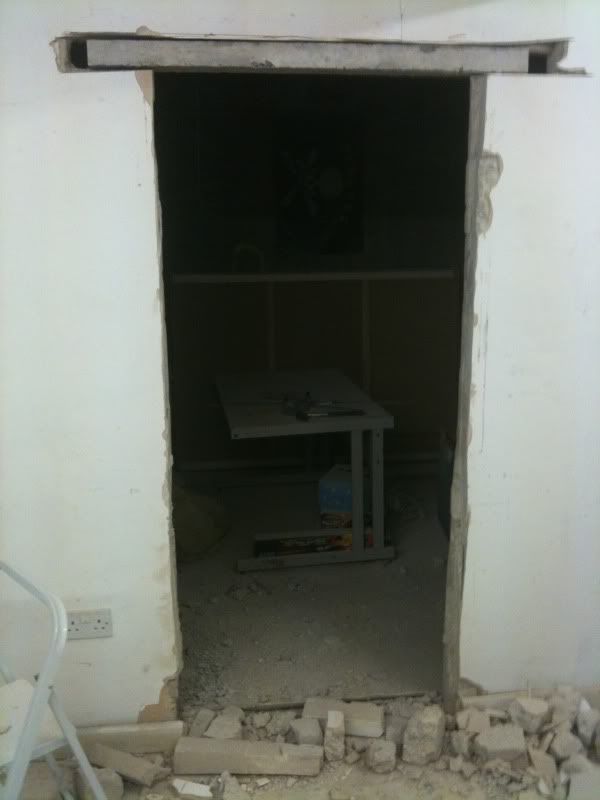
Have knocked the hole out in a dividing wall myself and will be making good the brickwork myself. Fascinating to look at how work was done in 1921 - like to wonder who did it and what their life was like then.
Will report back on progress. I may be gone some time! |
|
| Back to top |
|
|
|
 |
noseall

Joined: 02 Feb 2006 Posts: 17171 Location: Staffordshire, United Kingdom Thanked: 852 times
|
Posted: Sat Mar 08, 2008 10:08 am |
|
|
top tip:
when knocking a doorway out in masonry, stitch drill up each side first, it will make bolstering the bricks/blocks less difficult.
also, we either make the opening wide enough to accommodate a piece of 4"x 2" fixed up each side thus allowing freedom of fixing the casing.
or
make the opening only a couple of inches wider than the casing, then dab a piece of plasterboard up each side of the masonry. this plasterboard can be fitted as straight and true as ya boots thus giving the casing a flat and upright surface to fix to. just allow the dab to set first.  |
|
| Back to top |
|
|
|
 |
mk2phil

Joined: 23 Jun 2006 Posts: 262 Location: United Kingdom Thanked: 1 time
|
Posted: Fri Jan 08, 2010 12:09 pm |
|
|
when fitting a new internal door lining, should I use normal rawplugs and large screws to fix, or proper frame fixings - i.e. the ones that normally come with the grey sleeve?
Thanks in advance |
|
| Back to top |
|
|
|
 |
masona

Joined: 05 Jan 2003 Posts: 12359 Location: Essex, United Kingdom Thanked: 100 times
|
Posted: Fri Jan 08, 2010 12:53 pm |
|
|
| mk2phil wrote: | | when fitting a new internal door lining, should I use normal rawplugs and large screws to fix, or proper frame fixings - i.e. the ones that normally come with the grey sleeve? |
I always do, stronger and better specially with the door slamming etc also stagger the screws fixing but but not too near the edge of the frame. Try to use the smaller head screws which is less to fill in! |
|
| Back to top |
|
|
|
 |
NotHulkHogan

Joined: 31 Oct 2010 Posts: 4 Location: Manchester, United Kingdom
|
Posted: Sun Oct 31, 2010 2:15 pm |
|
|
hi guys been using this thread and others to get guidance on installing a doorway into a breezeblock wall seperating my garages.
I have cut out the doorway and fitted the lintel, and i have fully cemented the lintel in and built the frame and screwed it to the lintel
But there is quite a gap between the door frame and the side walls.
so the lining sides are not attached to anything, and im wondering what the best way is of filling the gap between the lining sides and the wall (its about 2-3" each side (roughly)
(obv the picture is pre cementing the lintel and fitting the frame. )
thanks in anicipation of your help  |
|
| Back to top |
|
|
|
|
|
 |
JohnD

Joined: 15 Nov 2005 Posts: 34355 Location: Hampshire, United Kingdom Thanked: 1087 times
|
Posted: Sun Oct 31, 2010 3:47 pm |
|
|
2 or 3 inches is a huge gap, why did you make it so big? I would have thought you'd need to batten the wall with scraps of timber to screw to.
you can use fire-resistant expanding foam (out of a can) between wall and lining. It sets hard and rigid, and sticks to both surfaces, holding the lining firmly in place. It is actually possible to wedge a door into place and fix it just with the foam, but I would personally feel happier with screws and packers as well, especially near the hinge points.
it will stop draughts and noise, as well as smoke and flame. You can trim it back with surform or breadknife once it is set. Protect surfaces around and under the frame when you inject it into the gap. If you put strong tape or battens over the gap, this will encourage it to expand into the gap rather than falling out. |
|
| Back to top |
|
|
|
 |
NotHulkHogan

Joined: 31 Oct 2010 Posts: 4 Location: Manchester, United Kingdom
|
Posted: Sun Oct 31, 2010 4:01 pm |
|
|
Well i cut the hole before i got the frame (I got the measurments from the website) and the lining fits the hole because the top panel fits into the gap exactly but what i didnt know is that the side are actually fitted in from the frame edge.
I think its called learning by experience  but expanding foam is a great idea and very quick to do, good call.
I was thinking of using part of the old breeze blocks and cement them in place, but your solution is much quicker. |
|
| Back to top |
|
|
|
 |
WestmidsChippy

Joined: 13 Sep 2010 Posts: 255 Location: West Midlands, United Kingdom Thanked: 7 times
|
Posted: Sun Oct 31, 2010 7:09 pm |
|
|
Buy a bigger door and your problems are solved. |
|
| Back to top |
|
|
|
 |
NotHulkHogan

Joined: 31 Oct 2010 Posts: 4 Location: Manchester, United Kingdom
|
Posted: Mon Nov 01, 2010 6:59 pm |
|
|
True but i have already bought the door and lining so dont really want to go down that route.
I think the gap on reflection is more 1-2 inches. so what i plan to do is
Join the two sides at the bottom using a temp spare piece of timber.
Then use long masonry screws to screw the lining to the masonry ensuring its true.
Then fill in the gaps using expanded foam and coat with plaster or cements
remove the spare piece of timber.
hopefully that will be job done and nice and strong. |
|
| Back to top |
|
|
|
 |
JohnD

Joined: 15 Nov 2005 Posts: 34355 Location: Hampshire, United Kingdom Thanked: 1087 times
|
Posted: Mon Nov 01, 2010 7:10 pm |
|
|
I'd screw a few battens into the aperture to line it out to as near as you can the right size and square, especially at hinge points and latch, and tap in packing wedges for final adjustment, before adding the foam. You cut off the ends of packing wedges once its firm and fixed. |
|
| Back to top |
|
|
|
 |
WestmidsChippy

Joined: 13 Sep 2010 Posts: 255 Location: West Midlands, United Kingdom Thanked: 7 times
|
Posted: Mon Nov 01, 2010 7:45 pm |
|
|
TBH frames are easier to fit then linings if you measured up right.
Check how plumb your walls are first before you cut any packers.
Place lining into opening and check that the head is level, if not make good.
if walls are reasonably good cut your first packer necessary width, place 1 inch (ish) from top of head down on hinge side and brown plug and screw into brickwork. plumb up both sides and cut necessary width packer for bottom , again 1 inch (ish) from floor level.
Now cut necessary width packers for your other fixings and remember that most of the time the timber will have a bow in it so you will have to correct such.
Try and position the fixings so when finished the slamming strips (door stops) will cover them.
Make good the other side and job is done.
Depending on what type of door you will be hanging and/or if you want the lining to out last your life then i would say to position two of your fixings roughly where you will be fixing the hinges as this will make good each time you open and close the door. |
|
| Back to top |
|
|
|
 |
NotHulkHogan

Joined: 31 Oct 2010 Posts: 4 Location: Manchester, United Kingdom
|
Posted: Mon Nov 01, 2010 7:50 pm |
|
|
Cheers guys excellent tip's |
|
| Back to top |
|
|
|
|
|
 |
|
|