
Electricity is dangerous and can be hazardous. In doubt? Call a qualified electrician.
N.B. This method is now excluded from the IEE Wiring regulations, but remains for reference.
There are two ways of extending a ring circuit, either extending it by adding junction boxes or by using existing sockets. When extending a ring circuit, planning is essential. As much as possible of the new circuit should be installed before breaking into the existing ring circuit (allowing use of power for lights/tools while you work). See also Extending a ring circuit using existing sockets.
Before carrying out any work on existing parts of the circuit switch off the mains and ensure that power has been cut.
SWITCH OFF ELECTRICITY AT THE MAINS
You will require two 30amp junction boxes and a length of 2.5mm2 cable.
The best way of using junction boxes to extend a ring circuit, is to find the length of cable between the two sockets on the existing ring closest to the desired extension area. Once located it can be cut in the middle giving two lengths of cable from the existing circuit to use in the extension. These cables will go into separate junction boxes which will ultimately be connected together using new cable to create the new section of ring circuit. The new cable runs round the room which you have extended the ring circuit to reach, looping out at points where you sockets are required - which can be cut into and added after the new section of the circuit has been tested - see Installing a power socket.
The digram on the left is an example of an existing ring circuit, and the diagram on the right shows the new part of the ring circuit in orange joined to the old ring circuit with junction boxes.
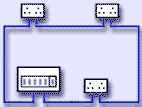
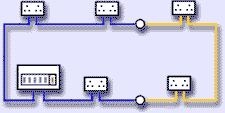
Decide on the optimum placement of the junction boxes.
At this stage we are not dealing with the existing cable, but just fitting the junction box. The box needs to be attached to a platform. The easiest method is to make a small plinth that sits between the joists. It is good practice not to attach it to the joist as you will then be working side on in a confined space. Attach the junction box to the plinth, making ready for connection.
Run the new length of cable (2.5mm2) round the room from one junction box to the other. Where you desire a socket, leave a generous loop of cable out of the wall which can be attached to a new socket once the job has been successfully completed.
Once complete, join the new circuit to the old circuit.
SWITCH OFF ELECTRICITY AT THE MAINS
Switch off the power using the main switch on the consumer unit. Once the power supply if off it is safe to continue. Cut the existing ring circuit in the middle of the run between the two sockets where the extension will be connected. Prepare both ends of these cables (see Preparing cable for connection).
Next, prepare the ends of the new stretch of cable, then connect to the junction boxes.
Undo the screws in the terminals but do not remove them. Place the ends of the cables (existing cable and new cable) into their corresponding holes by colour, i.e. Red to red, black to black, green/yellow to green/yellow (if the earth wire is bare place some sleeving over the exposed wire remainin in the junction box), tightening the screws as you go. Finally, ensure all the screws are tight and replace the junction box cover and screw down the lid. Use cable grips to grasp each wire going to the junction box to keep them secure.
Repeat the process for the second junction box. Finally, restore power and test the existing sockets on the original part of the ring main to ensure they work. You are now ready to fit sockets to the loops you left in the new cable, see Installing a power socket for details about how this is done.
Our forum is the perfect place to ask questions and get help. Join us, post your question/comment now!

