
Electricity is dangerous and can be hazardous. In doubt? Call a qualified electrician.
There are two ways of extending a ring circuit, either by adding junction boxes or by using existing sockets. When extending a ring circuit, planning is essential, as much of the new part of the circuit should be installed before breaking into the existing ring circuit (allowing use of power for lights/tools while you work). See also Extending a ring circuit using junction boxes.
SWITCH OFF ELECTRICITY AT THE MAINS
Before carrying out any work on existing parts of the circuit switch off the mains and ensure that power has been cut before starting. You will need a length of 2.5mm2 cable to extend the ring circuit.
On the existing ring circuit to be extended, find the two sockets adjacent to the area you wish to extend the circuit into. Plan the route of the new part of the circuit based on the positions of these two points, i.e. it will start at one of the existing sockets, go round the room and end at the adjacent socket therefore preserving the ring. The length of wire between the two existing sockets can be reused between one of the existing sockets and one of the new sockets.
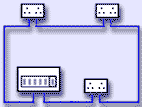
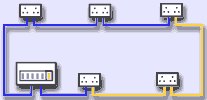
The digram on the left is an example of an existing ring circuit, and the diagram on the right shows the new part of the ring circuit in orange joined to the old ring circuit at an existing socket and a new socket.
Before switching off the mains supply, the new part of the circuit can be completed and installed without connecting to the mains. Plan the location of the new sockets and run the new cable round from the first new socket leaving generous loops of cable at each new socket outlet. Once you reach the last new socket continue the cable on to the other existing socket.
Install all the various sockets around the new stretch without touching the existing cable. If you want to test the ring circuit at this stage, simply install the first socket. See Installing a power socket for details on how to do this.
SWITCH OFF ELECTRICITY AT THE MAINS
Now switch off the mains supply at the consumer unit and ensure that the power is off. Undo one of the chosen existing sockets and remove the cable which runs to the other chosen adjacent socket. Replace this cable with the prepared new cable, twisting the matching conductors together (red-red, black-black, green/yellow to green/yellow). Fix them in the appropriate screw terminals i.e. red to Live (L), black to Neutral (N) and green/yellow to Earth (E or  ). This socket can now be screwed back in place.
At the other join, you are left with a length of old cable coming from the adjacent existing socket. Use this length of cable to run to the last of the new sockets added to the ring. Connect the new socket up, by twisting the wires together the same way as before i.e. red-red, black-black, green/yellow to green/yellow. Finally, fix them in the appropriate screw terminals i.e. red to Live (L), black to Neutral (N) and green/yellow to Earth (E or ) and then the socket can be screwed back in place.
Everything should now be connected. If you chose not to install all of the new sockets during the installation there will be loops of cable at the desired locations. These can be connected at a later stage once testing of the new circuit is complete. See Installing a power socket for details.
Finally, restore the power and test the original power sockets on the ring circuit and then test the new sockets to ensure they work.
Our forum is the perfect place to ask questions and get help. Join us, post your question/comment now!

