
| DO | |
| Place the base of the ladder on a firm, level, dry surface.
If there is a time when this is not possible - working on grass, for instance - tie the feet of the ladder to stakes in the ground to stop it slipping, and place a large flat wooden board underneath to help prevent it sinking. | 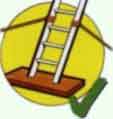 |
| DON’T | |
| Put a ladder on top of boxes, bricks, barrels or any other unstable surface just to gain extra height. | |
| DO | |
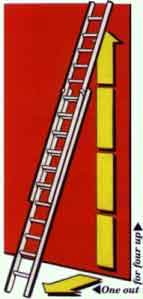 | Position the ladder so that the base won’t slip outwards. Leaning ladders are designed so that their safest angle of use comes when every 1 measure out from the wall is matched by 4 measures up it, (rungs are usually about a third of a metre apart, so it is easy enough to get the distances roughly right). Most new extension ladders now have a mark on the stiles to show the safest angle of leaning. Remember the rule: ‘ONE OUT FOR FOUR UP’. The more the base is moved out from this position, the greater the risk that it will slip outwards suddenly and fall down without warning! |
| DO | |
| Secure the bottom and the upper part of the ladder, by tying them (from stiles, not rungs) with ropes or straps onto a stable, fixed object. You can tie the base to stakes in the ground, or use fixed blocks or sandbags to help guard against the ladder slipping, or buy special stabilisers. A rope or strap tied from a stile onto a fixed object at about the height of the fifth rung from bottom will help to stop any further movement.
If it is impossible for some reason to secure the ladder, get another adult to ‘foot’ it (bystanding with one foot on the bottom rung and holding a stile in each hand). | 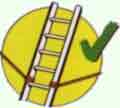 |
| DO | |
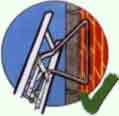 | Rest the top of the ladder against a solid surface, never against guttering, or other narrow or plastic features. Where a surface is too brittle or weak to support the top of the ladder, use a stay or a stand-off resting on a firm surface nearby. Bolt or clip this to the top of the ladder before putting up the ladder. |
| DO | |
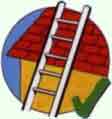 | Have at least three rungs extending beyond a roof’s edge if you are using a ladder to get yourself up onto the roof. |
| DO | |
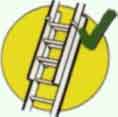 | Make sure that longer extension ladders (over 18 rungs) have an overlap of at least three rungs. Shorter ones (up to 18 rungs) need a minimum overlap of two. |
| DO | |
| Keep your body facing the ladder at all times, centred between the stiles. | |
| DON’T | |
| Reach too far forwards or sideways, or stand with one foot on the ladder and the other one on something else. | |
| DO | |
| Move the ladder to avoid overstretching, and re-secure it whenever necessary, however frustrating that might be! | |
| DO | |
| Try to keep both hands free to hold the ladder as much as possible while you are climbing or descending - if you need to carry any tools, use a shoulder bag, belt holster or belt hooks. | |
| DON’T | |
| Carry heavy items or long lengths of material up a ladder. | |
| DO | |
| Hold onto the ladder with one hand while you work. You can get special trays which fit between the stiles to take paint pots, tools etc. | |
| DO | |
| Wear strong, flat shoes or boots, with dry soles and a good grip. | |
| DON’T | |
| Wear sandals, slip-ons or have bare feet on a ladder. | |
| DO | |
| Make sure a door is locked, blocked or guarded by someone if you are up a ladder in front of it. | |
| DON’T | |
| Use a ladder in a strong wind. | |
| DON’T | |
| Use a ladder near any power lines. | |
| DON’T | |
| Be tempted to use a ladder if you are not fit enough, or suffer from giddiness or aren’t confident with heights. (See ‘Are you up to the job?’ in Ladder Safety Introduction) | |
| DON’T | |
| Allow any child under 16 to use a ladder. | |
Our forum is the perfect place to ask questions and get help. Join us, post your question/comment now!
