
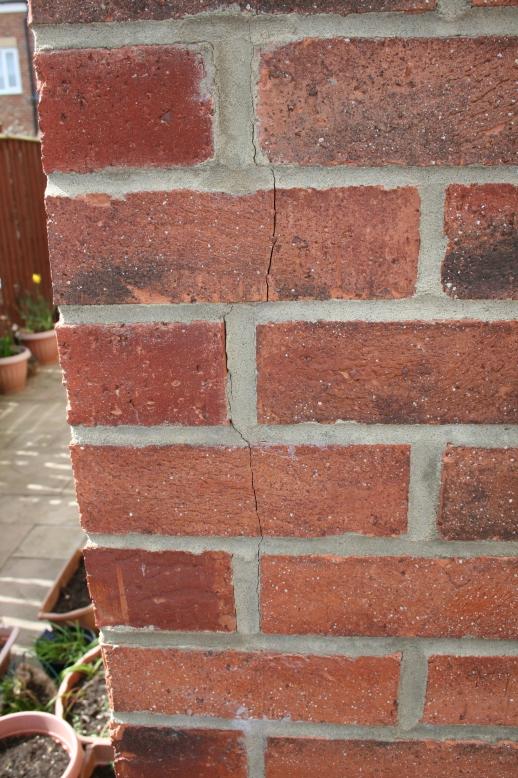
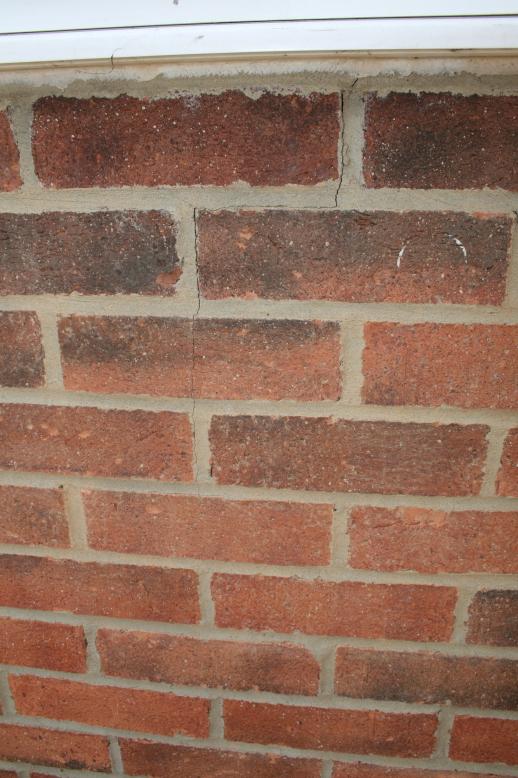
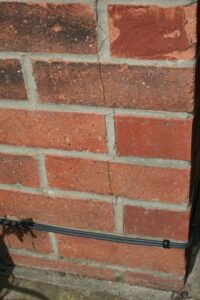
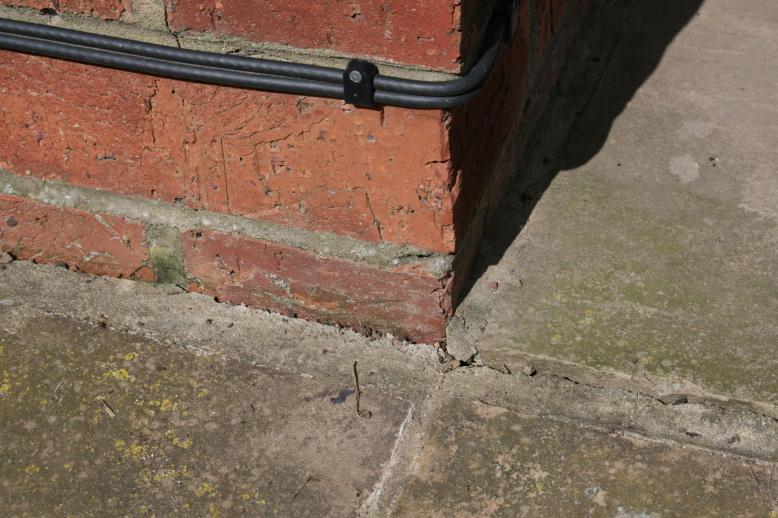
A homeowner looking to buy a detached house – only eight years old – spotted vertical cracks on the external brickwork near a corner. The south-facing wall had two cracks, each around three feet long, one low down and another about four feet up. The east-facing wall had a crack near the same corner and another running below a window. The patio slab at the base of the corner had dropped slightly. An extension joined the east wall about six and a half feet from the cracked corner. The rest of the brickwork looked fine. The homeowner wanted to know whether this was serious enough to justify a structural survey before making an offer.
What’s Likely Going On
This is a common one in UK houses, and the pattern here is textbook. Vertical cracks close to a corner, running through the bricks rather than following the mortar joints, point strongly towards thermal and moisture movement in the outer leaf. When brickwork heats up during the day it expands, and when it cools at night it contracts. Over months and years that cycle builds up stress, and the weakest points give way first – corners and the areas below window openings.
There’s another factor that catches people out on newer builds. Fired clay bricks come out of the kiln bone dry. Once they’re laid, they gradually absorb moisture from the air and undergo a small but permanent expansion. It’s irreversible – nothing to do with the daily heating and cooling. On a relatively long wall panel with no movement joint, that expansion has nowhere to go, and the corner acts as an anchor point. Something has to give, and usually it’s the bricks nearest the quoin that crack.
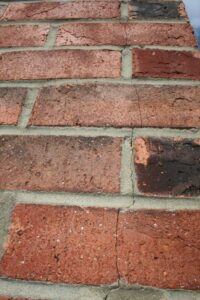
On top of that, if the mortar mix was too strong for the bricks – and that grey colour in the joints is a giveaway for a cement-heavy mix – the mortar won’t flex with the brickwork. Soft clay bricks paired with a hard mortar is a recipe for exactly this kind of cracking. The mortar wins the tug of war and the bricks lose.
The good news is that in most cases like this, the movement has already happened. It’s a one-off event in the early life of the wall, not something that gets progressively worse.
Simple Checks First
Before spending money on a structural engineer, there are a few things worth looking at yourself:
- Check whether the cracks pass through bricks or just follow the mortar joints. Cracks through the brick faces suggest movement in the panel rather than settlement. Settlement cracks tend to follow a stepped pattern along the bed and perp joints.
- Look at the crack width. If you can slide a pound coin into it, that’s worth investigating further. Hairline to a couple of millimetres on a newer property in this pattern is generally cosmetic.
- See whether the cracks extend below the damp proof course. If they stop above the DPC, it’s very unlikely to be foundation movement. If they carry on down into the substructure, that changes the picture entirely.
- Check the dropped patio slab separately. Patios settle on their own – the sub-base compacts or gets washed out. A dropped slab next to a cracked wall looks alarming but the two aren’t necessarily connected.
- Look at the extension junction. Differential movement between the main house and a later extension is common, but that would usually show as a crack right at the joint between the two structures, not six feet away at the corner.
Proper Fix – Good, Better, Best
Good: For cracks through the brick faces, the pragmatic repair is to fill them with a flexible sealant – clear or colour-matched silicone. This keeps water out and allows for any future minor movement without cracking again. For the cracked mortar joints, rake out the loose material to a depth of about 15mm and repoint with a softer mortar mix – something like NHL 3.5 or a pre-mixed lime mortar. Match the joint profile to what’s there – usually bucket handle or flush on modern housing.
Better: If the wall is still moving (check by making a pencil mark across the crack and measuring it again six months later), the underlying cause needs addressing. A pointing contractor can cut out and replace the cracked bricks entirely, rebuilding the corner from the quoin up and installing a proper movement joint in the panel. This is a better long-term fix if the movement hasn’t stabilised.
Best: If the wall panel is long enough that thermal movement is going to keep causing issues, have a movement joint cut in. A diamond-cut vertical slot filled with a compressible filler and sealed with a flexible mastic gives the brickwork somewhere to move without cracking. On domestic elevations this is rarely necessary, but if the panel is over about nine metres with no existing joints, it’s worth considering as a belt-and-braces job.
Bodges and Mistakes to Avoid
- Don’t repoint with a strong cement mortar. It’s the most common mistake. You’ll end up with the same cracks reappearing within a couple of years because the rigid mortar can’t cope with the movement. The repair needs to be softer than the brick.
- Don’t use rigid fillers like exterior caulk or cement paste in the brick cracks. They’ll just crack again. Silicone stays flexible.
- Don’t ignore water getting into open cracks over winter. Water gets in, freezes, expands, and makes the crack wider. Even a temporary silicone fill is better than leaving it open through a wet season.
When to Bring in a Specialist
If the cracks are wider than about 5mm, or if they extend below the DPC into the foundation brickwork, get a structural engineer to have a look – not a damp company, not a general surveyor, a chartered structural engineer. Same applies if you see matching cracks on the inside walls, doors that have started sticking, or floors that feel like they’re dropping. Those are signs of actual subsidence rather than thermal movement, and that’s a different conversation entirely.
For a property purchase, if you’re in any doubt, a structural engineer’s report is a couple of hundred quid and it gives you proper peace of mind – or proper ammunition for renegotiating the price.
Reality Check
On a job like this, the actual repair is a weekend’s work for a competent DIYer. Raking out and repointing needs a plugging chisel, a club hammer, and some patience – go steady near the cracked bricks so you don’t make things worse. Silicone the brick cracks on a dry day and leave it alone for 24 hours. If you’re cutting out and replacing bricks, allow for drying time on the new mortar before you paint or render over it. The mess is minimal – dust sheets on the patio, a bucket of water for slurry. The main thing is getting the mortar mix right. If it were my house, I’d repoint with a lime mortar and silicone the brick cracks, then keep an eye on it for twelve months. Nine times out of ten, that’s the end of it.