
Update, 26 August 2026: this article was written just after the government’s March 2026 announcement, when the rules were still being worked through. They have since landed, and not by the route the industry expected. The law that actually legalises plug-in solar is a statutory instrument, SI 2026/848, which was made on 16 July 2026 and comes into force on 27 August 2026. From that date a compliant kit up to 800W AC can legally connect through a standard 13A socket. “Compliant” means it meets the government’s Interim Product Specification, uses an approved plug and is verified on the ENA G98 Type Test Register. BS 7671 Amendment 4, discussed below, turned out not to be the enabling change many early reports assumed. The body of the article has been corrected on those two points; the practical buying advice still stands.
After years of being stuck in a legal grey area, plug-in solar – the small, self-contained solar kits that hang off a balcony or lean against a garden wall – is on its way to the UK mainstream. On 24 March 2026, the government announced it would update the rules to allow these kits to be sold on the high street and plugged straight into a standard domestic socket, without an electrician.
If you live in a flat, rent your home, or simply don’t fancy the cost and disruption of a full rooftop system, this is probably the most interesting development in home energy for several years. But there’s also a fair bit of noise and confusion around it, so here’s a grounded look at what plug-in solar actually is, where the UK has got to on the rules, what a kit will realistically do for your electricity bill, and what you should check before buying one.
What is plug-in solar?
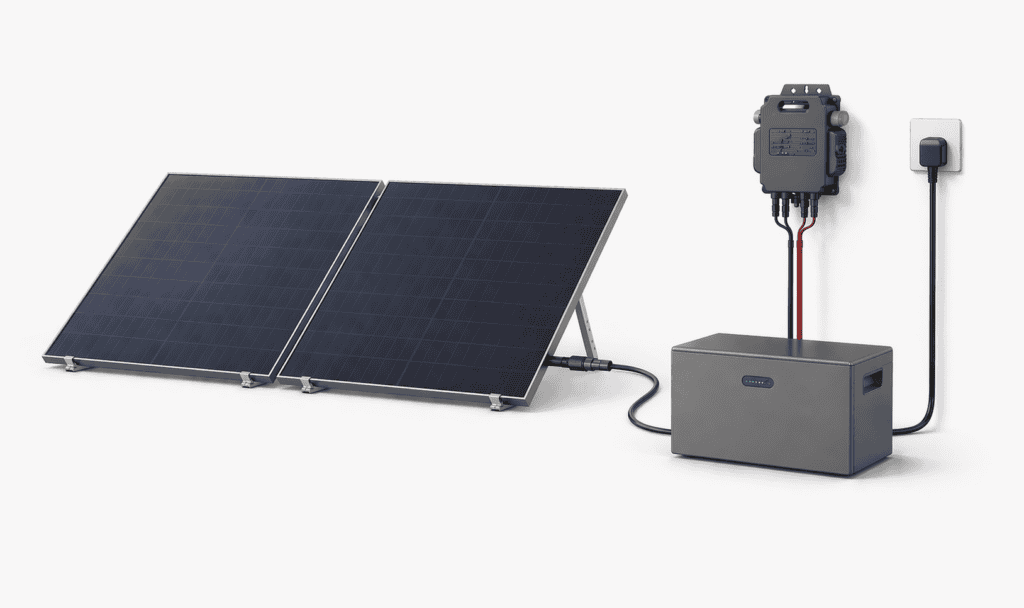
Plug-in solar – also called balcony solar, or by its German name Balkonkraftwerk (“balcony power plant”) – is a simplified version of a rooftop PV system. In the mature German market, a typical kit contains:
- Two solar panels, typically 400-500W each. Many modern kits use bifacial glass-glass panels, which generate from both sides and can deliver additional yield over standard panels – manufacturers quote up to 30% more in ideal conditions, with real-world gains typically in the 5-15% range when there’s a reflective surface behind the panel
- A microinverter which converts the panels’ DC output into 230V AC mains electricity. Under the UK rules this is capped at 800W AC output
- A cable ending in a standard mains plug, typically in 5m or 10m lengths
- Mounting hardware suited to where it’s going – balcony railing, flat roof, tile roof, garden shed, ground stand, or wall
- In most modern kits, a WiFi-connected app that shows real-time yield, daily and annual totals, and CO₂ savings
You may notice the panel wattages (say, 2 × 450W = 900Wp) exceed the 800W inverter limit. This is deliberate and is called overpanelling: because panels almost never produce their full rated output in real-world conditions, pairing more DC capacity with a slightly smaller inverter squeezes more useful energy out of the system without breaching the AC output cap.
You mount the panels outside in a sunny spot, plug the cable into a regular socket, and the system feeds electricity directly into the ring main that socket sits on. Whatever’s running in your house at the time – the fridge, router, TV, a phone charger – uses that electricity first, which means you draw less from the grid. When the sun goes down, the inverter simply shuts off and your home reverts to grid power automatically.
Under the new rules there’s no rewiring, no scaffolding, no roofer, and no electrician needed. Installation time depends on the mounting method, but manufacturers’ typical figures are in the 1-2 hour range for someone with basic DIY skills.
Why the government is pushing it now
The announcement came as part of a broader energy security package prompted by the conflict in the Middle East and ongoing concerns about the UK’s exposure to volatile fossil fuel prices. Alongside plug-in solar, the government confirmed the new Future Homes Standard, which will require most new homes in England to be built with solar panels and low-carbon heating as standard, and trailed a trial scheme to offer discounted electricity on windy days in parts of Scotland and East England rather than paying wind farms to switch off.
Energy Secretary Ed Miliband said the government was determined to “give our country energy sovereignty” by rolling out clean power however it can, including by making plug-in solar available in shops. Retailers including Lidl and Amazon, along with manufacturers such as EcoFlow, are working with the government to bring products to the UK market.
For context: plug-in solar is already well-established in Germany, where gov.uk cites around 426,000 new balcony systems registered in 2025 alone. The UK is broadly adopting a version of the German model, with the same 800W output limit.
Where the UK rules have got to
This is the bit that’s easy to get wrong, because the March announcement was reported in places as if plug-in solar was legal overnight. It wasn’t. The announcement was a statement of intent, and the actual legal machinery took another few months to arrive. Here’s how the pieces fit together:
1. SI 2026/848 is the law that legalises it. The Plugs and Sockets etc. (Safety) and ESQCR (Amendment) Regulations 2026 were made on 16 July 2026 and come into force on 27 August 2026. This is the instrument that actually creates a legal “plug-in microgenerator” (sunlight only, 800W AC maximum, standard plug) and allows it to connect through a 13A socket. If you want the one date that matters, this is it.
2. The Interim Product Specification defines a compliant kit. Rather than the standalone BSI product standard the industry first expected, compliance runs against the government’s Interim Product Specification, and the microinverter must appear on the ENA’s G98 Type Test Register. That’s the paperwork trail a retailer needs before it can legally sell a kit as UK-compliant, and it’s what you should be checking for as a buyer.
3. BS 7671 Amendment 4 is a wiring update, not the enabler. A new version of the wiring regulations, Amendment 4 (2026), was published by the IET and BSI on 15 April 2026. It was widely miscredited at the time with legalising plug-in solar, but it did not. Its headline new content is a chapter on stationary secondary batteries, and the connection rules in Section 551.7 (which require a generating set to be on a dedicated circuit on the supply side of the consumer unit) were left untouched. Amendment 4 matters for how fixed electrical work is certified, but it is not what makes a socket-connected kit lawful. SI 2026/848 does that.
One consequence of the timing: the law comes into force before any kit has been fully through the compliance chain. On the day the rules go live, expect the “certified for UK use” product list to be short or empty, and to fill up over the following weeks as manufacturers put their kits through type testing. Imported kits from mainland Europe don’t automatically qualify: a European CE mark or German VDE certification doesn’t transfer post-Brexit, and the thing to look for is UK compliance against the Interim Product Specification, not an EU mark.
If you’re not in a rush, waiting until kits that are demonstrably on the G98 Type Test Register appear in the shops is the sensible move. Insurers, DNOs and (if you ever sell the house) surveyors will all want to see the paperwork.
You can also install a compact solar system on a balcony, fence or garden wall the old-fashioned way, wired in via a fused spur on a dedicated circuit by a qualified electrician. That’s a more involved route and loses the “plug and play” appeal, but it’s been legal all along.
How much will a kit cost, and what will it save you?
As the UK market opens up, pricing is still settling. Based on German market prices and the first UK retail listings, expect roughly:
- Basic 800W solar-only kit (two panels + microinverter + mounts): around £450-£550. The standalone EcoFlow STREAM microinverter, one of the first products expected through UK certification, is around £149 on its own, with panel-plus-inverter bundles from roughly £499. These figures are current as of mid-2026 and the market is moving fast, so check the price before you buy.
- Battery-integrated kits are widely sold too, but as explained below they fall outside the plug-in rules for now and still need conventional installation, so treat them as a separate kind of purchase.
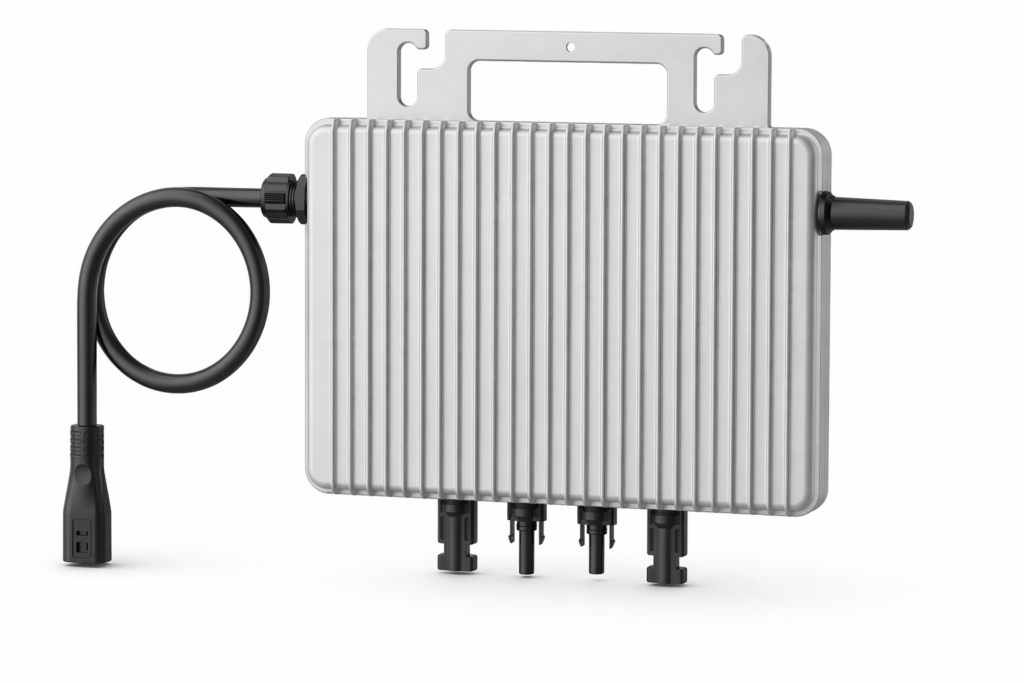
UK prices depend on certification costs, shipping, VAT and retailer margins, and may sit above German equivalents while the market is young.
For rough comparison, a full rooftop PV system with a home battery typically costs around £10,000-£14,000 for a typical household, so plug-in solar sits in a completely different affordability bracket whatever the final UK price turns out to be.
Savings depend heavily on where you live, which way your panels face, and how much electricity you use during daylight hours. An 800W system won’t produce 800W all day; real-world output varies with time of day, season, weather, panel orientation and shading. Because plug-in solar typically can’t export to the grid for payment, the savings only materialise when you use the electricity as it’s being produced.
The government hasn’t published an estimated annual saving figure. EcoFlow, one of the manufacturers working with the government on UK rollout, has said its two-panel system “can help you save up to £115 per year on energy costs.” Independent estimates tend to land lower, in the £40-£85 range for a battery-free kit once you assume no export payment and a realistic self-consumption ratio. Your own figure comes down to three things:
- How much of what you generate you can use in real time (the “self-consumption ratio”)
- How many hours of useful sunlight your mounting location gets
- What you’re paying per kWh for grid electricity
A household where someone is home during the day, or where the dishwasher and washing machine can run on timers during peak sun, will do substantially better than a household where everyone leaves at 8 and gets back at 6.
What about battery kits?
The idea of a battery is appealing, especially if your house is empty during the day. The panels would charge the battery while no one’s home, then the battery would discharge into your circuit in the evening when you’re actually using electricity, so you’d use far more of what you generate. That’s the model that’s taken off in Germany.
Here’s the catch, and it’s caught a lot of early UK buyers out: battery kits do not qualify for the new plug-in route. The law that legalises plug-in solar from 27 August 2026 covers solar-only devices, panels, a microinverter and a plug. It specifically excludes anything designed to import electricity, store it and supply it later. A compliant solar-only kit’s instructions even have to carry a warning against pairing it with a battery storage system.
That doesn’t make home batteries illegal. It means a battery system can’t use the plug-and-play socket route: it still needs a conventional installation by a qualified electrician, wired in on a dedicated circuit, exactly as a home battery always has. So the battery-integrated kits you’ll see on Amazon and elsewhere, EcoFlow’s STREAM battery range, Anker’s SOLIX Solarbank and similar, are not something you can legally plug into a wall socket and forget about. Buy one expecting the DIY shortcut and you’ve bought the wrong thing.
Why the split? The government took plug-in solar through a safety study, a consultation and a product specification before legalising it, and chose to handle solar first and storage separately. Batteries raise their own safety questions, so they’re expected to follow the same path: a study, then their own amendment and specification.
When might that happen? No official date has been set. Industry commentators expect a legal route for plug-in battery systems to emerge in 2027, the thinking being that the government can run the battery safety work in parallel now that solar has cleared the way. Treat that as an informed guess rather than a firm timetable. Separately, some in the trade expect Ofgem to open a simplified export-payment route for plug-in solar during 2027 as well. Neither is confirmed, and both could slip.
The practical takeaway: if you want storage now, budget for a proper electrician-installed home battery and don’t expect the socket shortcut. If the whole appeal of plug-in solar for you is that you can do it yourself, stick to a solar-only certified kit for the time being and keep an eye on the 2027 rulemaking.
Mounting: more of a decision than it looks
Where you’re actually going to put the panels is the single biggest practical choice, and kits are increasingly sold with the same electrical hardware paired to different mounting options. The main categories:
- Balcony railing clamps – adjustable 0-30° brackets that grip standard metal railings. The classic “Balkonkraftwerk” setup. Won’t work with glass or concrete balconies without specialist fixings.
- Flat roof / garden ground stands – ballasted or fixed-angle frames that sit on a flat surface. Good for sheds, garages, flat extensions, or a sunny patch of garden.
- Tile roof brackets – for mounting on a pitched outbuilding roof. Available in single-module or paired-module versions.
- Wall mounts – fixed-angle brackets for a sunny south-facing wall, useful where no railing or flat surface is available.
- Garden shed mounts – typically 0-30° adjustable, sized for typical shed roof pitches.
Check the weight: bifacial glass-glass panels are typically around 20-25kg each per manufacturer spec sheets, so fence panels and flimsy shed roofs may not be suitable without reinforcement. Concrete balconies, glass balustrades, and listed buildings all complicate mounting and may need a professional to assess the fixings.
What plug-in solar won’t do
A few reality checks worth being clear on:
- It won’t run your kettle. 800W covers your base load – fridge, router, standby devices, lighting, a laptop or two. A 2kW kettle or a 3kW electric shower will still be mostly supplied from the grid.
- It won’t keep the lights on in a power cut. Microinverters have a mandatory anti-islanding feature: when the grid goes down, they shut off automatically. This is a safety requirement, not a flaw.
- It won’t replace a rooftop system. If you own your home and have a suitable roof, a full rooftop PV install with a battery will generate several times more electricity and qualify for the Smart Export Guarantee. Plug-in solar is the option for people who can’t, or don’t want to, do that.
- It won’t pay you for exported electricity, at least not initially. Current plug-in kits are designed around self-consumption; any surplus goes to the grid unpaid. This may evolve as the market develops.
What to check before buying
The things that matter most when you’re comparing kits:
- UK compliance. This is the one non-negotiable. Look for a kit that meets the government’s Interim Product Specification and whose microinverter is on the ENA G98 Type Test Register, rather than an imported kit carrying only EU or German VDE marks.
- 800W AC output cap on the microinverter. This is the legal limit. Kits marketed with higher AC outputs are for other markets.
- Microinverter brand. Hoymiles, Enphase, Growatt, Deye, TSUN and Envertech are all well-established names in the European market. Check whichever model is in the kit has the correct UK G98 compliance and automatic grid-loss shutdown (anti-islanding).
- Number of MPPT inputs. If both panels face the same direction, a single-input inverter is fine. If they face different directions (say, one on an east wall, one on a south wall), you need a dual-input model so each panel operates independently. If you might expand later, a four-input inverter is a sensible future-proofing choice.
- Panel type. Bifacial glass-glass panels cost a bit more but generate somewhat more, especially over a light-coloured surface. Worth the upgrade if the siting suits.
- Mounting hardware suited to where you’re putting it. Railing clamps, wall brackets, ground stands, tile-roof mounts and flat-roof ballast kits are all different. Confirm the mount matches your situation before ordering.
- Cable length. Kits typically ship with a 5m or 10m socket cable. Measure the run from your chosen mounting spot to the nearest outdoor-rated socket before buying – running an indoor extension lead out through a window is not appropriate.
- App and monitoring. Most mainstream kits now include a WiFi-connected app showing real-time generation, daily and annual yield, and CO₂ savings. Worth having – it’s the quickest way to spot a fault or realise a panel has slipped out of alignment.
- Weather rating. Look for an IP-rated microinverter and MC4 connectors rated for outdoor use.
DNO notification – check before you install
Even under the new rules, you’re still expected to notify your Distribution Network Operator (DNO), the company that runs the cables in your street, after you plug a kit in.
Under the G98 distribution code, generation equipment up to 3.68kW on a single-phase supply follows a “fit and notify within 28 days” process: you fill in a free online form after installation telling the DNO what’s been connected. Plug-in solar at 800W sits well within that threshold, and the same route still applies under the new rules. It’s a light-touch step, not a barrier, but skipping it leaves your system invisible to the network operator.
Two catches worth knowing if your house isn’t a blank slate. G98 currently treats this as one device per household, so you can’t dot several kits around the house and notify them separately, at least until the network rules are updated. And the 3.68kW simple-connect allowance is cumulative across the property: if you already have rooftop solar, adding a plug-in kit on top could tip you over that line and into a fuller G99 application, which takes longer and is not a DIY job. If you’ve already got a roof array, check the totals before you buy.
For reference, Germany, which the UK is broadly modelling its approach on, has had balcony solar long enough to simplify its process considerably. German owners register their system online with the Federal Network Agency’s Marktstammdatenregister (MaStR) portal, which takes about five minutes and around five fields of information. Since the Solarpaket I reforms in May 2024, a separate notification to the grid operator is no longer needed, as the MaStR portal forwards the data automatically. Whether the UK ends up that streamlined remains to be seen, but it’s the direction of travel the government has indicated.
When you buy a certified UK kit, the retailer or manufacturer should make the current requirement clear in the instructions. If in doubt, a quick check of your DNO’s website will tell you what they expect. Your DNO depends on your postcode (UKPN for London and the South East, NGED for the West Midlands, Northern Powergrid for the North East, SSEN for Scotland, and so on).
Renting? You probably still can
One of the real advantages of plug-in solar is that it’s portable. Nothing is drilled into the building, the panels clamp on and off in minutes, and when you move house it comes with you. Strictly speaking a panel clamped to a balcony railing could count as an alteration, so it’s worth checking your tenancy, but most landlords won’t object to something that’s reversible, tidy and ultimately lowers a tenant’s bills.
So – should you buy one?
Plug-in solar isn’t a silver bullet. It won’t get anyone off the grid, it won’t power a heat pump, and the economics are thin if no one’s home during the day. But for the right household – daytime occupants, a sunny outdoor space, and electricity use that’s at least partly shiftable to daylight hours – a modest kit you can install without scaffolding or an electrician, that trims something off your daytime bill, is well worth a look.
The sensible plan for most people: from 27 August 2026, buy a kit that’s demonstrably UK-compliant (Interim Product Specification, plus a microinverter on the G98 Type Test Register) from a reputable retailer, follow the installation and notification instructions that come with it, and see how it goes. It’s the simplest, cheapest, least disruptive way to generate your own electricity the UK has yet offered, and the regulatory picture that was still forming when this was first written has now largely settled.