- Joined
- 18 Nov 2025
- Messages
- 1
- Reaction score
- 0
- Country

I have recently had a new extractor fan fitted in my bathroom as part of a full bathroom refurbishment. The vent is in the ceiling, close to the shower in the bathroom.
I have an 'in-line- extractor which is fitted in the loft with approximately 1.5 meters of plastic flexible ducting running from the bathroom vent, to the in line extractor. Then there is approximately 5m of flexible metal ducting running from the extractor to the vent on an outside wall (with a 1 metre climb).
The extractor fan doesn't seem to extract much of the steam when using the shower so I am looking at possibly making some improvements to the venting to make it more efficient.
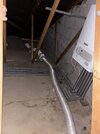
Firstly, I could definitely shorten the length of the metal dusting by about 1 metre and run it on a gradual incline from the extractor to the exit point, (the attached photo shows the current ducting runs slightly past the extraction point with a kink, before a steep incline to the extraction point).
I may also be able to shorten the plastic ducting on the other side, so it can be stretched a bit tighter (if that makes any sense?).
I also read that it should probably be insulated so once I have finished re-routing/improving the ducting, I will then look to insulate it properly.
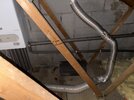
I already had an extractor fan before the bathroom got renovated (although it didn't really work very well either). The original extractor fan was not an in-line extractor but it extracted the same way as this one (through the bathroom ceiling and out to the same exit point). The old fan used just the flexible metal ducting which can be seen in the attached photo.
The exit point is on an external wall on the gable end- it cant be any lower due to an extension above the garage (see attached photo).
I am just after any other recommendations to possibly improve the efficiency of the fan. I have read that rigid ducting will improve it but I am worried that it would increase the noise levels. Currently, it is very quiet which I like but obviously its no good if it doesn't vent the steam very well
I have an 'in-line- extractor which is fitted in the loft with approximately 1.5 meters of plastic flexible ducting running from the bathroom vent, to the in line extractor. Then there is approximately 5m of flexible metal ducting running from the extractor to the vent on an outside wall (with a 1 metre climb).
The extractor fan doesn't seem to extract much of the steam when using the shower so I am looking at possibly making some improvements to the venting to make it more efficient.
Firstly, I could definitely shorten the length of the metal dusting by about 1 metre and run it on a gradual incline from the extractor to the exit point, (the attached photo shows the current ducting runs slightly past the extraction point with a kink, before a steep incline to the extraction point).
I may also be able to shorten the plastic ducting on the other side, so it can be stretched a bit tighter (if that makes any sense?).
I also read that it should probably be insulated so once I have finished re-routing/improving the ducting, I will then look to insulate it properly.
I already had an extractor fan before the bathroom got renovated (although it didn't really work very well either). The original extractor fan was not an in-line extractor but it extracted the same way as this one (through the bathroom ceiling and out to the same exit point). The old fan used just the flexible metal ducting which can be seen in the attached photo.
The exit point is on an external wall on the gable end- it cant be any lower due to an extension above the garage (see attached photo).
I am just after any other recommendations to possibly improve the efficiency of the fan. I have read that rigid ducting will improve it but I am worried that it would increase the noise levels. Currently, it is very quiet which I like but obviously its no good if it doesn't vent the steam very well