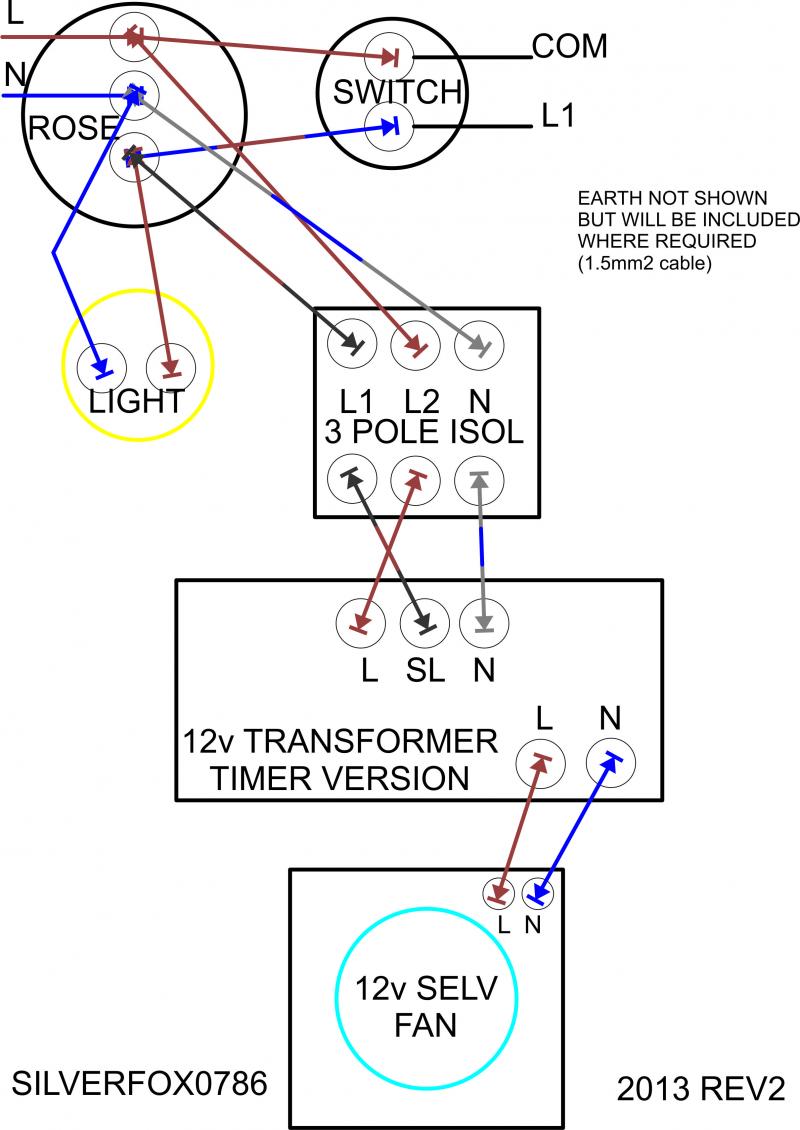
need a quick look in and approval to planned worked

Joined
17 Jan 2013
Messages
18
Reaction score
1
Location
Berkshire
Country
United Kingdom
Hi been reading on here for a long time and love the advice and knowlledge i read here

got some work im getting done and being the sort i am i like to plan plan plan before i look into the work itself

i will be getting a sparky to do the work dont worry. being a perfectionist and nosy git i like to know whats going on rather than trust the profesional to get on with it (Sorry) that just me

so i am gettign a 12v fan fitted and decided to do a wiring diagram so i have a clue whats going on

i was hoping someone could look in and tell me if i hit the mark or if im way off

thanks


Brown blue and yellow cable?

will be using 3 Core and Earth not sure if 3rd core is yellow or black but the sparky will know that

All cable will be 17th Edition approved


EDIT: ---

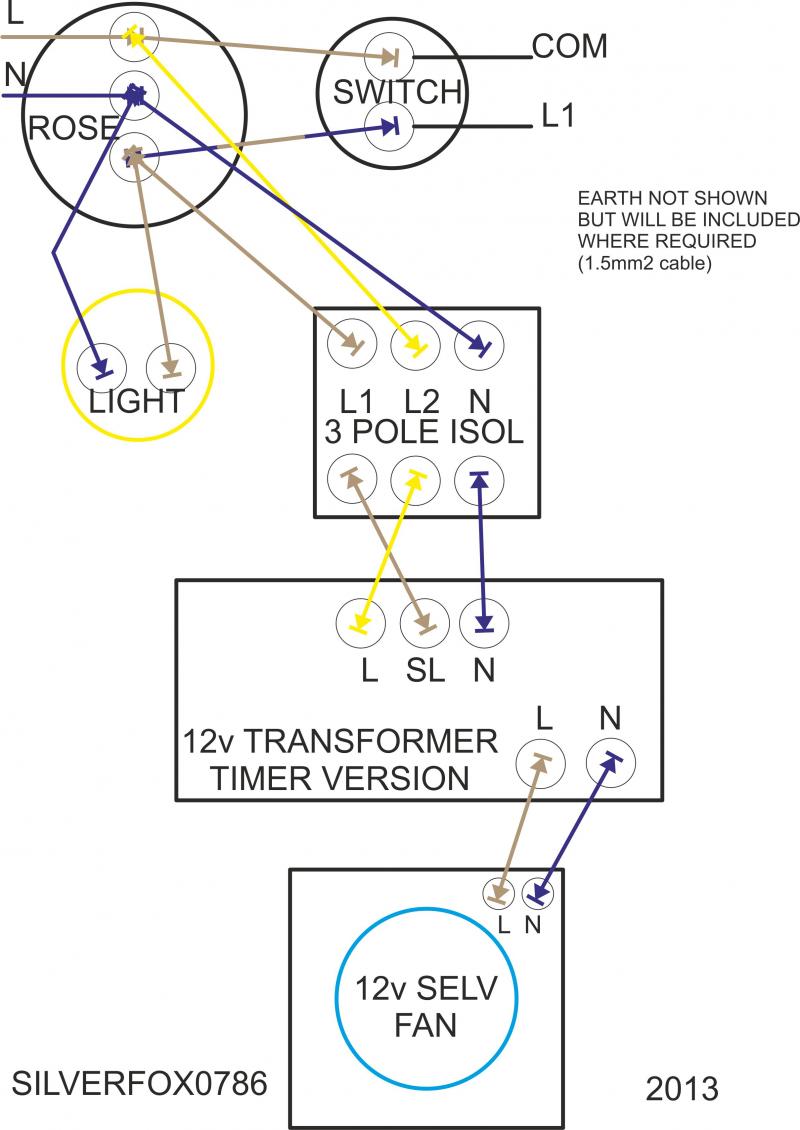
LOL just had a look my self i was WAY OFF

its Brown Black and Grey LOL

EDIT 2: ---

Here is the ammended version

 
Are you buying a 12V fan because you think you must?

im using 12V as i dont have a decent place within zone3 to install a 240v plus its better safety

The 12v SELV fan can only go in Zone1 and its cheaper and easier for the fan to be 12v rather than to get a 240v and put it on its own ring spur
 
240V fans are allowed in zone 1 if manufactured for that environment, IPX4 (or IPX5 if subject to splashing) and would be connected the same as the transformer (although you may need a fuse - as you may for the transformer - if required by the manufacturer).
 
240V fans are allowed in zone 1 if manufactured for that environment, IPX4 (or IPX5 if subject to splashing) and would be connected the same as the transformer (although you may need a fuse - as you may for the transformer - if required by the manufacturer).

thats what a read too

iii) Extractor fans
• If no other form of ventilation exists, an extractor fan with an IPX4 rating or higher should be
installed in Zone 2 or above – but the SELV source must be located in Zone 3 or beyond. If
restricted space makes this impossible, it is acceptable to locate a 230V IPX4 fan in zone 1,
but a 30 mA Residual Current Device (RCD) must protect it.
• This type of fan can also be used in zone 2 but does not have to have the RCD protection
• Isolators should disconnect both poles. This means that where the fan has a timer trigger
input a 3-pole isolator is required.

for me to do this it would cost me soooo much as a new run to the RCD would need to be made, walls need chasing, carpets upturned, floor boards need lifting and then a MCB possibly needs installing as my RCD is full

for a 12v SELV all i need to do is use the current supply line comming in and add the transformer and run the cabling within the celing area which can be acessed from the loft

a lot less work so hence alot less cost and over all a safer solution voltage wise esspecially with the fact that diabled people will be using teh facilities
 
Fair enough.

However -
it is acceptable to locate a 230V IPX4 fan in zone 1,
but a 30 mA Residual Current Device (RCD) must protect it.
RCDs protect the circuit (and people) not the fan.
In the ceiling with cabling in the loft would not require an additional RCD.


• This type of fan can also be used in zone 2 but does not have to have the RCD protection
If additional, concealed fixed wiring is installed to the transformer, it may.
 
i will be getting a sparky to do the work dont worry.

Why should we worry? Who are we to judge? It up to you if you want to do it yourself.

Oh it's not that but I would be reluctant to give advice on anything that could potentially kill someone. And all I was looking for is advice. The work will be done by professionals and I would understand if anyone refused to give me advice if they thought I was going to do the work as would I as I couldn't have on my conscious that the advice I gave was used in the wrong context and a person was hurt
 

If you need to find a tradesperson to get your job done, please try our local search below, or if you are doing it yourself you can find suppliers local to you.

Select the supplier or trade you require, enter your location to begin your search.


Are you a trade or supplier? You can create your listing free at DIYnot Local

 
Back
Top