• Looking for a smarter way to manage your heating this winter? We’ve been testing the new Aqara Radiator Thermostat W600 to see how quiet, accurate and easy it is to use around the home. Click here read our review.

Chimney Pots and Cowls

Joined
10 Jan 2017
Messages
1,868
Reaction score
287
Location
Derbyshire
Country
United Kingdom
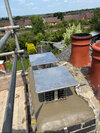
The roofers working on our house removed 4 pots and fitted 4 cowls. Fitting them was my request as they will service working flues and keep unused flues ventilated. I also had liners put down.

The question on my mind is this -- is this method of fixing acceptable? Seems strange them being cemented in, but they said it's fine. I've kept hold of all 4 original (1906) pots.

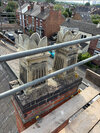
Before and after (different stacks but same house and method).
 

Attachments

  • IMG_3180.jpeg
    IMG_3180.jpeg
    1 MB · Views: 101
  • IMG_3179.jpeg
    IMG_3179.jpeg
    1.2 MB · Views: 97
OP,
Ref the two metal terminals - they are not cowls neither are they suitable for purpose. They will allow rain to enter the stack and flues.
Remove them and their flaunching, & put your pots back with fresh flaunching.
There are various cowls available for your Crown pots.

Flaunching mix consists of three of sand, one of cement, and stone chippings to firm the flaunching up.
 
OP,
Ref the two metal terminals - they are not cowls neither are they suitable for purpose. They will allow rain to enter the stack and flues.
Remove them and their flaunching, & put your pots back with fresh flaunching.
There are various cowls available for your Crown pots.

Flaunching mix consists of three of sand, one of cement, and stone chippings to firm the flaunching up.
They are cowls and they were marketed especially for my pots. The flaunching mix used was a 3:1 mix (no aggregate added).

Genuine question so that I understand - how would rain to enter the stack? Wind driven rain I'll accept as you'd get on any pot, but are you saying it would be worse in my set up?
 
Don't know the answer but the cement looks very neat :-)
 
Poster #6,

Ref the "cement looking neat" can often mean that the mix is too wet - wet mix can crack within a year or two.
Sloppy mix is often used to skim over old flaunching instead of replacing the old flaunching.
Correctly done flaunching should project about 25mm past the face of the stack.
 
They are terminals, which are meant to sit on top of a pot, your set up will allow a lot more water in when its raining.

A terminal is a collective term to describe an area at the ending of something, in this case a cowl.

I am more than happy to be schooled on this, but I'm just trying to understand how the set up will allow more water in than usual.

The hood on the cowl is wide and the flaunching slopes away - is this not enough? Again, genuine question. Forums can be nasty places these days so I'm trying to make clear my tone/position.
 
Poster #6,

Ref the "cement looking neat" can often mean that the mix is too wet - wet mix can crack within a year or two.
Sloppy mix is often used to skim over old flaunching instead of replacing the old flaunching.
Correctly done flaunching should project about 25mm past the face of the stack.

A lot of speculative commentary there.
In my case all flaunching was removed. The mix was absolutely fine. If you look down the stack in my second picture you will see a course of protruding bricks - these have a groove on their underside to allow water to drip away from the chimney face. They were were built that way in my road when new.
 
OP,
Precisely what is "speculative commentary"?

You have two sets of protruding brickwork - the lower projection is in line with the upper projection.
However, sand & cement fillets could suggest that water was dripping & catching on the lower projection?
 
OP,
Precisely what is "speculative commentary"?

You have two sets of protruding brickwork - the lower projection is in line with the upper projection.
However, sand & cement fillets could suggest that water was dripping & catching on the lower projection?

The speculation about the mix on the flaunching.

Possibly so re the fillets. However, the course of bricks I mention have a drip groove. Stack was sound when inspected and now all are fully opened and venting, so good air flow.

I still don't understand how these cowls are going to admit more water. I'm dubious over their install but I was assured all okay, and I wasn't confident enough in my own knowledge to dispute. Just trying to understand it in detail.
 
Def not the correct items cemented in. You will get more water getting through than Niagara falls!......
 
Def not the correct items cemented in. You will get more water getting through than Niagara falls!......

Again, happy to be schooled but how so? As in - how would the water track into the cowl?

If mine let in the Niagra Falls, the open pots to the right must let in the Pacific Ocean.
 

If you need to find a tradesperson to get your job done, please try our local search below, or if you are doing it yourself you can find suppliers local to you.

Select the supplier or trade you require, enter your location to begin your search.


Are you a trade or supplier? You can create your listing free at DIYnot Local

 
Back
Top