Fuse box tripping?

As I see it, there are a few options for you now:

1. You get a competent electrician in, who will use a test meter to look for leakage (e.g. due to dampness) in that circuit, and narrow it down by disconnecting items (e.g. at ceiling roses) one at a time until the problem has been found. (This shouldn't be difficult, but it does take a bit of patience and some experience. A 17-year-old who has mostly been installing wiring in new-builds might not be ideal.)

2. You do the same but without the test meter: this is a much slower process, as you'll need to disconnect parts of the circuit and then wait e.g. a week to see if you get a trip - and live without some of your lights in the meantime.

3. You do the same as the electrician, but using a normal multimeter rather than a fancy insulation resistance meter. This may or may not be able to detect the fault. (The one time I had an RCD trip due to damp in an outside light, I was able to identify it using a multimeter. But that was an instant trip.)

4. You ignore it for the time being. With luck it will slowly get worse. If it eventually gets to the point where it trips immediately or almost immediately, it should be much easier (for you or an electrician) to diagnose.

These all have obvious advantages and disadvantages!
 
Will do. I'll see if we have any of those telescopic cameras at my workplace. I really don't want to be taking up all the floorboards for a clear view of all the wiring
 
As I see it, there are a few options for you now:

1. You get a competent electrician in, who will use a test meter to look for leakage (e.g. due to dampness) in that circuit, and narrow it down by disconnecting items (e.g. at ceiling roses) one at a time until the problem has been found. (This shouldn't be difficult, but it does take a bit of patience and some experience. A 17-year-old who has mostly been installing wiring in new-builds might not be ideal.)

2. You do the same but without the test meter: this is a much slower process, as you'll need to disconnect parts of the circuit and then wait e.g. a week to see if you get a trip - and live without some of your lights in the meantime.

3. You do the same as the electrician, but using a normal multimeter rather than a fancy insulation resistance meter. This may or may not be able to detect the fault. (The one time I had an RCD trip due to damp in an outside light, I was able to identify it using a multimeter. But that was an instant trip.)

4. You ignore it for the time being. With luck it will slowly get worse. If it eventually gets to the point where it trips immediately or almost immediately, it should be much easier (for you or an electrician) to diagnose.

These all have obvious advantages and disadvantages!
Cheers to you everyone for the advice. Waiting on a couple more electricians getting back to me. I like doing a bit of DIY but something like this probably better to get an expert
 
It was powered using a mains plug, the cable went through the window and into the plug socket close by.

It would not affect your lighting circuit, or cause it to trip, because it is not on that circuit. You only need investigate, things on that downstairs lighting circuit.

Random question but if it was water ingress wouldn't it constantly trip out, like refuse to trip in at all? It's been just over 2 hours and hasn't tripped since.

Water can evaporate quite quickly, once it has gone, you will be able to reset.
 
It would not affect your lighting circuit, or cause it to trip, because it is not on that circuit. You only need investigate, things on that downstairs lighting circuit.


Water can evaporate quite quickly, once it has gone, you will be able to reset.
Cheers. I'll post again if something stand out happens and when I get more info
 
Will do. I'll see if we have any of those telescopic cameras at my workplace. I really don't want to be taking up all the floorboards for a clear view of all the wiring

I really wouldn't bother with those, at this stage. Were it me, with no test gear, I would be isolating sections of the circuit, as suggested by endecotp above....

Start, by making a list of all the lights which go out, when it trips. Next, you need to make a bit of a guess as to how, whoever wired it, actually wired it.

Usually the cable will go from the consumer unit, to the nearest light on your list, but dependent on access to run the cable. Usually the cable will run in a big semi-circle, dropping off at each ceiling rose in turn. You then make a guess at which is the middle ceiling rose, on that semi-circle, and disconnect there - then wait to see if it trips again. If it doesn't then the fault is beyond that point.

You will need to study a diagram of a ceiling rose, to know what wires to investigate in there, but mark them with a permanent marker, and take a photo of each, before disconnecting anything, so you can restore them correctly.

Having halved the circuit, as above, you then need to quarter it, to further tie the fault section down, to before or after where you have parted the circuit. You continue the process, until you have identified where the problem lies - Only then, might you need to lift a floorboard etc..
 
I really wouldn't bother with those, at this stage. Were it me, with no test gear, I would be isolating sections of the circuit, as suggested by endecotp above....

Start, by making a list of all the lights which go out, when it trips. Next, you need to make a bit of a guess as to how, whoever wired it, actually wired it.

Usually the cable will go from the consumer unit, to the nearest light on your list, but dependent on access to run the cable. Usually the cable will run in a big semi-circle, dropping off at each ceiling rose in turn. You then make a guess at which is the middle ceiling rose, on that semi-circle, and disconnect there - then wait to see if it trips again. If it doesn't then the fault is beyond that point.

You will need to study a diagram of a ceiling rose, to know what wires to investigate in there, but mark them with a permanent marker, and take a photo of each, before disconnecting anything, so you can restore them correctly.
Ta Harry. House was built in the late 1890s and we're on an old style of wiring. Last time I checked the ceiling rose it was about 7 or 8 wires.
Meter is in the living room cupboard. At the minute I'm guessing it goes living room, vestibule, kitchen. Or vestibule, living room, kitchen. When I have more info I can let you know. Sun is currently shining but are due more rain later tonight. Light drizzle doesn't seem to affect it but when it comes down harder I'll see if it trips then
 
Ta Harry. House was built in the late 1890s and we're on an old style of wiring.

I would hope not! Are they plastic, red and black, or brown and blue. Is there an earth wire, at each ceiling rose. If you can answer those questions, it will help us.

Last time I checked the ceiling rose it was about 7 or 8 wires.
Usual, would be 6. L+N in, L+N looped out, L to switch, plus a switch wire. Then you will see the pair, of the flex, down to the lampholder.
 
I would hope not! Are they plastic, red and black, or brown and blue. Is there an earth wire, at each ceiling rose. If you can answer those questions, it will help us.


Usual, would be 6. L+N in, L+N looped out, L to switch, plus a switch wire. Then you will see the pair, of the flex, down to the lampholder.
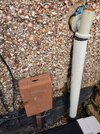
Let me check, might be tomorrow morning and I'll get a pic for you. Just took this outside my front. Is this how the electricity gets in the house, the small brown thing? obviously the other is the gas. I would imagine though if this was the problem it would blow everything, not just the downstairs lights
 

Attachments

  • 20260315_154732.jpg
    20260315_154732.jpg
    760.6 KB · Views: 12
Could be as simple as a nail thru a wire , friend had one that only tripped the breaker when you stepped on one side of the affected floor board .
 
Could be as simple as a nail thru a wire , friend had one that only tripped the breaker when you stepped on one side of the affected floor board .
Yeah i tried jumping all over the upstairs yesterday to try and trigger it. Didn't work. Not ruling it out yet though as it's happened a few times whilst we've been in bed
 

If you need to find a tradesperson to get your job done, please try our local search below, or if you are doing it yourself you can find suppliers local to you.

Select the supplier or trade you require, enter your location to begin your search.


Are you a trade or supplier? You can create your listing free at DIYnot Local

 
Back
Top