Search results
-
F
Solid wall houses and render.
Building regulations in the nineteenth century? I wonder how many builders could even read! I also wonder who enforced them? The most significant legislation was the 1984 Building Act which set up the provision of Building Regulations as we know them. The emphasis was on planning control...- Flyboytim
- Post #10
- Forum: Plastering and Rendering
-
F
Where to even start! Damp everywhere, recommendations please
Damp proofing companies want to sell you a product or service! In what sense do you think they can be independent? I think you may be dreaming! http://www.buildingpreservation.com/ is a link for the company ree referred to -
F
Damp where removed chimney breast used to be
The light switch has a nice circle of damp around it! From the various coloured wires in the light switch, it appears to be a 2-way switch perhaps? If the wires are running through conduits from floorspace to the loft void, there is probably some air flow which could be chilling the metal... -
F
Chimney problems, falling brick particles into Fireplace
The chimney is not performing the function it was intended for, which was to carry smoke and hot air from the hearth below on a regular basis, and certainly throughout the winter months. That would have kept the brickwork dry, covered with a layer of hydrophobic soot, and not allowed... -
F
Solid wall houses and render.
1930s Semis in Birmingham were generally solid construction with weak lime mortar containing local red sand, and no appreciable cavity in the walls. Lime(stone) was not a local commodity in Birmingham, unlike brickclays and soft sands. Cement mortar pointing done in the sixties rarely adhered...- Flyboytim
- Post #8
- Forum: Plastering and Rendering
-
F
Chimney Woe
The chimney was a source of ventilation before it was removed, but everywhere seems to have a damp problem this winter, with the relentless Atlantic depressions. It seems that the builder has not stabilized the chimney structure that has been left, nor capped off the flue(s) that are still... -
F
Small render border
Remove it completely as it is bridging above the DPC, and theoretically a source of damp penetration. It may have been added following an injected DPC to mask the injection holes. Hopefully it will not have disfigured the wall significantly. -
F
fixing timber to brick
Before wall plugs and power drills were available or affordable, a plugging chisel and hammer were used to fix wedge shaped plugs of wood into gaps made in the mortar course, and the timbers were simply nailed in place. -
F
Damp Surveyor Con?
The acid test is to drill the wall where the damp is worst with a masonry bit, If dust comes out the wall is dry. If however the bit is filled with steaming sludge, then it is saturated.- Flyboytim
- Post #10
- Forum: General Discussion
-
F
Where to even start! Damp everywhere, recommendations please
The acid test is to drill into the middle of an internal brick in the damp area - if dust comes out, the brick is dry, if steaming sludge is present then the brick is saturated. If It is just the plaster, then it will dry as the humidity drops. If you drill the internal mortar, is it lime-based... -
F
Where to even start! Damp everywhere, recommendations please
(Re-)rendering is possibly not the answer. If the house was built with permeable bricks, a lime mortar, and has been surfaced with an impermeable render (inside and/or outside), and has a filled blown particle cavity wall insulation, and gypsum plaster, especially if painted with a vinyl or... -
F
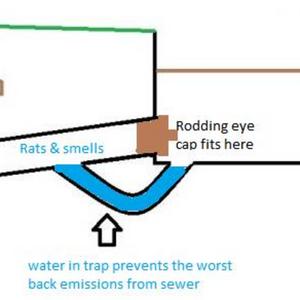
What is this? U-bend from inspection chamber?
They are not essential, but by allowing the waste to flush out the trap each time waste is run out, stuff like congealed fat cannot build up in the inspection chamber, to block the system later when chunks of it break off, and block the main pipe - which is why it probably needed rodding out... -
F
Air and wood moisture ratio- woodworm.
Generally, warm interior air is moisture laden, so you do not want it escaping into the loft on a regular basis. If there is warm moist bathroom air venting into an insulated (cold) loft, the cold surfaces will be likely to have condensation - brickwork, exposed timbers, and the underside of...- Flyboytim
- Post #6
- Forum: Wood / Woodwork / Carpentry
-
F
What is this? U-bend from inspection chamber?
You are missing the cap for the rodding eye - the straight pipe down to the sewer. The waste should siphon out through the trap. -
F
Inside of Tanking Wet
This is daft! Outside brick wall, above ground, rendered, tanking, then condensation. Of course there will be condensation!! There is nowhere else for the water vapour to go!! You need to change the mindset that impermeable means dry!! Impermeable means that the water stays inside if... -
F
Inside of Tanking Wet
What is directly on the other side of the tanked wall? -
F
Bubbling flaking paint a sign of condensation or worse?
These are typical areas where condensation occurs due to lack of air movement. Try not to cycle your heating so that it is warm when you are in and awake, and off when you are out and asleep - rather try to maintain a constant heat at a slightly lower temperature than you are used to, only... -
F
Any doubters out there?
Assuming that groundwater, river, flash and tidal surge floods may be a much commoner feature of the UK weather for the forseeable future, as well as much more prolonged wetter weather, what sort of construction methods should be considered to safeguard the housing stock for the future? What... -
F
Pointing Narrow Gap.
I like the multitool oscillating cutter with the silicon carbide edged half disk - less dust and more control than an angle grinder or other rotating chasers. You can always pipe a soft plasticised mortar into a narrow crack, either with an "icing bag"-type mortar piping bag, or an...