Yes not enough to turn an engine over, but plenty for an led strip lightA car battery at 11.5V is flat.
View attachment 422756

You are using an out of date browser. It may not display this or other websites correctly.
You should upgrade or use an alternative browser.
You should upgrade or use an alternative browser.
12V solar panel battery charging
- Thread starter jj4091
- Start date
My neighbour's 2011 diesel Opel Omega failed to start ~ 2 years ago (original 95 AH battery), the terminal volts were 11.8 so I connected in my 3.8A smart charger, after 32 minutes the battery/charger were up to 14.3V and the charger then went into trickle mode, (battery obviously knackered), 15 minutes after disconnecting the charger the terminal volts were 12.5 and the car started immediately and was constantly charging at 14.3V so alternator OK, next morning same story, no start initially, so new battery. Its amazing that my charger had only put 2AH into this battery in 32 minutes and it was then capable of starting the car even if only once, I can only explain it by the fact that while a cranking current of say 400A is required the energy (AH) required is quite small, a 3 sec crank at 400A only requires 0.33 AH.

- Joined
- 27 Jan 2008
- Messages
- 29,535
- Reaction score
- 3,636
- Location
- Llanfair Caereinion, Nr Welshpool
- Country

A lead acid battery, slowly covers the plates with sulphur as it discharges, and as time goes by, this sulphur gets harder and harder, as a result the recharge time needs to also be longer and longer.
The only way to measure state of charge is a hydrometer which today we can't use because we are using absorbed glass mat, or valve regulated lead acid versions (AGM and VRLA) so we try to use discharge voltage drop with a set known load instead, but this is just somewhere near.
So when my father-in-laws stair lift failed (2 x VRLA) due to charger being unplugged, fast cure was two new batteries, the old pair I did not find until he died, 6 to 9 months latter, zero volts showing so could not really use a smart charger, but at around 5 Ah too small to put on a large charger, so linked to a good battery in parallel and the smart charger was put on the pair, plugged into an energy monitor so I could see from my office if it had started to charge.
12 days it took, with basic no power being drawn, then just as if flicked a switch, it started to charge, and followed the standard charging curve, repeated with the second battery in the pair, using the first battery as donor, as worried that if there was a shorted cell, it would not switch off. But that also charged up in the same way.
Since then, I have repeated this many times with batteries which have been laid up. During Colvid I found I had to move charger between the three cars we had at the time, and with an energy monitor you could see how each time the battery dropped to 12.8 volts, the charger would restart, until battery at 14.4 volts, and then it would switch off, and you could see volts rapid fall to 13 volts, then the time before it hit 12.8 volts would increase the longer the battery had been on charge.
So before condemning a battery, it needs to be on a smart charger for 14 days. Only then are you reasonably sure all sulphur has returned to H2SO4, I found it takes around 2 days to recharge a battery once my car has been left that long it will not charge, the energy monitor shows the rate dropping to 0.1 amp, and returning to 0.8 amp, and the charged indicator lights up. But until the time at 0.1 amps is 6 hours or more, the battery is likely not fully charged, as it can take up to 14 days to soften again and return to being sulphuric acid.
A traction lead acid, i.e. milk float, fork lift, etc, will take 10 hours to recharge, it can't be fast charged, so we charge a car battery and take a car for a "good run" of maybe 5 hours, which in the grand scheme of things is nowhere near long enough.
I look at the smart charger, most of the time at 3 amp, holding at just under 14.4 volts, so a 60 Ah battery, (60/3) will take 20 hours to fully charge, but near the end the charge rate is dropped, to 0.8 amp, so more like 24 hours, even if none of the sulphur has become hard.
Even the works smart charger, able to charge at 200 amps, when cranking engine, it still within a few minutes drops to around 3 amps, same applies to the car's alternator, unless one fits a Sterling alternator to battery inverter, standard way with narrow boats, the car alternator does not stage charge, it has a fixed voltage of around 13.8 to 14.2 depending on the vehicle.
The sterling unit can take two alternators input, and it kids the alternators that the battery is low to get more out of the alternators, then charges the engine start battery at 13.8 volts, but the domestic batteries are charged at around 14.8 volts, with pulses, and the charger uses the voltage decay rate between each pulse to work out state of charge, and can charge at 120 amps but in the main a lot less, the pulse charge is used as if the battery is used while being charged, a simple stage charger can fail to realise the battery is fully charged and overcharge the battery.
There is some debate, that pulse charging can damage the battery, but also overcharging, and undercharging can as well, so it is a case of selecting a method best suited for the application.
The stop/start used with automatic cars, uses the engine computer to work out charge rate, so when the car stops using the stop/start, that's a sign the battery is either not fully recharged, or faulty, so if that happens with wife's Jag, then I put the battery on charge, using the jump start post under the bonnet, so the cars computer is measuring the charge rate. Battery is in the boot, so kept cool.
The only way to measure state of charge is a hydrometer which today we can't use because we are using absorbed glass mat, or valve regulated lead acid versions (AGM and VRLA) so we try to use discharge voltage drop with a set known load instead, but this is just somewhere near.
So when my father-in-laws stair lift failed (2 x VRLA) due to charger being unplugged, fast cure was two new batteries, the old pair I did not find until he died, 6 to 9 months latter, zero volts showing so could not really use a smart charger, but at around 5 Ah too small to put on a large charger, so linked to a good battery in parallel and the smart charger was put on the pair, plugged into an energy monitor so I could see from my office if it had started to charge.
12 days it took, with basic no power being drawn, then just as if flicked a switch, it started to charge, and followed the standard charging curve, repeated with the second battery in the pair, using the first battery as donor, as worried that if there was a shorted cell, it would not switch off. But that also charged up in the same way.
Since then, I have repeated this many times with batteries which have been laid up. During Colvid I found I had to move charger between the three cars we had at the time, and with an energy monitor you could see how each time the battery dropped to 12.8 volts, the charger would restart, until battery at 14.4 volts, and then it would switch off, and you could see volts rapid fall to 13 volts, then the time before it hit 12.8 volts would increase the longer the battery had been on charge.
So before condemning a battery, it needs to be on a smart charger for 14 days. Only then are you reasonably sure all sulphur has returned to H2SO4, I found it takes around 2 days to recharge a battery once my car has been left that long it will not charge, the energy monitor shows the rate dropping to 0.1 amp, and returning to 0.8 amp, and the charged indicator lights up. But until the time at 0.1 amps is 6 hours or more, the battery is likely not fully charged, as it can take up to 14 days to soften again and return to being sulphuric acid.
A traction lead acid, i.e. milk float, fork lift, etc, will take 10 hours to recharge, it can't be fast charged, so we charge a car battery and take a car for a "good run" of maybe 5 hours, which in the grand scheme of things is nowhere near long enough.
I look at the smart charger, most of the time at 3 amp, holding at just under 14.4 volts, so a 60 Ah battery, (60/3) will take 20 hours to fully charge, but near the end the charge rate is dropped, to 0.8 amp, so more like 24 hours, even if none of the sulphur has become hard.
Even the works smart charger, able to charge at 200 amps, when cranking engine, it still within a few minutes drops to around 3 amps, same applies to the car's alternator, unless one fits a Sterling alternator to battery inverter, standard way with narrow boats, the car alternator does not stage charge, it has a fixed voltage of around 13.8 to 14.2 depending on the vehicle.
The sterling unit can take two alternators input, and it kids the alternators that the battery is low to get more out of the alternators, then charges the engine start battery at 13.8 volts, but the domestic batteries are charged at around 14.8 volts, with pulses, and the charger uses the voltage decay rate between each pulse to work out state of charge, and can charge at 120 amps but in the main a lot less, the pulse charge is used as if the battery is used while being charged, a simple stage charger can fail to realise the battery is fully charged and overcharge the battery.
There is some debate, that pulse charging can damage the battery, but also overcharging, and undercharging can as well, so it is a case of selecting a method best suited for the application.
The stop/start used with automatic cars, uses the engine computer to work out charge rate, so when the car stops using the stop/start, that's a sign the battery is either not fully recharged, or faulty, so if that happens with wife's Jag, then I put the battery on charge, using the jump start post under the bonnet, so the cars computer is measuring the charge rate. Battery is in the boot, so kept cool.
Thanks Eric that's all very interesting especially the bit about sulphur which I had never heard of before. But unfortunately it does not help me decide if the solar panel is no goodA lead acid battery, slowly covers the plates with sulphur as it discharges, and as time goes by, this sulphur gets harder and harder, as a result the recharge time needs to also be longer and longer.
The only way to measure state of charge is a hydrometer which today we can't use because we are using absorbed glass mat, or valve regulated lead acid versions (AGM and VRLA) so we try to use discharge voltage drop with a set known load instead, but this is just somewhere near.
So when my father-in-laws stair lift failed (2 x VRLA) due to charger being unplugged, fast cure was two new batteries, the old pair I did not find until he died, 6 to 9 months latter, zero volts showing so could not really use a smart charger, but at around 5 Ah too small to put on a large charger, so linked to a good battery in parallel and the smart charger was put on the pair, plugged into an energy monitor so I could see from my office if it had started to charge.
12 days it took, with basic no power being drawn, then just as if flicked a switch, it started to charge, and followed the standard charging curve, repeated with the second battery in the pair, using the first battery as donor, as worried that if there was a shorted cell, it would not switch off. But that also charged up in the same way.
Since then, I have repeated this many times with batteries which have been laid up. During Colvid I found I had to move charger between the three cars we had at the time, and with an energy monitor you could see how each time the battery dropped to 12.8 volts, the charger would restart, until battery at 14.4 volts, and then it would switch off, and you could see volts rapid fall to 13 volts, then the time before it hit 12.8 volts would increase the longer the battery had been on charge.
So before condemning a battery, it needs to be on a smart charger for 14 days. Only then are you reasonably sure all sulphur has returned to H2SO4, I found it takes around 2 days to recharge a battery once my car has been left that long it will not charge, the energy monitor shows the rate dropping to 0.1 amp, and returning to 0.8 amp, and the charged indicator lights up. But until the time at 0.1 amps is 6 hours or more, the battery is likely not fully charged, as it can take up to 14 days to soften again and return to being sulphuric acid.
A traction lead acid, i.e. milk float, fork lift, etc, will take 10 hours to recharge, it can't be fast charged, so we charge a car battery and take a car for a "good run" of maybe 5 hours, which in the grand scheme of things is nowhere near long enough.
I look at the smart charger, most of the time at 3 amp, holding at just under 14.4 volts, so a 60 Ah battery, (60/3) will take 20 hours to fully charge, but near the end the charge rate is dropped, to 0.8 amp, so more like 24 hours, even if none of the sulphur has become hard.
Even the works smart charger, able to charge at 200 amps, when cranking engine, it still within a few minutes drops to around 3 amps, same applies to the car's alternator, unless one fits a Sterling alternator to battery inverter, standard way with narrow boats, the car alternator does not stage charge, it has a fixed voltage of around 13.8 to 14.2 depending on the vehicle.
The sterling unit can take two alternators input, and it kids the alternators that the battery is low to get more out of the alternators, then charges the engine start battery at 13.8 volts, but the domestic batteries are charged at around 14.8 volts, with pulses, and the charger uses the voltage decay rate between each pulse to work out state of charge, and can charge at 120 amps but in the main a lot less, the pulse charge is used as if the battery is used while being charged, a simple stage charger can fail to realise the battery is fully charged and overcharge the battery.
There is some debate, that pulse charging can damage the battery, but also overcharging, and undercharging can as well, so it is a case of selecting a method best suited for the application.
The stop/start used with automatic cars, uses the engine computer to work out charge rate, so when the car stops using the stop/start, that's a sign the battery is either not fully recharged, or faulty, so if that happens with wife's Jag, then I put the battery on charge, using the jump start post under the bonnet, so the cars computer is measuring the charge rate. Battery is in the boot, so kept cool.

Try this.
Set your M.Meter to 10A, change red lead & select 10A.
Connect the solar charger red lead to the battery + terminal.
Connect the M.Meter red to the battery - terminal.
Connect the M.Meter black cable to the solar black lead.
Read off the (any) charging current.
Disconnect the M.meter and ENSURE you return the M.Meter to "normal", otherwise, when doing normal probing, you will blow the 10A quick blow fuse in the M.Meter which should have one.
Set your M.Meter to 10A, change red lead & select 10A.
Connect the solar charger red lead to the battery + terminal.
Connect the M.Meter red to the battery - terminal.
Connect the M.Meter black cable to the solar black lead.
Read off the (any) charging current.
Disconnect the M.meter and ENSURE you return the M.Meter to "normal", otherwise, when doing normal probing, you will blow the 10A quick blow fuse in the M.Meter which should have one.
Attachments
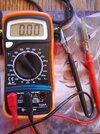
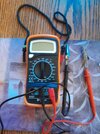

- Joined
- 18 Apr 2022
- Messages
- 7,407
- Reaction score
- 1,132
- Country
A lead acid battery, slowly covers the plates with sulphur as it discharges, and as time goes by, this sulphur gets harder and harder, as a result the recharge time needs to also be longer and longer.
The only way to measure state of charge is a hydrometer which today we can't use because we are using absorbed glass mat, or valve regulated lead acid versions (AGM and VRLA) so we try to use discharge voltage drop with a set known load instead, but this is just somewhere near.
So when my father-in-laws stair lift failed (2 x VRLA) due to charger being unplugged, fast cure was two new batteries, the old pair I did not find until he died, 6 to 9 months latter, zero volts showing so could not really use a smart charger, but at around 5 Ah too small to put on a large charger, so linked to a good battery in parallel and the smart charger was put on the pair, plugged into an energy monitor so I could see from my office if it had started to charge.
12 days it took, with basic no power being drawn, then just as if flicked a switch, it started to charge, and followed the standard charging curve, repeated with the second battery in the pair, using the first battery as donor, as worried that if there was a shorted cell, it would not switch off. But that also charged up in the same way.
Since then, I have repeated this many times with batteries which have been laid up. During Colvid I found I had to move charger between the three cars we had at the time, and with an energy monitor you could see how each time the battery dropped to 12.8 volts, the charger would restart, until battery at 14.4 volts, and then it would switch off, and you could see volts rapid fall to 13 volts, then the time before it hit 12.8 volts would increase the longer the battery had been on charge.
So before condemning a battery, it needs to be on a smart charger for 14 days. Only then are you reasonably sure all sulphur has returned to H2SO4, I found it takes around 2 days to recharge a battery once my car has been left that long it will not charge, the energy monitor shows the rate dropping to 0.1 amp, and returning to 0.8 amp, and the charged indicator lights up. But until the time at 0.1 amps is 6 hours or more, the battery is likely not fully charged, as it can take up to 14 days to soften again and return to being sulphuric acid.
A traction lead acid, i.e. milk float, fork lift, etc, will take 10 hours to recharge, it can't be fast charged, so we charge a car battery and take a car for a "good run" of maybe 5 hours, which in the grand scheme of things is nowhere near long enough.
I look at the smart charger, most of the time at 3 amp, holding at just under 14.4 volts, so a 60 Ah battery, (60/3) will take 20 hours to fully charge, but near the end the charge rate is dropped, to 0.8 amp, so more like 24 hours, even if none of the sulphur has become hard.
Even the works smart charger, able to charge at 200 amps, when cranking engine, it still within a few minutes drops to around 3 amps, same applies to the car's alternator, unless one fits a Sterling alternator to battery inverter, standard way with narrow boats, the car alternator does not stage charge, it has a fixed voltage of around 13.8 to 14.2 depending on the vehicle.
The sterling unit can take two alternators input, and it kids the alternators that the battery is low to get more out of the alternators, then charges the engine start battery at 13.8 volts, but the domestic batteries are charged at around 14.8 volts, with pulses, and the charger uses the voltage decay rate between each pulse to work out state of charge, and can charge at 120 amps but in the main a lot less, the pulse charge is used as if the battery is used while being charged, a simple stage charger can fail to realise the battery is fully charged and overcharge the battery.
There is some debate, that pulse charging can damage the battery, but also overcharging, and undercharging can as well, so it is a case of selecting a method best suited for the application.
The stop/start used with automatic cars, uses the engine computer to work out charge rate, so when the car stops using the stop/start, that's a sign the battery is either not fully recharged, or faulty, so if that happens with wife's Jag, then I put the battery on charge, using the jump start post under the bonnet, so the cars computer is measuring the charge rate. Battery is in the boot, so kept cool.
Maybe we should be phasing out the use of L-A batteries in favour of Li-ion in many applications.
- Joined
- 27 Jan 2008
- Messages
- 29,535
- Reaction score
- 3,636
- Location
- Llanfair Caereinion, Nr Welshpool
- Country
@Johntheo5 you need to be careful, I have tried in the past to list step by step what should be done.
So my meter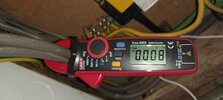 has a big advantage, there is no worry about an error blowing the meters fuse or cut-out, if they have them. I remember my first AVO Multiminor going up in smoke, the latter AVO Mk 8 had cut-outs and fuses, but still managed to blow one up, due to over-voltage spike, taking out the germanium diode.
The meter shown is not so accurate with low DC currents, but a lot harder to kill.
I would personally measure voltage at the panel first, start at a high volt reading and move down, it should show over 13 volts.
I would likely use a 24 volt head-light bulb, as I have some, across the output of the panel, I would expect a lower voltage, and I would calculate the load, 60 watt at 24 volt = 60/24 = 2.5A and 24/2.5 = 9.6Ω so if for example you measure 16 volts then 16/9.6 = 1.667 amps. So 16 x 1.667 = 26.667 Watts.
So using a fixed resistance I can measure the output of the panel. Without connecting it to a battery.
You can use the meter on amp range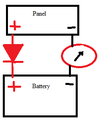 to see charge rate, but in the main analogue multi-meters are not centre zero, these
  are what I use to use, rather inacurate, but you again can't hurt them. But £37 for electronic clamp one (UNI-T UT210E) or 0-534-30 Durite meter at £29 I think I would go for the electronic clamp-on AC/DC meter.
I would perfer a diagram to connect A to B, as just too easy to make an error.
I think likely diode in the wrong place, or wrong way around,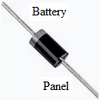 may be more like this
 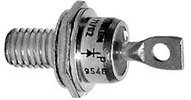 which will normally show direction on the diode like this one does
 a zenor diode looks nearly the same, the sign is different
 but a 14 volt zenor and a normal diode with a meter using a 9 volt battery will test the same.
So my meter
has a big advantage, there is no worry about an error blowing the meters fuse or cut-out, if they have them. I remember my first AVO Multiminor going up in smoke, the latter AVO Mk 8 had cut-outs and fuses, but still managed to blow one up, due to over-voltage spike, taking out the germanium diode.The meter shown is not so accurate with low DC currents, but a lot harder to kill.
I would personally measure voltage at the panel first, start at a high volt reading and move down, it should show over 13 volts.
I would likely use a 24 volt head-light bulb, as I have some, across the output of the panel, I would expect a lower voltage, and I would calculate the load, 60 watt at 24 volt = 60/24 = 2.5A and 24/2.5 = 9.6Ω so if for example you measure 16 volts then 16/9.6 = 1.667 amps. So 16 x 1.667 = 26.667 Watts.
So using a fixed resistance I can measure the output of the panel. Without connecting it to a battery.
You can use the meter on amp range
to see charge rate, but in the main analogue multi-meters are not centre zero, these are what I use to use, rather inacurate, but you again can't hurt them. But £37 for electronic clamp one (UNI-T UT210E) or 0-534-30 Durite meter at £29 I think I would go for the electronic clamp-on AC/DC meter.I would perfer a diagram to connect A to B, as just too easy to make an error.
I think likely diode in the wrong place, or wrong way around,
may be more like this which will normally show direction on the diode like this one does
- Joined
- 27 Jan 2008
- Messages
- 29,535
- Reaction score
- 3,636
- Location
- Llanfair Caereinion, Nr Welshpool
- Country
A leisure battery, and vehicle start battery are different; however, both can have the option to top up electrolyte with water, so slight over charging does not really matter, I would put gallons of water into forklift batteries, the equalising charge always overcharged them.you were supposed to be able to charge either a leisure battery or the main battery in a camper van
However, the VRLA and AGM lead acid battery is a very different beast. And many standard battery chargers carry a warning not to use with AGM batteries. Water can't be replaced, so it needs a very different approach, this in the main ends up being a pulse, so battery voltage decays to 12.8 volts, then it gets a pulse until 14.4 volts, then charger turns off again.
So with a non VRLA or AGM lead acid, the old two bobbin dynamo regulators was set to 16 volt open circuit, and would either over or under charge batteries, the standard battery charger used unsmoothed DC, so stick a capacitor on the output to smooth it, and the voltmeter would read 18 volts. i.e. to peak to peak voltage.
So with a battery which can be topped up, over charging is not really that much of a problem. Want to limit how long it goes on for, but not a massive problem.
Under charging is more of a problem, but as long as a diode is in circuit, I fail to see how connecting a solar panel to battery can reduce the voltage? So to my mind, it seems the diode is either missing or faulty or wrong way around.
The diode is a one-way valve, and will not allow the battery to discharge.

DIYnot Local
Staff member
If you need to find a tradesperson to get your job done, please try our local search below, or if you are doing it yourself you can find suppliers local to you.
Select the supplier or trade you require, enter your location to begin your search.
Please select a service and enter a location to continue...
Are you a trade or supplier? You can create your listing free at DIYnot Local


