2 zone heating help please

Joined
20 Oct 2025
Messages
2
Reaction score
0
Country
United Kingdom
So first post here and really hoping you can help.

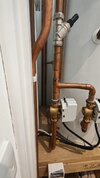
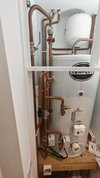
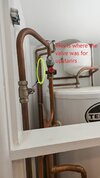
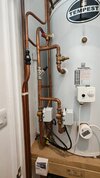
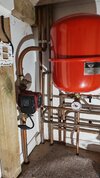
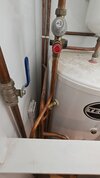
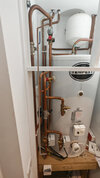
My setup is a Boiler with a megaflow and originally was a two zone heating system one for upstairs and one for downstairs. To cut a long story short, due to a faulty motorised valve it kept tripping the boiler. I no longer wanted the two zone heating system so I removed the upstairs motorised valve and replaced the faulty one, however when i put the hot water on the upstairs radiators come on. Can anyone tell by the pictures provided how the pipework should now be re-run now the upstairs zone valve has been removed?

Many thanks.
 

Attachments

  • 1.jpg
    1.jpg
    166.6 KB · Views: 22
  • 2.jpg
    2.jpg
    138.2 KB · Views: 21
  • 3.jpg
    3.jpg
    138.4 KB · Views: 22
  • 4.jpg
    4.jpg
    182.3 KB · Views: 22
  • 5.jpg
    5.jpg
    298.9 KB · Views: 20
  • 6.jpg
    6.jpg
    133.6 KB · Views: 22
I no longer wanted the two zone heating system so I removed the upstairs motorised valve and replaced the faulty one, however when i put the hot water on the upstairs radiators come on.

Your upstair zone, is now plumbed, straight onto the flow of the boiler, and so any demand on the boiler will result in the upstairs zone receiving heat. The simplest solution, might be to refit the zone valve for the upstairs. If that's not possible, then the upstairs zone, where the zone valve was, needs to now be connected to the output of your now single zone valve.
 
This is what i was kind off thinking, would the pipe run be like this picture?
2.2.jpg
 
I am only an electrician, but I do not really understand why one has in pipe zone valves for central heating unless there is a large section, which is often not required, such as with my house the flat under the main house?

The problem, as I see it, is the zone valve in the pipe work
1760975985199.png
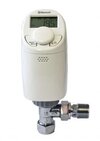
has a microswitch in it, but the zone valve at the radiator EQ3-Straight-213x300.jpgdoes not, so we want some way to tell the boiler to fire up. So we end up with a hub,
1760976295688.png
somewhere to connect to both TRV heads and boiler to tell the boiler when to run. We want a zone valve for the DHW so we can control the temperature to below that of the radiators, but it is clearly cheaper to install a system to control large sections of the heating, rather than individual rooms, but to put both TRV heads and in pipe zone valves would be like installing RCDs which in turn feed RCBOs. We want either/or not both, as they do the same job.

Maybe your home is very different to mine, but I have 14 heated areas, of them 4 are the flat under the main house, rarely used in winter, so all four rooms controlled by a zone valve. The other 10 are in the main house, we give the areas names, like dinning room, kitchen, shower room, bathroom, living room, office, craft room, hall, bedroom 1 and bedroom 2. Each room has different times when it is used, so we have programmable TRV heads which set at what time and to what degree each room is heated. Splitting into upstairs and downstairs would not work. The office and craft room are upstairs, but are used in the day.

So 10 programmable TRV heads, but only one is linked to the hub, we also use wall thermostats, the problem is the house was piped years ago, so we have radiators under windows, this means a TRV is cooled by the outside wall, until the heating is running, so they are cooler than the room.

Central heating in the main works on a near enough system. To have an ideally placed thermostat in each room is a pipe dream, it would cost too much, so we just get it near enough, but it is unlikely that can be achieved without multiple linked thermostats, but that does not mean every room needs a linked thermostat.

Basic idea is the TRV stops a room over heating, and wall thermostats stop a room getting too cold. But every home is diffrent, there is no one magic formula which will work in all homes, the owner has to decide what is a happy compromise between installation cost and running cost.

 
I am only an electrician, but I do not really understand why one has in pipe zone valves for central heating unless there is a large section, which is often not required, such as with my house the flat under the main house?

The problem, as I see it, is the zone valve in the pipe work View attachment 396371 has a microswitch in it, but the zone valve at the radiator View attachment 396372does not, so we want some way to tell the boiler to fire up. So we end up with a hub, View attachment 396373 somewhere to connect to both TRV heads and boiler to tell the boiler when to run. We want a zone valve for the DHW so we can control the temperature to below that of the radiators, but it is clearly cheaper to install a system to control large sections of the heating, rather than individual rooms, but to put both TRV heads and in pipe zone valves would be like installing RCDs which in turn feed RCBOs. We want either/or not both, as they do the same job.

Maybe your home is very different to mine, but I have 14 heated areas, of them 4 are the flat under the main house, rarely used in winter, so all four rooms controlled by a zone valve. The other 10 are in the main house, we give the areas names, like dinning room, kitchen, shower room, bathroom, living room, office, craft room, hall, bedroom 1 and bedroom 2. Each room has different times when it is used, so we have programmable TRV heads which set at what time and to what degree each room is heated. Splitting into upstairs and downstairs would not work. The office and craft room are upstairs, but are used in the day.

So 10 programmable TRV heads, but only one is linked to the hub, we also use wall thermostats, the problem is the house was piped years ago, so we have radiators under windows, this means a TRV is cooled by the outside wall, until the heating is running, so they are cooler than the room.

Central heating in the main works on a near enough system. To have an ideally placed thermostat in each room is a pipe dream, it would cost too much, so we just get it near enough, but it is unlikely that can be achieved without multiple linked thermostats, but that does not mean every room needs a linked thermostat.

Basic idea is the TRV stops a room over heating, and wall thermostats stop a room getting too cold. But every home is diffrent, there is no one magic formula which will work in all homes, the owner has to decide what is a happy compromise between installation cost and running cost.
Thank you for sharing!
 

If you need to find a tradesperson to get your job done, please try our local search below, or if you are doing it yourself you can find suppliers local to you.

Select the supplier or trade you require, enter your location to begin your search.


Are you a trade or supplier? You can create your listing free at DIYnot Local

 
Back
Top