CH and HW dependence after repairs

Joined
20 Oct 2009
Messages
17
Reaction score
0
Location
Berkshire
Country
United Kingdom
We have a standard fully-pumped (vented) system consisting of Potterton (Flamingo) boiler in garage, cylinder with thermostat upstairs in airing cupboard, room stat in lounge, Grundfos 15-50 circulation pump next to cylinder, a 2-port motorised valve (Honeywell) and a Potterton timer (programmer); also a F&E tank in the loft.

The system was already installed when we bought the house and was working OK. The only problem was the piping: all radiators were connected 'in series' with a single pipe running around the house between them, from output to the next input. This meant, closing any single radiator would close the entire chain - hence TRVs would not work and were not installed.

2 years ago we had the entire piping re-done, whereby now each radiator has 2 pipes ('upstream' and 'downstream') and each is fitted with a thermostatic valve, so they can be controlled separately. The rest of the system was not touched, as far as we are aware. This separate control works and, when radiators get supply, they are controlled by the TRV-s.

Since that repair, however, I have discovered a problem: heating often (most of the time) does not start despite demand from the room stat and fully open TRV (and timer on 'permanent ON').

I found 2 ways to start the heating:
(a) Turn on a hot water tap anywhere in the house and waste a couple of litres of hot water - this kick-starts the circulation pump.
(b) Turn up the cylinder thermostat - to above 70 deg., nearly 80 - does the same. (But water gets too hot with all that follows in terms of comfort, economy and overheating risks).

Different timings for CH and HW also cause a problem and, despite having a 'very porgrammable' timer (the 6002 model), HW has to be permanently ON to ensure CH works (from time to time). Also, leaving the motorised valve in 'Auto' positon reduces the chance of CH starting as needed, so I keep it on 'Manual' (which, I am sure, is not what it was made for).

Reading this forum I found that such behaviour is normal for systems with pumped CH and gravity HW, but I am pretty sure ours is not one of those.

What could have gone wrong during the repairs (re-piping of radiators)? What would you suggest to try/check in order to diagnose the problem and eventually eliminate it?
 
You have one or two 2port MV's, and whats it on the hot water or heating.
 
I'm guessing it's a C-plan and the zone valve is broke or wired wrong.
 
How many water pipes connected to the boiler?

Does the pipe leaving the pump divide in two, one branch to the cylinder, the other to the radiators?

Model number of motorized valve?

What controls the motorized valve? Hint: try the room and cylinder thermostats and listen to the valve.
 
yea your absolutely right I didint read it properly :oops: well it is early on a sunday morning, :wink:
 
How many water pipes connected to the boiler?

One pipe. All I can see is a short and very thick pipe (apparently insulation) from the boiler to the garage ceiling. That casing/insulation is wide enough to hide 2pipes, but I believe it's only one. In any case, one pipe comes to the pump (the ONLY pump) from a Myson Aerjec II

Does the pipe leaving the pump divide in two, one branch to the cylinder, the other to the radiators?
Model number of motorized valve?

Yes, exactly. The point where it divides is the valve - a Honeywell V4073A

What controls the motorized valve? Hint: try the room and cylinder thermostats and listen to the valve.

The cylinder stat - when turned up to around 75 deg C, noise is heard (vibrations felt) in the valve's powerhead. The same happens when some hot water is drawn from a tap (and apparently temperature inside the cylinder drops, triggering the stat)

I am sure before the mentioned re-piping it was the room stat - but now it has no effect. I can hear it click when passing the curent ambient temperature, but that doesn't result in anything anywhere else in the system.

I also believe wiring was not touched during that porject (unless unintentionally or something just burned/disconnected on its own). At least it was not in the brief of those plumbers to do anything on the wiring.

I hope the above helps in diagnosing the problem?

(Answers to questions asked by others are in the original post)
 
Excuse my plumbing ignorance: in the original post I called the morotised valve " 2-port " meaning it had 2 outputs from a single input. Perhaps this should be called " 3-port " ? (or " 2-way " ?)

Now that I quoted the exact model, I hope it's clear. it splits the pump output between HW and CH and (theoretically) should feed either one separately, or both of them. That's what it was doing previously.
 
How many water pipes connected to the boiler?
One pipe.
There must be at least two water pipes connected to the boiler - flow (hot water leaving the boiler) and return (cooler water entering the boiler). They may both be in casing/insulation you mention.

Does the pipe leaving the pump divide in two, one branch to the cylinder, the other to the radiators?
Model number of motorized valve?
Yes, exactly. The point where it divides is the valve - a Honeywell V4073A
Just seen your last post. Yes, that's called a three-point valve or a mid-position valve.

Your problem can be cause by:
Motorized valve
Cylinder Thermostat
Room Thermostat
Programmer.

Do you have a large box into which everything connects - called a wiring centre? If so can you post a photo of the box with the lid off and the cables labelled, e.g pump, room thermostat etc. Need this to guide you with the tests. (There is an unofficial "standard" wiring, but not everyone follows it).
 
D_Hailsham";p="1382670 said:
Your problem can be cause by:
Motorized valve
Cylinder Thermostat
Room Thermostat
Programmer.

Do you have a large box into which everything connects - called a wiring centre? If so can you post a photo of the box with the lid off and the cables labelled, e.g pump, room thermostat etc. Need this to guide you with the tests. (There is an unofficial "standard" wiring, but not everyone follows it).

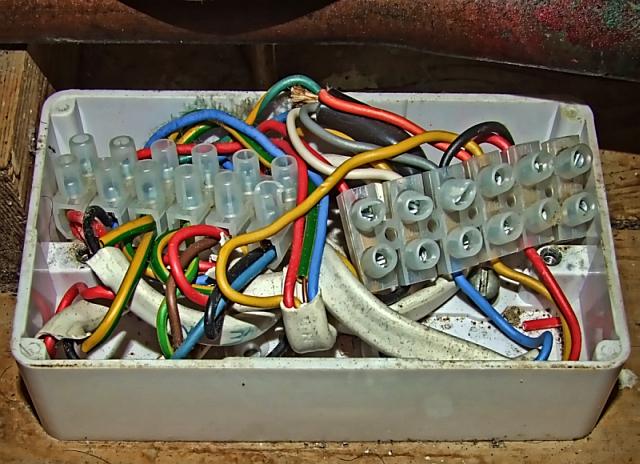
Just before I read your last post, I had taken the lid off the "wiring centre". A neat little white box from the outside, the inside horrified me: can't imagine having to track any circuit there...

Here's a photo of British workmanship at its best (this masterpiece was constructed years before Polish and other alien plumbers and electricians became fashionable):

Click on picture to enlarge

If all else fails, I will buy a small multimeter (currently I have no circuit-testing device of any kind at home) and I know how to use one. I also have the full documentation of the installed equipment form the previous owners - in the Potterton literature I found the (recommended) schematics and may try to check to what extent the installation matches those. But in view of what you see in the photo, I would rather avoid this.

From your suggested points of possible falure I am quite confident to exclude:
- The programmer: it's a brand new EP6002 I just bought and it does switch the circuits on and off at the preset times. Even the previous EP2002 (I still have it) was working, but one of the sliders had lost its fixation points (broken small plastic part inside) and was sliding freely -very easy to move to a wrong position by accident while moving towels in the cupboard; I also wanted the more detailed settings possible with the 6002.
- The cylinder thermostat (a Honeywell L641A) is switching the circuits on when cylinder water temperature drops below the chosen setting - and off, when it exceeds the setting. This is how I currently turn the 3-point valve and the pump on: by 'cheating' the thermostat, which works.

I think we can narrow the suspicions to the valve and room stat. Are there any tests for their functionality that you could suggest - that do not involve digging into the so-called 'wiring centre'?
 
Labeled cables? :shock:

This box is mounted on the airing cupboard floor. Under the boards is a spaghetti mess of identical, unmarked, flat white cables going further through the floor and walls - and no way to tell which one comes from where. Unless a thorough testing is performed around the house. Which will porbably have to be done, sooner or later (I wonder how much a pro electrician would charge for just tracing the circuits and labeling all wires?)
 
Labeled cables? :shock:

This box is mounted on the airing cupboard floor. Under the boards is a spaghetti mess of identical, unmarked, flat white cables going further through the floor and walls - and no way to tell which one comes from where. Unless a thorough testing is performed around the house. Which will porbably have to be done, sooner or later (I wonder how much a pro electrician would charge for just tracing the circuits and labeling all wires?)

Actually the valve wiring is quite clear.

Dave will have no problem making a few suggestions in the morning.
 
Labeled cables? :shock:

This box is mounted on the airing cupboard floor. Under the boards is a spaghetti mess of identical, unmarked, flat white cables going further through the floor and walls - and no way to tell which one comes from where. Unless a thorough testing is performed around the house. Which will porbably have to be done, sooner or later (I wonder how much a pro electrician would charge for just tracing the circuits and labeling all wires?)

Actually the valve wiring is quite clear.

Dave will have no problem making a few suggestions in the morning.
cracker :lol:
 
Actually the valve wiring is quite clear.

Yes, even I could figure that, having the benefit of seeing beyond this photo - that the cable coming out of the valve is black (and there's only one black cable in the box. Eureka!)
It's also the only one that has a grey and orange wire - I had already come across these colours while reading the forum to find a problem like mine..

OK - valve cable identified. Next?

Dave will have no problem making a few suggestions in the morning.

I hope he will (as none of tonight's posters could :( )
 

If you need to find a tradesperson to get your job done, please try our local search below, or if you are doing it yourself you can find suppliers local to you.

Select the supplier or trade you require, enter your location to begin your search.


Are you a trade or supplier? You can create your listing free at DIYnot Local

 
Back
Top