

Hi all,
Our upstairs (small 2 floor 2up-2down house) radiators only get hot on the bottom few inches, no heat at all above them, downstairs certainly appear to work fine and have no trouble maintaining a decent temperature in the bathroom and living room. But the issue means our bedroom and the nursery are really quite cold... and with a small baby, this is a bit of an issue.
Unfortunately, I know little about plumbing, but really can't afford a plumber unless there is no other option. But, what I do know:
-The house is 1920s, but the heating/hot water system must have been updated at some point from first installation as there are a few pipes that are blocked off in the airing cupboard... I'd suspect this may have been in the late 90's/early 2000s as that is the approximate age of the boiler (which is a odd make, but a good boiler for it's time [known from when we had a gas leak]). In the loft is the fairly normal 1 large tank (the ball cock got limescaled and caused a drip a while back [I managed to fix that]) and the small tank (I assume an expansion tank)... it looks like there's a fair amount of orange (rusty?) stuff at the bottom of that tank. Both tanks have water and functional ball cocks. Since I know from piping diagrams it might help, the tanks are in the loft, hot water cylinder in the airing cupboard upstairs and boiler on the ground floor. We definitely don't have a combi boiler before anyone asks.
I've tried bleeding the radiators with essentially no success: There was a hiss for quite a while (probably more than a minute though I didn't time it), but no water appeared... the radiator perhaps got warmer a small fraction higher afterwards, but further efforts have made no difference.
That made me suspect we had some form of blockage from the expansion tank, stopping water "topping up" the system when the radiators are bled.
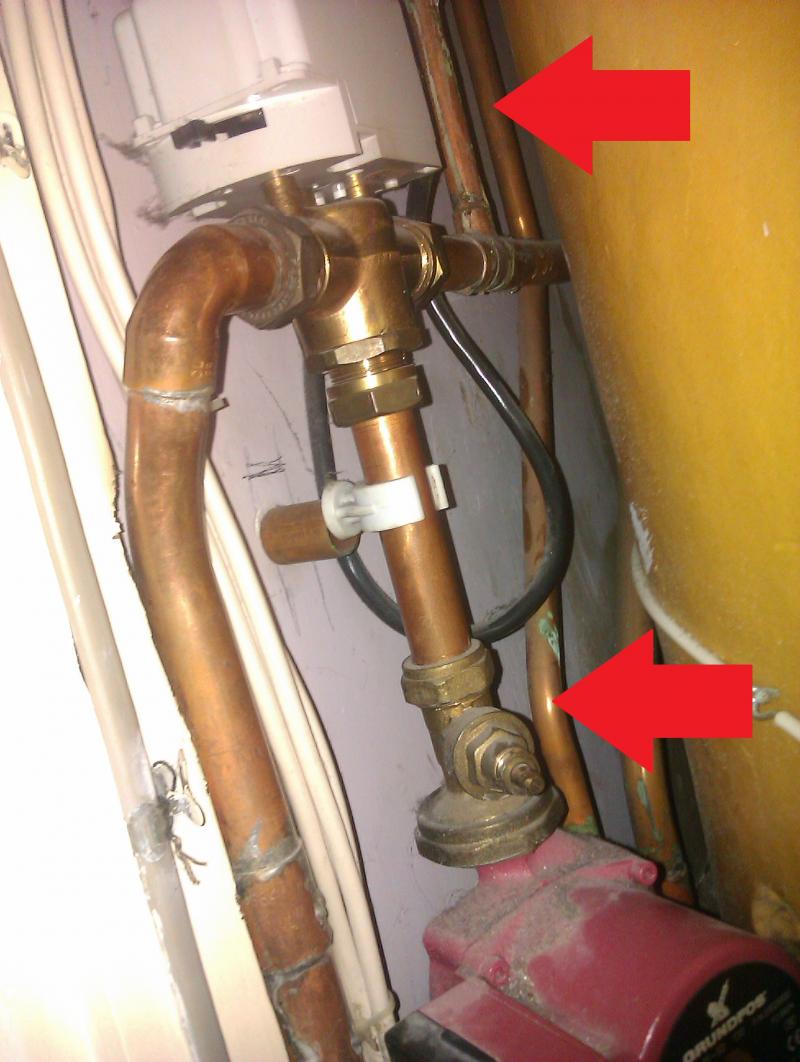
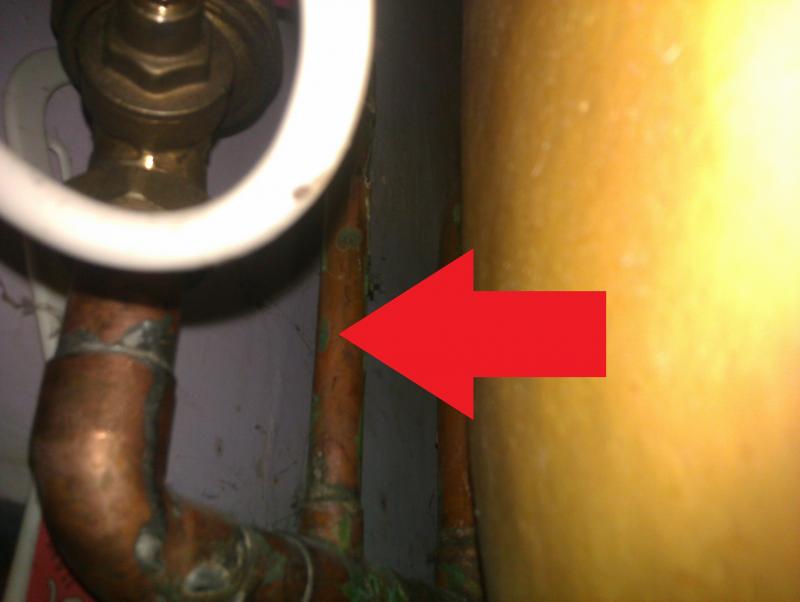
BUT I have discovered in the airing cupboard (rather well hidden by the shelving unfortunately) a green tap/valve on a pipe, that I am wondering what does? It is on a thinner pipe than most in there that comes from the piping just below the pump and disappears up into the loft (in the direction of the tanks)... but it is proving hard to figure out which pipe is which once in the loft... they are lagged by time they emerge... all in identical lagging... so I can't figure out where the pipe goes.
So, I wonder, what does the green tap/valve do? Is this the problem, turning that tap will allow water down into the central heating system? If so, will it just require a temporary opening, to refill? or will it need opening and then the radiators bleeding? Should it be open or closed now/long term? I'm rather nervous to turn it currently since I don't know it's purpose and am afraid of flooding the house etc.
The images below show what is going on with the piping in that area, with red arrows showing the pipe with the green tap/valve heading for the loft.
Any help or advice would be really useful.
Thanks, Rob[/list]
Our upstairs (small 2 floor 2up-2down house) radiators only get hot on the bottom few inches, no heat at all above them, downstairs certainly appear to work fine and have no trouble maintaining a decent temperature in the bathroom and living room. But the issue means our bedroom and the nursery are really quite cold... and with a small baby, this is a bit of an issue.
Unfortunately, I know little about plumbing, but really can't afford a plumber unless there is no other option. But, what I do know:
-The house is 1920s, but the heating/hot water system must have been updated at some point from first installation as there are a few pipes that are blocked off in the airing cupboard... I'd suspect this may have been in the late 90's/early 2000s as that is the approximate age of the boiler (which is a odd make, but a good boiler for it's time [known from when we had a gas leak]). In the loft is the fairly normal 1 large tank (the ball cock got limescaled and caused a drip a while back [I managed to fix that]) and the small tank (I assume an expansion tank)... it looks like there's a fair amount of orange (rusty?) stuff at the bottom of that tank. Both tanks have water and functional ball cocks. Since I know from piping diagrams it might help, the tanks are in the loft, hot water cylinder in the airing cupboard upstairs and boiler on the ground floor. We definitely don't have a combi boiler before anyone asks.
I've tried bleeding the radiators with essentially no success: There was a hiss for quite a while (probably more than a minute though I didn't time it), but no water appeared... the radiator perhaps got warmer a small fraction higher afterwards, but further efforts have made no difference.
That made me suspect we had some form of blockage from the expansion tank, stopping water "topping up" the system when the radiators are bled.
BUT I have discovered in the airing cupboard (rather well hidden by the shelving unfortunately) a green tap/valve on a pipe, that I am wondering what does? It is on a thinner pipe than most in there that comes from the piping just below the pump and disappears up into the loft (in the direction of the tanks)... but it is proving hard to figure out which pipe is which once in the loft... they are lagged by time they emerge... all in identical lagging... so I can't figure out where the pipe goes.
So, I wonder, what does the green tap/valve do? Is this the problem, turning that tap will allow water down into the central heating system? If so, will it just require a temporary opening, to refill? or will it need opening and then the radiators bleeding? Should it be open or closed now/long term? I'm rather nervous to turn it currently since I don't know it's purpose and am afraid of flooding the house etc.
The images below show what is going on with the piping in that area, with red arrows showing the pipe with the green tap/valve heading for the loft.
Any help or advice would be really useful.
Thanks, Rob[/list]


