Damp party wall

Status
Not open for further replies.
Joined
18 May 2015
Messages
2
Reaction score
0
Location
London
Country
United Kingdom
Hi Folks - any ideas where this damp is coming from and how I can deal with it, please?

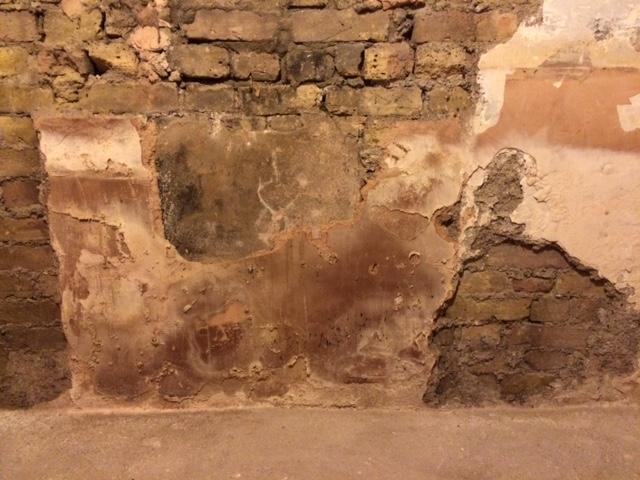
I've stripped out my kitchen in a late Victorian mid-terraced house, and there's serious damp along much of the party wall and both of the adjacent walls (one also feels damp on the living room side). The old kitchen units were mouldy and rotten. It goes to about 80 cm height. The chimney was removed long ago (1971 according to the newspapers I found) and boarded over to within a metre of the ground, the same had been done in the bathroom upstairs. There's no sign of a leak coming down as the board was in good shape, and there are definitely no leaks from upstairs, at least not in the last 3 years since I replaced the bathroom. There are no services or drains on this side of the kitchen, and next door tells me the same (but I haven't got to have a look there yet). This would have originally had a suspended floor, but now has a concrete floor with a step down from the rest of the house. A lot of the original plaster fell off in my hands, and felt fairly dry. The bricks also don't feel that damp. The newer plaster from a previous repair job is definitely wet. I was wondering about hygroscopic plaster, but could that cause so much damp? Or something to do with the concrete floor? Any advice much appreciated...Thanks a lot...
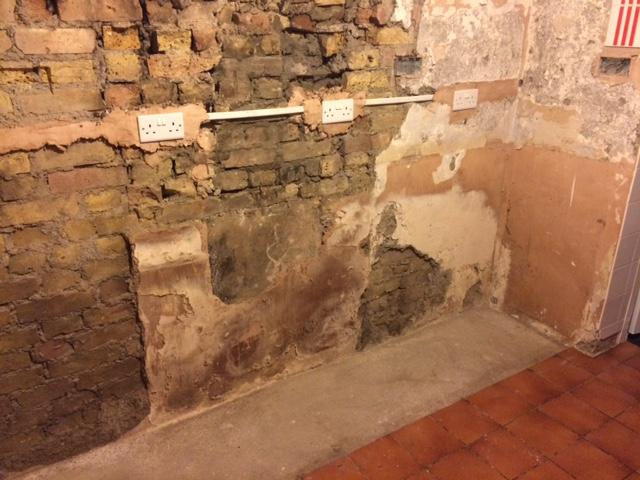
 
Number one suspect would be rising damp, rising up from the base of the party wall. Could you post pics of the whole kitchen wall.

Given that the party wall is a solid wall then surely your neighbour should also be experiencing damp issues?

No membrane can be seen at the edge of the slab so perhaps moisture is coming thro the slab - altho the concrete surface appears dry?

Previous remedial work using a sand and cement render has been done to a height of about 800mm. The gypsum skim finish is wrong, a remedial finish should be used over a S&C render.

If the other rooms along the party wall are showing damp signs then why not post pics of these floor/walls on here? Their suspended floors & skirtings could be affected?
The kit conc floor might be blocking thro ventilation from front of the house to back?

I dont understand what you are saying about the chimney breast(s)?
 
Moist warm air from the kitchen gets behind the units and condenses on the wall behind. There the moisture is absorbed by the wall which then becomes colder, and as a consequence, more prone to condensation. The easiest way to stop it is to add waterproofer to you mortar mix when sorting the wall.
 
Thanks guys for getting back so quickly...

I've posted another pic which has as much of the wall as I can capture, also shows the upper middle section where the chimney breast was previously removed - but I'm sure it's not moisture coming down, as the chimney breast is also removed from the room above, and things feel dry on the upper part of the wall.

I'm pretty sure that there's no membrane under the concrete slab, but the surface of the concrete does feel totally dry.

Water's unmetered on both houses, but I need to check with my neighbour about possible leaks on his side.

Maybe my imagination, but the bricks where the plaster came off (2 days ago now) are already feeling a drier... the wettest bit is the remaining plaster on the central cement rendered section (I assume the back of the old fire place).

Firstly I'll check properly on things on my neighbour's side, then get the rest of the plaster off and see how / if things dry out...

Thanks for your help....
 
As joe said, give it a chance to dry out and take it from there.
 
OP, you will be waiting a long time for brickwork covered with damp contaminated render & plaster to "dry out" and even longer for brickwork impregnated with soot to "dry out".

You should remove all the "plaster" from the party wall, and make a judgement call on how far to remove any contaminated plaster on the return wall.

What you have is far more than condensation. Why? Because you can see the change in damp brick to drier brickwork. You can also see the line of the old flue up to the sooty flue footprint.

Condensation would not have penetrated your S&C render to dampen the underlying brickwork - to imagine that it would is ignorant guesswork that could cost you dearly.

Adding waterproofer to the render mix will do nothing - absolutely nothing - to prevent condensation. In some circumstances it would increase the possibility of condensation forming.

Beware ignorant DIY'ers giving rubbish advice.

The old flue line and the sooty brickwork should be wire brushed back to reasonably clean brick. Then apply SBR as a sealer and tack coat to the old flue footprint - this will mask any remaining "soot chemicals".

Leaving the solid wall(s) to "dry out" is always an option - but precisely how long can you do without a finished kitchen? Rising damp by definition cannot and will not totally dry out. Do the neighbours intend to hack off & dry out their side?

Finally, render the wall(s) with a sand and lime mix at 3:1, use a remedial skim finish plaster such as limelite. Stop the render 50mm above the floor.
 
Perhaps the neighbours already have an impermeable layer on their side and you are recieving all the damp.
Id get a new bricky though, and block up that old flue (it looks like it has a big gap in the pic), while your at it, you could even start knocking our and rebuilding ;)
 

If you need to find a tradesperson to get your job done, please try our local search below, or if you are doing it yourself you can find suppliers local to you.

Select the supplier or trade you require, enter your location to begin your search.


Are you a trade or supplier? You can create your listing free at DIYnot Local

 
Status
Not open for further replies.
Back
Top