
• Looking for a smarter way to manage your heating this winter? We’ve been testing the new Aqara Radiator Thermostat W600 to see how quiet, accurate and easy it is to use around the home. Click here read our review.

Double Pole isolator switch for Bathroom Light Pull & Extractor Fan?

Joined
26 Jun 2007
Messages
44
Reaction score
1
Country
United Kingdom
I'm replacing a broken bathroom light pull switch. It also starts the extractor fan, which must have a separate permanent live as it overruns some minutes after pulling the switch off again.

I was surprised to find a Double Pole isolator switch, the 16A sort you might use with a wall heater; not the simple single pole two contact type commonly used. A pair of live (red) wires enter and another red/live pair leave the isolator from each side. Tests suggest that one half of the double pole isolator (i.e. a Live In/Live Out) interrupts the live supply to lights; the other half of isolator (Neutral In/Neutral Out) interrupts the live supply to the extractor fan. Wires are double red & earth, not a common DIY cable so I assume professional work.

This seems an uncommon arrangement, where single pole simple switches are normal and wiring a fan to come on with lights is surely common. This appears the original built installation, not a bodge. Can anyone explain why this has been done, and whether a single pole switch could not pair the lives entering and then pair the lives leaving? More oddly, one of the live wires 'in' remains live even after the supplying FCU is switched off, only becoming safe when the lights MCB is tripped at the Fuse Box.

What has the electrician done, and why?
 
"Isolator" switches are commonly fitted to bathroom fans as well as a functional switch.

They are useful when faults develop on the fan so that it may be switched off and leave the lights working.
This is more likely with a three-pole isolator as the two-pole will likely control the light as well.

Many think that local isolation is required by the regulations but it is not.
The fan manufacture will state that one should be fitted - I think for the same reason.
That then becomes another reason for fitting an isolator because it is then 'manufacturers' instructions'.

It is unusual to use twin red cable. The neutral should be identified.
 
"Isolator" switches are commonly fitted to bathroom fans as well as a functional switch.

They are useful when faults develop on the fan so that it may be switched off and leave the lights working.
This is more likely with a three-pole isolator as the two-pole will likely control the light as well.

Many think that local isolation is required by the regulations but it is not.
The fan manufacture will state that one should be fitted - I think for the same reason.
That then becomes another reason for fitting an isolator because it is then 'manufacturers' instructions'.

It is unusual to use twin red cable. The neutral should be identified.
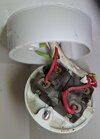
This is not being used as a true isolator (Live & Neutral), just as a double pole switch separately interrupting live supplies to lights and to fan. This is the reason all cables are red, no neutrals in the switch fitting (see pic). So light pull switch puts on lights and fan together. Fan later continues on its overrun setting.

Isolator #1 edit - Copy.jpg
 
This is not being used as a true isolator (Live & Neutral), just as a double pole switch separately interrupting live supplies to lights and to fan.
Oh, ok. I may have misunderstood your description.

Then it is doing just that - allowing the switching of the light and fan to remain independent.

This is the reason all cables are red, no neutrals in the switch fitting (see pic). So light pull switch puts on lights and fan together. Fan later continues on its overrun setting.
Ok.
 
OK, so firstly why? The two loads cannot be separately isolated with a double pole switch like this; both on/off together. A single live feed through a single pole switch could have then fed both lights & fan. Simpler, with a cheaper common ceiling switch.

Secondly, despite being fed from a nearby FCU just outside of the bathroom, the rear left red wire (presumed input) remains live despite the FCU being switched off; only becomes safe if Lights MCB is tripped at Fuse Box. What has been done?
 
Secondly, despite being fed from a nearby FCU just outside of the bathroom,
Obviously I do not know what has been done in your house but -

One reason is that it allows the three conductors of the fan to be isolated by a double pole FCU.

E.g.

1763642134734.png
 
One reason is that it allows the three conductors of the fan to be isolated by a double pole FCU.
But the isolator only passes one (switched live) conductor to the fan. The other switched live passes through it to the lights. So it can't be for better isolation, this offers no more than a simple switch would.
 
More oddly, one of the live wires 'in' remains live even after the supplying FCU is switched off, only becoming safe when the lights MCB is tripped at the Fuse Box.

What has the electrician done, and why?
Fan instructions generally include a diagram showing a 3A fuse in the supply.

In typical UK installations where the fan is powered from a 6A MCB lighting circuit, this instruction should be ignored.

If an FCU is used, it should supply both the perm and switched live to the fan - and hence also the light. Yours clearly has not been done in this way. I’d argue that that is dangerous.

I don’t know whether professional or DIY electricians are more likely to do this.
 
Fan instructions generally include a diagram showing a 3A fuse in the supply.

In typical UK installations where the fan is powered from a 6A MCB lighting circuit, this instruction should be ignored.

If an FCU is used, it should supply both the perm and switched live to the fan - and hence also the light. Yours clearly has not been done in this way. I’d argue that that is dangerous.

I don’t know whether professional or DIY electricians are more likely to do this.
Am I correct in assuming it's unsafe because the disconnection of the FCU doesn't leave the Isolator completely safe? I'm glad I always probe with a mains detector even when all should be safe.

But that aside, why would a permanent live be on that rear left wire? From the layout of the room (FCU nearby to the Left of isolator; lights & Fan further to the Right) I had assumed the left side was the input. This permanent Live made me wonder if I was wrong and the left was in fact the load/output side. But a permanently live fan output would mean it would never switch off. The permanent live must be on the input side, as if that live doesn't come from the FCU, but elsewhere. Meanwhile, in that case you'd never fit a FCU just for a light circuit. I am beginning to think this is a 'professional' mistake or a bodge by someone later on.

Is there any good reason the live supply and live load sides cannot just be joined as two pairs and passed through a simple one pole switch? Is that the normal thing to do?
 
My diagram shows you why a DP pull cord switch is sometimes used.

There is a Permanent Live at one of the terminals.
 
My diagram shows you why a DP pull cord switch is sometimes used.

There is a Permanent Live at one of the terminals.
In your diagram, the permanent live from the ceiling rose does go to one of the DP isolator terminals, as you say, then back again so forming a switch for the light. But the permanent live in my pic is the rear/left, a circuit which (by experiment) controls the fan.

It is the near/front pair of lives that control the light in my bathroom. So that puts the permanent live on the wrong circuit. Could that be a mistake?
 
But the isolator only passes one (switched live) conductor to the fan. The other switched live passes through it to the lights. So it can't be for better isolation, this offers no more than a simple switch would.
No. Although the FCU only switches the permanent live fee do the fan (as well as the neutral), it also (when switched 'off') disables the switched live to to the fan, since that is derived from the permanent live output of the FCU. Switching off the FCU therefore effectively achieves 'three pole isolation' of the fan.

It's actually quite a clever approach for those who feel the need to supply the fan through both an FCU and an isolator (neither of which is required by regulations, despite what fan manufacturers often say) - since it requires only one accessory (the FCU) in addition to a (DP) light switch.
 
Obviously I do not know what has been done in your house but -

One reason is that it allows the three conductors of the fan to be isolated by a double pole FCU.

E.g.

View attachment 399750
I've found this method a number of times, it can be cheaper than a 3 pole isolator.

Some rental agencies prefer this method with the FCU to be supplied from a different circuit. IDKY
 
Last edited:

If you need to find a tradesperson to get your job done, please try our local search below, or if you are doing it yourself you can find suppliers local to you.

Select the supplier or trade you require, enter your location to begin your search.


Are you a trade or supplier? You can create your listing free at DIYnot Local

 
Back
Top