
Help Designing a Wiring System

Joined
14 Dec 2008
Messages
140
Reaction score
1
Location
Stirlingshire
Country
United Kingdom
Hi,

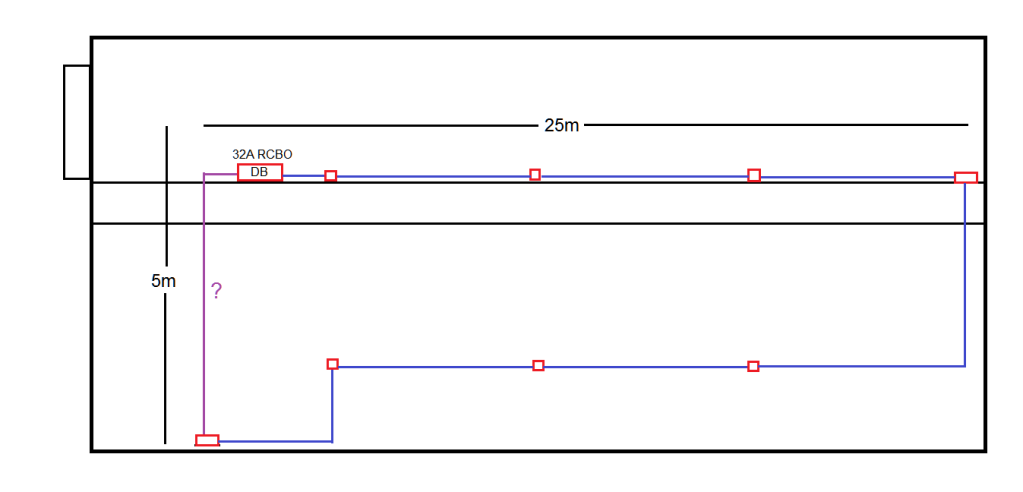
Could you help with the following diagram please?
wiring123.png


Which would be best, a ring or radical circuit? I think ring due to the length.

Also, when trying to calculate the cable size online I come out at 10mm. Is that really correct? I'd have thought 2.5mm like normal circuits, but I suppose it is the distance needed cover?
Would the protection need to be a 32A MCB/RCBO?

There is 6 single gang, and 2 double gang sockets in total, wiring clipped to tray.


I am NOT going to be doing any practical work what so ever, this is just a query I have and would like to try to know the 'Why' of it.
 
A ring circuit can serve a floor area of 100m/sq. 25x5 = 125.

There is a guidance of a maximum length of cable of something like 75m (forget the exact recommendation). So your length looks OK.

I would be looking at two radial circuits my self. Probably 4mm 32amp radials (75m/sq each), or if lower demand, 2.5mm 20amp radials (50m/sq each).
 
That would be fine on 2.5mm the via a ring.

Why have singles, rather than doubles?

As to radials, I don't see the value in have to use 2 ways on the cu, two rcbos and extra cost of 4mm over 2.5mm.

Could you expand you query and confirm what the room is, what you intend to have on the circuit and clear up whether it's a domestic or commercial site?
 
Hi,
Thanks for the replies. I'm not doing the work, it is just theory for my SNVQ.

The room would be a roof void of a factory building.

Where in the regs does it say about maximum floor area a ring can serve? I have never seen this, but would be good to have a read.

I would have thought one ring, with 2.5mm would be better than 2 radials in 4mm, do to cost and ease of working with 2.5mm over 4mm?
Would the protection still be 32A on a 2.5mm ring over the large distance?


Thanks
 
Where in the regs does it say about maximum floor area a ring can serve? I have never seen this, but would be good to have a read.
It terms of 'the regs', per se, it doesn't say that. Appendix 15 (which is only 'informative') of BS 7671 merely says that the floor area being served should be taken into account when designing a ring final circuit, adding the statement "Historically, a limit of 100 m² has been adopted". If this hypothetical circuit is for a factory roofspace, do I take it that only occasional, probably single, loads are expected - if so, then I would imagine that you could 'take into account' the area being served and conclude that a single ring would be fine.
Would the protection still be 32A on a 2.5mm ring over the large distance?
Without intending any offence, if you need to ask that question I think you probably would benefit from familiarising youself a bit better with some of the underlying principles. The rating of a CPD does not depend upon the length of the circuit.

Kind Regards, John
 
As far as I can remember 106 meters of 2.5 mm sq with 1.5 mm sq earth as a ring and 45 meters as a radial.

Lift it to 4 mm and back to 108 meters and clearly with a 32A MCB you would need 4 mm anyway.

Although therefore either 2.5 mm ring or 4 mm radial will give same volt drop and loop impedance as each other what I have found a problem is where some one assumes it's a ring and tries to extend it with 2.5 mm cable. However also seen where ring is broken so really does not matter which method is used.

When 17th came out I could not understand where the 106 meters came from so made an excel program with:-
Measured Ze
Measured Zs
Size of Line conductor
Size of Earth conductor
Impedance of Live conductors
Ring Main
Ambient temperature
Nomial volts
Correction factor Ct
Max permitted operating temp tp
Rating factor for grouping Cg
Rating factor for ambient temperature Ca
Design current for circuit Ib
Tabulated current-carrying capacity of a cable It
Orignal mV/A/m
Corrected mV/A/m
Cable length
Volt drop

Using all this information I could still not get the 106 meters until pointed out that the design current is considered as 26 amp. It seems to be accepted that 20 amp at centre and 12 amp spread even is used for a ring. Clearly with a radial there may be a different consideration but I used same figures.

Out of interest I banged in 32A instead of 26 and still it shows over 100 meters.

I used excel as I knew the results for 2.5 mm on a ring so I could check the program was giving right results but only tested with 2.5 mm so there may be an error but I would not think it would be enough to cause a problem with the 55 meters you are using.
 
As far as I can remember 106 meters of 2.5 mm sq with 1.5 mm sq earth as a ring and 45 meters as a radial.
You're presumably talking here about cable length, based on considerations of Zs and/or voltage drop. The question was (and answers were) about the floor surface area served by a final circuit. In the (hypothetical) case being cited, the total 2.5 mm² cable length would only be 60 metres or so, hence usually well within the limit of maximum cable length which you mention.

Kind Regards, John
 
I thought he could use it as a rule of thumb now the floor area has been put in the history books :wink:
Fair enough. Of course, the cable length limitations you were discussing have 'always' been there, in addition to the floor area considerations when they were in vogue.

Floor area clearly always was a very poor guide to anything, particularly if one doesn't specify different maximum areas for different types/uses of rooms/spaces. Far more important, IMO, is consideration of what the power requirements of the area being served are likely to be - even though it can never be anything other than a (hopefully 'intelligent') guess.

Kind Regards, John
 
That is always the problem it is a bit of guess work.

I did fall foul one time with a shrink wrap machine the volt drop caused it to fail with 6mm supply. I had wanted to use 10 mm but was overridden by boss. I was altered to 10 mm and was then OK.

It was just unlucky that the machine was so dependent on correct voltage. Until rewire could only be used on night shift.

In Uni we wanted a compressor to work with a PLC program and it could only be used one end of benches. Clearly wired to work the PC's no one considered a compressor would be plugged in.
 
HI'm not doing the work, it is just theory for my SNVQ.
So you're going to come here, get other people to help you with work which you are supposed to be doing to show that you understand what they are teaching you?
 
HI'm not doing the work, it is just theory for my SNVQ.
So you're going to come here, get other people to help you with work which you are supposed to be doing to show that you understand what they are teaching you?
It seems like a valid part of the teaching/learning process to me, for those inclined to participate. If you do not wish to, that's obviously fair enough.

Kind Regards, John
 
And that helps his lecturer(s) realise that he isn't progressing properly and/or that they aren't succeeding in teaching him properly, how, exactly?
 
And that helps his lecturer(s) realise that he isn't progressing properly and/or that they aren't succeeding in teaching him properly, how, exactly?
Education is, IMO, not as insular as you imply. Asking questions on a forum is no different from reading a book, searching the internet or discussing with colleagues - all of which I would regard as valid parts of the totality of education. As I said, if you disapprove, you are free to just ignore it.

Kind Regards, John.
 
And that helps his lecturer(s) realise that he isn't progressing properly and/or that they aren't succeeding in teaching him properly, how, exactly?

Yea but it's only by asking questions you can learn right? Like with when i was asking about that horrendously dangerous diagram of mine :mrgreen:. You guys really helped me and now I understand more and that's because the answers to my questions cleared up a lot of my lack of understanding.

It's like for example lets say plastering, reading up on it would take weeks (if you're a slow reader like me lol), but imagine having a pro next to you showing you how it's done and being able to ask anything and get an immediate answer, you'd learn in no time. Sometimes the answers you need aren't always in books if you need a specific answer.
 

If you need to find a tradesperson to get your job done, please try our local search below, or if you are doing it yourself you can find suppliers local to you.

Select the supplier or trade you require, enter your location to begin your search.


Are you a trade or supplier? You can create your listing free at DIYnot Local

 
Back
Top