• Looking for a smarter way to manage your heating this winter? We’ve been testing the new Aqara Radiator Thermostat W600 to see how quiet, accurate and easy it is to use around the home. Click here read our review.

Potential damp?

Joined
12 Jan 2025
Messages
25
Reaction score
1
Country
United Kingdom
Hi guys, Apologies if this is not in the correct category, wasn't too sure what it would come under.

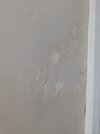
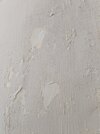
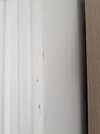
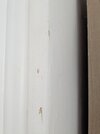
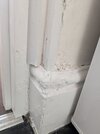
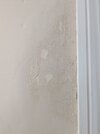
I moved into this house about a year and 3 months ago. And ever since there has always been a damp patch in our dining room, to be more precise about 5 ft off the floor and to the side of a door frame. (The door frame was installed after the damp was noticed so nothing related here) It initially started out as just that, a bit of a dark mark. We then painted the room, obviously looked fine for a bit then the dark mark came back. I have since then sanded it back to the bare plaster, primed it, sealed it and painted again. Which now brings us to attached pictures. It has slowly got to this stage since sealing and painting. The first lot of pictures is in the dining room and the second lot of pictures is on the other side of the wall in the kitchen. Now this is in the middle of the house, with no internal pipes or external guttering sitting above it. So not entirely sure what's causing it.

My only other thought is that the boiler is on the other side of the wall ( in the kitchen) but as far as I can tell none of it's pipes run above the damp.

The bottom of the wall is very soft and you can see a clear bubbling / distortion to the shape of the skirting and surrounding wall which I assume is from this damp.

My next idea was too physically removed all plaster / plasterboard within the affected area and take it back to the bare brick. Potentially on both sides. I was just wondering if this would be worth while or if anyone else had a better idea?
 

Attachments

  • PXL_20250123_143953132.jpg
    PXL_20250123_143953132.jpg
    272.7 KB · Views: 48
  • PXL_20250123_143955444.jpg
    PXL_20250123_143955444.jpg
    269.8 KB · Views: 50
  • PXL_20250123_143958031.jpg
    PXL_20250123_143958031.jpg
    352.4 KB · Views: 44
  • PXL_20250123_144006243.jpg
    PXL_20250123_144006243.jpg
    128.7 KB · Views: 45
  • PXL_20250123_144008650.MP.jpg
    PXL_20250123_144008650.MP.jpg
    127.3 KB · Views: 46
  • PXL_20250123_144019051.jpg
    PXL_20250123_144019051.jpg
    191.2 KB · Views: 42
Also may be worth pointing out this is dead above a radiator that is on for the majority of the day.
 
It could be historic leaking from pipes and/or damp in the wall from another source. I think you have worked out what to do in terms of chopping out the plaster etc,
 
It could be historic leaking from pipes and/or damp in the wall from another source. I think you have worked out what to do in terms of chopping out the plaster etc,
Cheers for the reply blup. How would I potentially go about eliminating a leak that is still there, and potentially in the ceiling above? Only as the issue has obviously come back multiple times over a year. Don't think that would particularly be a job I could do. There is minor damp at the bottom but think this may all be from the same source.
 
Cheers for the reply blup. How would I potentially go about eliminating a leak that is still there, and potentially in the ceiling above? Only as the issue has obviously come back multiple times over a year. Don't think that would particularly be a job I could do. There is minor damp at the bottom but think this may all be from the same source.
If its still there, identify the source of it. Even if you have to get somebody in you can specify what and where is the problem so potentially saving money.

If its not residual damp that is drying out and getting wet again, you could lift the boards in the ceiling above to trace pipes. An inspection camera that fits to your phone is a cheap way of achieving this if access is difficult, but you might have to drill a/some holes in the floor
 
If its still there, identify the source of it. Even if you have to get somebody in you can specify what and where is the problem so potentially saving money.

If its not residual damp that is drying out and getting wet again, you could lift the boards in the ceiling above to trace pipes. An inspection camera that fits to your phone is a cheap way of achieving this if access is difficult, but you might have to drill a/some holes in the floor
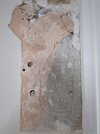
Hiya mate, sorry for the late reply on this. Finally got around to taking the plasterboard off. The wall underneath looks and feels very dry. The only thing I can point out is where the damp was, was where the grey area is in the picture. I've marked a line as to where the damp roughly was on the plasterboard. Whether or not that material (no idea what it is) is causing it. No idea.

The only other thought is the evenly spaced holes that look like they are filled with some sort of sponge material? These may be normal to have just had no idea what they are! Cheers bud
 

Attachments

  • 17388385724887513153014312177135.jpg
    17388385724887513153014312177135.jpg
    278.1 KB · Views: 37
Maybe some kind of damp injection holes? The cement might have been added to keep damp at bay but it found its way through.
 
Yeah just gave it a quick Google and they're dry rods. So obviously an existing issue. Would just plasterboard back over it but it's bound to come back. Will have to get someone out more than likely
 
Does it feel damp?

You could tape some bacofoil over the area, leave it for a few days and then remove the foil and see if it is damp on the reverse side.

If you are lucky, it might just be the case that you have salts coming out of the old plaster.

Oh, and yes, they do look like DryZone rods.
 
Doesn't feel damp at all which is the weird. And I'd say the back of the plasterboard I took off the wall wasn't damp either. But there's obviously something going on for someone to have put the dry rods there previously.

I'll try your cling film idea cheers.

I would have agreed that it was just salts coming out, but the plasterboard started to become a bit "bouncy"? Almost. In the most affected areas, like it was losing its rigidity.
 
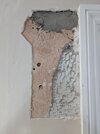
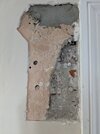
@blup @opps Hiya both, been a while on this one but only just got around to looking at it any further. Left it a while how it was in the picture, and noticed the white powder coming through the cement / grey area in the picture. The same white powder that was showing through the plaster.

I've now chipped all of this cement out and it is currently how it looks in the attached picture. Do you think I could fill the space with mortar and then go over with some finishing plaster? I assume the powder was coming from the grey stuff as when chipping it away it was everywhere! (See the first image, it was almost all white)
 

Attachments

  • PXL_20250312_163710822.MP.jpg
    PXL_20250312_163710822.MP.jpg
    353.2 KB · Views: 26
  • PXL_20250312_164903601.jpg
    PXL_20250312_164903601.jpg
    359.8 KB · Views: 30

If you need to find a tradesperson to get your job done, please try our local search below, or if you are doing it yourself you can find suppliers local to you.

Select the supplier or trade you require, enter your location to begin your search.


Are you a trade or supplier? You can create your listing free at DIYnot Local

 
Back
Top