RCBO tripping - identify likely location - help.......

I know, what he really needed to do was fault find. And I did walk around pulling o some light fittings with him, but that was the end of it!! He doesn't seem interested in replying now or not quickly..

Sounds as if he just wasn't experienced in fault-finding, or couldn't be bothered.
 
So, some updates.

I rechecked my multi meter impedance testing of the circuit with the live and earth of the outgoing wire disconnected and I was wrong.

There is no reading between Neutral and Earth with the earth wire disconnected from the earth bar of the consumer unit. I must have tested the wrong side of the wago connector on the cct in question. It's the only one where you can see the extension of the earth connection to reach the earth bar. I must have separated it and tested the wrong side of it with neutral, giving the reading... face palm....

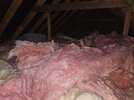
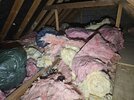
The lighting circuit in question has the neutral connections in the loft above the ceiling. The down side, is that they are hidden amongst large amounts of insulation, and the house is in 3 wings and full wiring is hard to trace without pulling the insulation all up which is not pleasant and messy to say the least, even with a respirator and boiler suit on....

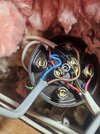
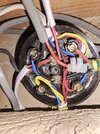
I've located 4 jcn boxes so far. There is 7 light switches on the lighting circuit. A few power multiple lights like outside (2), wall lights (3). Although, I haven't identified all the connections inside the junction boxes I've found yet, it appears there may be more than one switch connection being placed in each junction box given the number of cables and number of terminals used. They're not as straight forward as I've encountered before as there is more cables and more terminals in use and 3 core cables. I'm sure I can work it out with the multimeter. All the earth terminals are collected at the back of the junction box to make room I guess..

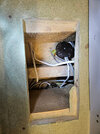
A few photos included.

Edit: Duplicate connection box photo removed and other added.

So, do I need a basic insulation resistance tester to be able to "see" this fault? Will one with 6xaa batteries test at the required voltage with enough reliability?

I did purchase a 6A RCBO as well, but given I haven't identified or fixed anything yet, it would make more sense trying to test to isolate the area of the problem and resolve it that way.

Many thanks for any help.
 

Attachments

  • cu.jpg
    cu.jpg
    381.2 KB · Views: 36
  • Conn1.jpg
    Conn1.jpg
    136.7 KB · Views: 36
  • Loft.jpg
    Loft.jpg
    211 KB · Views: 38
  • loft2.jpg
    loft2.jpg
    318.7 KB · Views: 37
  • conn3.jpg
    conn3.jpg
    194.3 KB · Views: 35
  • Loft conn.jpg
    Loft conn.jpg
    26.3 KB · Views: 37
A few power multiple lights like outside (2)

Those, are what I would concentrate my efforts upon. Trace the wiring, from the lights, to where they connect to the indoor installation, and isolate them completely. Then test again.

So, do I need a basic insulation resistance tester to be able to "see" this fault? Will one with 6xaa batteries test at the required voltage with enough reliability?

Yes, it should be perfectly adequate. This type of meter, includes a battery powered inverter, which boosts the battery voltage, usually to 150/500/1000 volts. The 500v setting is perfectly adequate for your needs, but remember it's double your mains voltage, and it can give you quite a jolt.
 
When I get this basic insulation tester and need to test the lighting cct, neutral and earth, im assuming I need to remove all led bulbs in lamps and disconnect the start of led ceiling down light cable runs to exclude?

Unfortunately l, the outside two lights are not the obvious fault as I replaced the outside lights and ran new cable to a connection point in loft. So unless its further back, its not those. But with the tester and breaking down circuits im pretty confident I'll find where the fault is, assuming there's only one!!
 
1762723002631.jpeg I have looked, maybe eyesight is failing, but I can't see any earth wires? The rules changed 1966, where all fixed wiring needs an earth wire, but even before that, the rules allowing the earth to be omitted did not really allow no earths, and at that time cables were old colours and imperial sizes, and in the main pre-PVC cables.

I remember in the Falklands trying to sort out missing earths, and not easy, even if using old cable, it is in essence a re-wire, as every cable has to be re-terminated.
 
View attachment 398779 I have looked, maybe eyesight is failing, but I can't see any earth wires? The rules changed 1966, where all fixed wiring needs an earth wire, but even before that, the rules allowing the earth to be omitted did not really allow no earths, and at that time cables were old colours and imperial sizes, and in the main pre-PVC cables.

I remember in the Falklands trying to sort out missing earths, and not easy, even if using old cable, it is in essence a re-wire, as every cable has to be re-terminated.
Hi, yes good spotting. I did write in the previous post with the photo the earth connections on all the junction boxes are made around the back. But there's quite a lot of text in this thread now, so I understand why you didn't see it.

Bit unconventional? I suppose it was done because they're all so busy with the number of connections and wires used. This house would have been built around 1966 or 1967. But Lighting circuits have been altered with upstairs dormers x 2 and an infill flat roof extension between two wings...
 
edit: an RCBO trips straight away, and was tried with an alternative, so it was "temporarily" replaced with an MCB to give service.

Slightly longer back story that I can fill in if you want with lots more detail but I don't think will add much to the following explanation

A registered electrician, who did the consumer unit change out, and BR competent person notification, could not identify the fault, I'm not sure he even did much looking and removed the RCBO that was tripping on the downstairs lighting and used a MCB to give service following change to a contactum CU with RCBOs and surge protection device or whatever it is called... .. He now can't be located or will not respond to me to resolve!!

I know he shouldn't of left it like that but that is how it is!!...

edit. previously the CU was a split board with no RCD protection on lighting...
Removing a safety device is completely unacceptable.
 
A short update.

I deconstructed the 2 main lighting cct connection boxes in the loft, where I cut an access hole.

It was like trying to arrange spaghetti with 1 hand 10inches down a rabbit hole - working in that access space...

I tested all legs for N+E. And found the problem cable - it was a single t+e lighting feed for one of the lights. It disappeared under a roof area now covered by the floor of one of the rear dormers, I could see it going under and over joists, not through. It was inaccessible. I suspect - but could not confirm - it had been nailed through probably when loft conversion was done 25 years ago. There was previously no RCD protection on the lighting.

So, I cut it out and ran a new section of cable following a different route. Re-tested the cable and it showed infinite on the cheapie chinese insulation tester I bought. Similar to that posted by @ericmark . Thanks, it did the job! Before the fix, it was showing 0.0 megaohms n+e.

Re-instated all connections and tested again at consumer unit. Showed infinite on all combinations. N+E, N,L, L,E.

I now need to get the electrician back to fit the RCBO quoted for in the original job and the install cert, which is easier said than done but I will try to use my incredible powers of persuasion!!

Thanks All
 

If you need to find a tradesperson to get your job done, please try our local search below, or if you are doing it yourself you can find suppliers local to you.

Select the supplier or trade you require, enter your location to begin your search.


Are you a trade or supplier? You can create your listing free at DIYnot Local

 
Back
Top