• Looking for a smarter way to manage your heating this winter? We’ve been testing the new Aqara Radiator Thermostat W600 to see how quiet, accurate and easy it is to use around the home. Click here read our review.

Swapping to rigid ducting?

Joined
20 Jan 2021
Messages
77
Reaction score
3
Country
United Kingdom
Hi all,

Recently discovered a little bugger of a mouse had gotten into the attic eaves and, for whatever reason, decided to chew the aluminium flexible ducting used for the cooker hood. I'm presuming it could smell food and tried to make its way to the kitchen. Either way, it has chewed a good few holes in that thing. Rather than just replacing it like-for-like, I'm wondering about converting it to a rigid setup.

The duct itself basically begins in the kitchen ceiling, where it does a 90 degree bend into the eaves via the room above's floorboards, and then terminates into another couple of 90 degree bends and out the wall. Total length is around 2m or so (if even that), so I believe the 90 degree bends aren't too harmful to the performance.

I was thinking of swapping it out for rigid PVC ducting, slapping around foam pipe insulation, and then foil taping it all up (foil tape is much thicker and sharper when cut compared to that flexible tubing crap, so I hope that deters any further rodents from trying their luck).

This will be my first time having a go at rigid ducting, so any advice for connections/cementing the PVC (good idea, bad?) and things to keep in mind if maintenance or disassembly is required in future. Cheers. Will likely give this a go on the shower ducting as well, which as a similar setup and distance.

Attached a crude drawing showing how the ducting generally looks like.
 

Attachments

  • sdfsdf.png
    sdfsdf.png
    14.2 KB · Views: 61
If you have a TLC Electrical store near you they stock a wide range of flat channel duct. As standard I fit 204mm x 60mm through lofts.

You may have to take the cowl off of your extractor hood and start again, the 204x60mm can be used with 5 inch or 6 inch flexible duct out of the extractor and then connects to either a 5 inch or 6 inch flat channel connector, which connects to the flat channel which is available in 1 & 1.5 mtr lengths. You'll need a flat channel connector or two depending on the length.
If your ducting comes out in the soffit you'll need a rectangular to round adaptor to continue out with flexi duct.

I.Sells is another ducting supplier, Toolstation & Screwfix do 204 x 60 but you won't get the rectangular to round from either.
 
If you have a TLC Electrical store near you they stock a wide range of flat channel duct. As standard I fit 204mm x 60mm through lofts.

You may have to take the cowl off of your extractor hood and start again, the 204x60mm can be used with 5 inch or 6 inch flexible duct out of the extractor and then connects to either a 5 inch or 6 inch flat channel connector, which connects to the flat channel which is available in 1 & 1.5 mtr lengths. You'll need a flat channel connector or two depending on the length.
If your ducting comes out in the soffit you'll need a rectangular to round adaptor to continue out with flexi duct.

I.Sells is another ducting supplier, Toolstation & Screwfix do 204 x 60 but you won't get the rectangular to round from either.

Sounds good but as mentioned I don't want to use flexi duct again.
 
Use round pipe not flexi.

How big is the difference between 150mm round pipe and 204x60 square pipe? I ask because 150mm may be a tight fit under the floorboard space. Wondering if it might be worth it to just be all rectangular ducting.
 
You'll just need very short lengths of round pipe to run from the outlet to the adaptor.
 
How big is the difference between 150mm round pipe and 204x60 square pipe? I ask because 150mm may be a tight fit under the floorboard space. Wondering if it might be worth it to just be all rectangular ducting.
What I meant was round pipe from the extractor to flat channel ducting connecter and then round pipe from the rectangular to round through your cavity wall and onwards to the vent.

The difference between 204x60 and 150 is 90mm. If you look at the product you'll understand why.
 
What I meant was round pipe from the extractor to flat channel ducting connecter and then round pipe from the rectangular to round through your cavity wall and onwards to the vent.

The difference between 204x60 and 150 is 90mm. If you look at the product you'll understand why.

I didn't mean the dimensions, I meant in terms of airflow potential, round vs rectangular.
 
100dia= 7,853mm2
204*60=12,240mm2 which is 30% smaller than 150dia
150dia=17,671mm2 which is 40% bigger than 204*60
 
Last edited:
Okay so, cleared out the eaves so I could get better access to all the ducting. I've since discovered that bugger of a mouse has also chewed at the bathroom flexi ducting as well! Guess it wasn't going for food but because it just seems to like chewing soft aluminium foil. It also triggered one of the traps but didn't get caught (although none of the bait was taken after it was scared off). Hoping it is a mouse and not a rat, lol. It's basically declared war on me so we will see how it goes. It seems to disappear for long periods of time then randomly show up again.

I'll be replacing the bathroom ducting first. One question - how should I go about fitting the ducting? I recall reading about creating a slight dip so that any condensation runs to a safe place, and not back down into the bathroom (or into the fan). I'm wondering how to do it with my very short run, though.

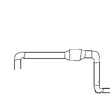
The regular run would just be a straight run as shown in the first attached image. I do plan to cover all the ducting with pipe insulation (up to the 90 degree bend after the inline fan as after that it disappears behind the finished walls) made for 100mm ducting and then foil tape it all over, so do I need to even bother with accounting for accumulated condensation?

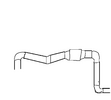
Otherwise, the only thing I could think of is something like in the second attached image, where I try and angle the pipe down and then use a 15 degree turn or something and bring it back up, and then there's a dip in the middle where water can safely accumulate if necessary.

What do you think? Overthinking? No need?
 

Attachments

  • duct1.png
    duct1.png
    11.1 KB · Views: 34
  • duct2.png
    duct2.png
    10.9 KB · Views: 30
Why do you want to accumulate water and block the pipe.?

You are misreading. I do not want that to happen, but this is a cold attic and condensation within needs to be taken into account, or so I read.
 

If you need to find a tradesperson to get your job done, please try our local search below, or if you are doing it yourself you can find suppliers local to you.

Select the supplier or trade you require, enter your location to begin your search.


Are you a trade or supplier? You can create your listing free at DIYnot Local

 
Back
Top