Do these need to be fitted on all baths, even if supplied by a combi. Or is it still just for stored hot water? Thanks

You are using an out of date browser. It may not display this or other websites correctly.
You should upgrade or use an alternative browser.
You should upgrade or use an alternative browser.
Thermostatic mixing valves in baths
- Thread starter XanderHarris
- Start date
D
Deleted member 267285

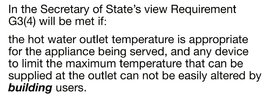

Just interested:

Does the wording on the right hand side mean that after the building is erected, G3(4) no longer applies and/or
if not formed by change of use it does not apply in any case?
Does the wording on the right hand side mean that after the building is erected, G3(4) no longer applies and/or
if not formed by change of use it does not apply in any case?
D
Deleted member 267285
No, it means that once installed, the way it’s preventing exceeding temperatures (usually a thermostatic mixing valve - TMV2/3) is provided upon when built, for example a new build, is maintained, and should be written in the building regulations part G3, the same regs that apply to the installation and maintenance of unvented hot water cylinders. They don’t apply to retrofit circumstances.Just interested:
View attachment 303032
Does the wording on the right hand side mean that after the building is erected, G3(4) no longer applies and/or
if not formed by change of use it does not apply in any case?
Interesting. Does it mean the water from a hot tap (no mixer, separate H&C taps) must not exceed 48°C? That's how it seems to read, but HW is usually somewhat hotter than that.No, it means that once installed, the way it’s preventing exceeding temperatures (usually a thermostatic mixing valve - TMV2/3) is provided upon when built, for example a new build, is maintained, and should be written in the building regulations part G3, the same regs that apply to the installation and maintenance of unvented hot water cylinders. They don’t apply to retrofit circumstances.

Does the wording on the right hand side mean that after the building is erected, G3(4) no longer applies and/or
if not formed by change of use it does not apply in any case?
The way we interpret the regs is that it applies to new builds or newly created bathrooms where there wasn't one before. When a bath is installed into one of these, it must now have a TMV2/3 rated mixing valve installed on the feed to the bath to ensure the water in the bath cannot exceed that set temp. It also means that once one is installed (as per the regs) and if it fails then it must be replaced (as per the regs) and not just removed, so yes the regs will still apply.
The system is designed to control the max temp that can be delivered out of the tap into the bath. It's to prevent scalding. In the case of separate taps/mixing taps, the HW must have a TMV inline to reduce the HW to a max of 48Deg, they're usually fitted below the bath.
OK thanks, we live and learn!The system is designed to control the max temp that can be delivered out of the tap into the bath. It's to prevent scalding. In the case of separate taps/mixing taps, the HW must have a TMV inline to reduce the HW to a max of 48Deg, they're usually fitted below the bath.

- Joined
- 22 Jan 2007
- Messages
- 24,293
- Reaction score
- 3,625
- Country

Bath only, and they do need serviced, which they very rarely are.Does it mean the water from a hot tap
I was just thinking of bath hot taps, but I see what you mean.Bath only, and they do need serviced, which they very rarely are.
Thanks a combi would only get it above 48c in the summer. With a 35c rise it needs the incoming water to be above 18c. I'm sure when I did college level 3. 2015/2017 that it was just for storaged water. But this appears to have changed?
- Joined
- 22 Jan 2007
- Messages
- 24,293
- Reaction score
- 3,625
- Country
Not sure if it has changed but the TMV is supposed to be a cover all, with the bath being the dangerous bit, hence why bath only.But this appears to have changed?
D
Deleted member 267285
The building regulations that these are applied to are from 2010.2015/2017 that it was just for storaged water. But this appears to have changed?

DIYnot Local
Staff member
If you need to find a tradesperson to get your job done, please try our local search below, or if you are doing it yourself you can find suppliers local to you.
Select the supplier or trade you require, enter your location to begin your search.
Please select a service and enter a location to continue...
Are you a trade or supplier? You can create your listing free at DIYnot Local
Similar threads
- Replies
- 4
- Views
- 1K
- Replies
- 4
- Views
- 2K