My old festool track saw- I set to score about 0.25mm/0.5mm and then a full cut when working with laminates. You are then able to set the depth to do the rest of the cut.
I saw the other responses to this, which given the OPs statement that he was using a plunge saw don't ring true to me. I think your comments, however, are correct and to back it up I attach some relevant photos:
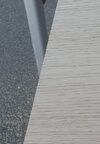
This is the roughish edge I started with as the sheet was supplied (not cut to size):
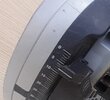
The saw was set to 2mm below the surface (7mm shown is 2mm DoC PLUS 5mm thickness of the guide rail):
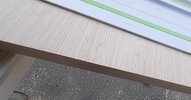
The guide rail was clamped to the material (essential!), the saw adjusted so it dodn't waggle on the rail and a 2mm deep scoring cut was made:
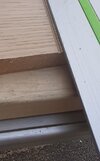
The blade was retracted and the saw was pulled back to the start position. A full depoth cut was made. Note the clean edge:
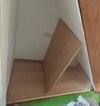
This is what the 19mm veneered was beng cut for - understairs dividers for a cupboard unit:
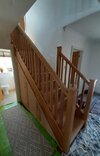
And this is the bespoke cupboard as installed (plus the oak staircase which went with it):

On a plunge saw you do not need a negative rake blade (sorry,
@Munroast), because the anti-splinter strip on the guide rail is what prevents spelch
on the rail side of the cut on the top surface only (on the other side of the cut on the top surface will still splinter unless your saw has an outboard splinter block, as fitted to Festools and Mafells), but you do still need a blade with the correct number of teeth and correct tooth pattern. On Festools this is 160mm/48t, Bosch/Mafell/Makita it is something like 165mm/48t whilst cordless DWs require 165mm/42t - all ATB (alternate top bevel). Too few teeth and you get a rough cut, too many teeth and you get scorched edges because the (smaller) saw gullets clog with waste too easily
Rip cutting (with the grain) of splintery veneers such as oak works well, but cross cutting is where
@opps's technique works. In fact current generation Festool plunge saws and all the Makita plunge saws made since they started have a knob which allows you to make a 1mm deep scoring cut as your first cut, then slide the saw back to the start of the cut, push the knob back in and make a second full depth cut and you will get a clean cut.
A couple of additional points: the guide rail must be always clamped down before you start doing this type of cut and the adjusters on the saw must be set so that the saw cannot waggle about on the rail. And, the blade
must be sharp to start with. Don't have the Makita magic button as fitted to the SP6000/DSP600, etc? Set the first cut depth manually to 6mm (1mm depth of cut + 5mm for the thickness of the rail). The old Festool used in the example above didn't have such a button, so I set the depth of cut to 2mm manually for the scoring cut... If you still have issues with a rough cut making the scoring cut conventionally, then try making the scoring cut by moving the saw to the far end of the material, plunging the saw to the 1 or 2mm and then drawing the saw backwards to make the scoring cut. This can sometimes cure the issue



