• Looking for a smarter way to manage your heating this winter? We’ve been testing the new Aqara Radiator Thermostat W600 to see how quiet, accurate and easy it is to use around the home. Click here read our review.

Water tank replacement options

Joined
6 Nov 2008
Messages
492
Reaction score
10
Location
Durham
Country
United Kingdom
Hi,

I have recently bought a fairly big victorian house that is detached and rural.
It has a new worcester boiler that is oil fed.

I am replacing the bathroom and asked a local plumber to discuss options and he turned the hot tap on and explained the hot pressure was not great.
The boiler was not on as its run out of oil and I have to arrange to have it filled.

He mentioned a mains pressure tank that would give better pressure and also provide a decent shower that sounded promising. He also has a "nearly new one" he would provide and install for under £1000

I have done some research and am concerned about possible service costs, reliability etc of pressure tanks so am I better of with an extra pump?

At the moment I think I have a normal type setup with water tank in the upstairs bathroom with another small tank on top of it.

Any suggestions and ideas ???

Thanks
 
A well designed gravity system can deliver a greater flow than some mains pressure systems by using the cold storage tank as a buffer for when demand exceeds supply.

Mains pressure systems can deliver water at a higher pressure, but the flow is limited to the maximum flow from the cold water mains, unless you include an accumulator.

Much of the modern brassware available is designed to work with higher water pressures than gravity systems can supply.

Booster pumps can be quite noisy.

Did your plumber measure the mains water pressure and flow at your kitchen tap?
 
No he didn't measure the pressure with any specific tools.
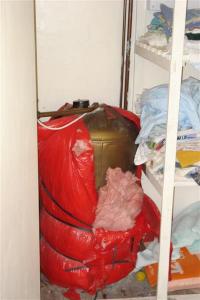
I forgot to mention that I needed to move the existing tanks to a smaller cupboard in the bathroom so I could free up some space. The smaller cupboard is not quite as high, so this may be why he mentioned the mains pressure tank? Its above the radiators but not by much.

I may be able to get a small tank in the loft area if I need the extra height.

Will a well designed gravity system power a decent shower or am I still looking at a pump. As long as the flow is Ok i'm happy!

I'll try and get some pictures up tomorrow.
 
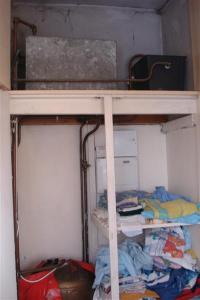
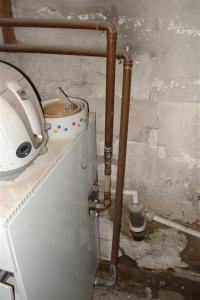
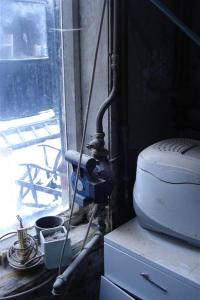
I'm hoping someone will have a look at these pics and give me some ideas to improve pressure (power shower) and efficeincy
There are pictures of tanks, pump and boiler in no particular order.

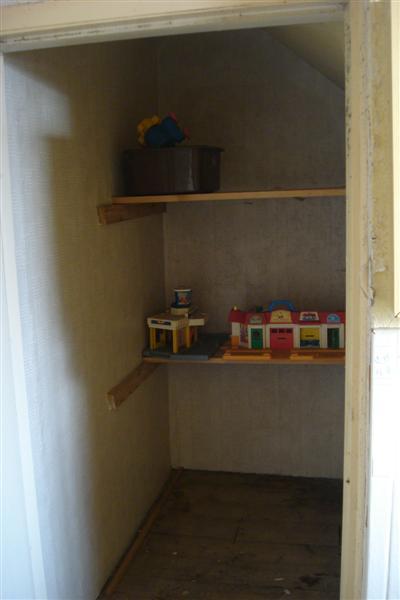
111000_110304_17844_13099026_thumb.jpg


111000_110304_17843_46516214_thumb.jpg


111000_110304_17841_15006581_thumb.jpg


111000_110304_17842_39721659_thumb.jpg


I want to move the tanks from the cupboard they are in to this (adjacent to the current tank cupboard but not quite as high.


Any suggestions greatfuly received
 
My two pennies worth! You could try and squeeze a bigger cistern in the roof, the unvented is a good bit of kit, but only as good as the incoming mains supply. The round type cisterns can be 'squashed' to fit through smaller loft hatches if need be. If funds allow you would be as well to change cylinder too, modern types have far better insulation to keep the water hot.

Shower: I'd put in a decent mixer shower once you've sorted the cistern issues. If you're still not happy with performance then can always retrofit a pump. Ask installer to route and allow room in pipework to cut in a pump if need be at a later date.
 
"salient points" noted. Please excuse my lack of knowledge, I am trying to learn some basics and would be happy to keep the gravity system if its capable.

.....so I do not need a pump for the shower and the tanks will move into the cupboard I posted in the last picture?

I think the idea of the mains pressure tank came from the fact I could remove the exisiting tanks and just use one big tank in the empty cupboard.

Thanks


Rob
 
Indeed, there is also the option of having a couple of smaller cold water tanks linked together instead of a single large one, if space on the loft is limited in height.

The cylinder can be situated in the cupboard without any difficulty.

You will need a cold water tank of appropriate size to feed it (especially if the water supply is of a lowish pressure/flow rate), and it's difficult to ascertain whether the cupboard it big enough.

A final thought relating to having a couple of tanks - it may be possible to have one tank in the loft which links to a sealed one in the cupboard above the cylinder - in fact, if you are going to replace the current cylinder, it may be possible to use it as such a sealed cold water tank. The additional head of water from the tank int the loft may obviate the need for a pump, and if it doesn't work, you have a local tank into which the pump could be plumbed. Bit of an odd layout, but it's a possibility, and I am unaware of any regulations that disallow it..
 
That's brilliant. Just the sort of information I was looking for. I now have options to contemplate.

dextrous, in the last scenario I would have a cylinder in the bottom of the cupboard, another cylinder on top of that ( to feed it) and another cylinder in the loft (to feed the top cylinder?)/

As I said I am learning so I have a couple of very basic questions:

I am assuming the cylinder is the hot water store, or is it just for an immersion heater?

There are 2 tanks above the cylinder. I am assuming one is a cold water feed from the rising main to the cylinder and the other?......

When I put the hot water tap on, is the boiler heating the water directly and then pumping it straight up?


Thanks for the patience[/list]
 
in the last scenario I would have a cylinder in the bottom of the cupboard, another cylinder on top of that ( to feed it) and another cylinder in the loft (to feed the top cylinder?)/
Yes - connecting the with 28mm pipe to allow sufficient flow.

As I said I am learning so I have a couple of very basic questions:

I am assuming the cylinder is the hot water store, or is it just for an immersion heater?
the bottom cylinder is heated up via the boiler, with an immersion (if you like) as a back up.

There are 2 tanks above the cylinder. I am assuming one is a cold water feed from the rising main to the cylinder and the other?......

The small one is the feed and expansion tank for the central heating - it keeps the radiator pipework "topped up" and allows for expansion of water as it heats up.

The larger one is supplied by the mains, and replenishes the hot water cylinder as you run hot water from it.

When I put the hot water tap on, is the boiler heating the water directly and then pumping it straight up?

Not normally - the water in the cylinder is heated up by the boiler, and when you turn a tap on, it uses this water, which is replenished from the big cold water tank. Any pump you currently have will be for the radiators
 
Thanks for clearing up the confusion.

Last stupid question of the day (by me anyway)
My rudimentary knowledge makes me think the cold water pressure is OK. I guess this as I turn the tap and the water comes gushing out and is comparable to other houses I have lived in.

If the cold pressure is Ok then the theory is If I have a well set up gravity system I will have hot water at a similar/same rate as the cold?
 
Thanks for clearing up the confusion.

Last stupid question of the day (by me anyway)
My rudimentary knowledge makes me think the cold water pressure is OK. I guess this as I turn the tap and the water comes gushing out and is comparable to other houses I have lived in.

If the cold pressure is Ok then the theory is If I have a well set up gravity system I will have hot water at a similar/same rate as the cold?

The tap in your kitchen is most likely (but not always) to be the only one connected to the water mains. The only way you will get a similar flow of hot water is if you either replace your current setup with a combi boiler, or use an unvented cylinder as suggested by your plumber in the opening post. Both of these do not need any cold water tank.

If you keep the current setup, the pressure of hot water available will be determined solely by the height of the cold water tank - the higher this is, the greater the pressure (10 m height provides 1 bar of pressure). This may cause problems if you want a decent shower, in which case you'll either have to go for an electric shower, or incorporate a pump. If cold water is at mains pressure at all of your taps throughout the house, there may be further (not insurmountable) complications.
 
What would you consider reasonable pressure?. I am not going to get anywhere near 10m above the shower, maybe only only a few metres so thats maybe 4-5psi which doesn't sound a lot.

I just need to be able to run a bath and have a decent shower...
It might be worth looking at a mains pressure due to the height constraints or I could pump the water for the shower up above it and not have the tank so high?
 
A couple of meteres above the shower head would not be too bad - the 10m figure was for information and not practical purposes!

I've never known a pump to be used to raise water above the cold water tank, and I'm not sure that it can be done in part due to the fact that when it's turned off, it would force water back through the top of the vent pipe. But others may chip in here if I'm wrong.

To be honest, the cost of adding more water tanks, a new cylinder, pumps (with associated electrical work which may end up with you needing a new consumer unit) etc is starting to come close to the price your plumber wanted for installing that unvented cylinder.
 
Yeah. I hear what you are saying.
I'm ok with the £ for the unvented cylinder if people think it is a good reliable hassle free way of heating water?!
 

If you need to find a tradesperson to get your job done, please try our local search below, or if you are doing it yourself you can find suppliers local to you.

Select the supplier or trade you require, enter your location to begin your search.


Are you a trade or supplier? You can create your listing free at DIYnot Local

 
Back
Top