• Looking for a smarter way to manage your heating this winter? We’ve been testing the new Aqara Radiator Thermostat W600 to see how quiet, accurate and easy it is to use around the home. Click here read our review.

Alpha CB24 Hot water-not hot enough even on highest temp stg

So the diaphragm is tired, it can open fully with first surge of water but then slip back in the end water will go cold alltogether.

You need a diaphragm, but also look to see if water comes out of the hole in the top of the neck of the diverter valve where the flow switch sits, any signs of leakage you need a full service kit (about £42 plus vat) or new diverter valve (£103 plus vat or thereabouts). You could get away with just the diaphragm, most of the time it would do.

If you do change the diverter valve the small philips No.0 screw holding it onto the pump manifold invariably is stuck. You have to use a hacksaw to cut a slot in it and use a flat screwdriver. Sometimes the shaft of the screw breaks and the you have to fit a new pump manifold aswell (about £40 plus vat) or drill it out tap it and insert a new grubscrew to fit new tap. (this is however not an option we <Alpha service engineers> are allowed as such a modification should the diverter valve part company with the pump manifold the ensuing water leak could do untold damage to the house and Alpha don't want that law suite). You however can do as you please, especially since you would have to pay for your manifold.

The seal kit to replace the necessary gaskets and o rings is not cheap. Something like £27 plus vat but you get a really useful lot of good stuff that comes in handy for many other boilers, far more than you need for this one job.
 
HG, John, Paul, thank you so much for lending your time to me on this one, (I realise that it might be the last thing you need when you've finished work....)

Right so, the chap who came to look at the boiler a few months ago said he replaced the diaphragm - could it be that he either did not replace it or maybe he didn't do it correctly?

Either way, it looks like I probably need to cover that base first. Is this a tricky job to carry out (the exploded diagram that I have looks like it has lots of parts!!) and also how much approx is a diaphragm (I can prob pick one up from the Plumb Center on my way to work tomoz)

Am I heading in the right direction?

P.s really appreciate your help and realise that our conversation will surely help others in same position (guess thats the idea of a forum - sharing knowledge and also in my case ignorance, which are two sides of the same coin!!) :oops:
 
eccoboy said:
Flow rate is 9 litres per min
Cold water temperature is 10c
Hottest water running at 9 litres per min is just 39c

Cheers Ben

Hang on folks, you have all read this and then gone on to suggest other faults!

A 24 kW boiler can heat 9.3 litres/minute through 35° C.

He has 9 li/min raised 29°C.

Allowing a couple of degrees lost in the pipework in my view this boiler is performing pretty close to what it should do bearing in mind that its a few years old and may not be set up spot on and the heat exchanger may be a little clogged. !

I had exactly the same complaint from a customer today. Its all because the incoming water is colder than it used to be.

Tony

Edited to correct temperature rise! Thankyou.
 
eccoboy said:
Actually, yes, the heating pipe out does get hot, does that help?

Diverter valve it is, but if its passing then it could be the other end thats sticking rather than a faulty diaphragm not pushing it

39-10 =29 Not 35 or even 35 ish. The missing 6º are headed off into your heating system.
 
So, Sooey, Slug and Agile, do we agree that this is a diverter valve problem? If so how do we go about rectifying it? Bearing in mind the diaphragm has been replaced (I think) is there something else that needs checking / cleaning etc. ??

Cheers Ben
 
Yes there are two parts to the DV and it is the other part.

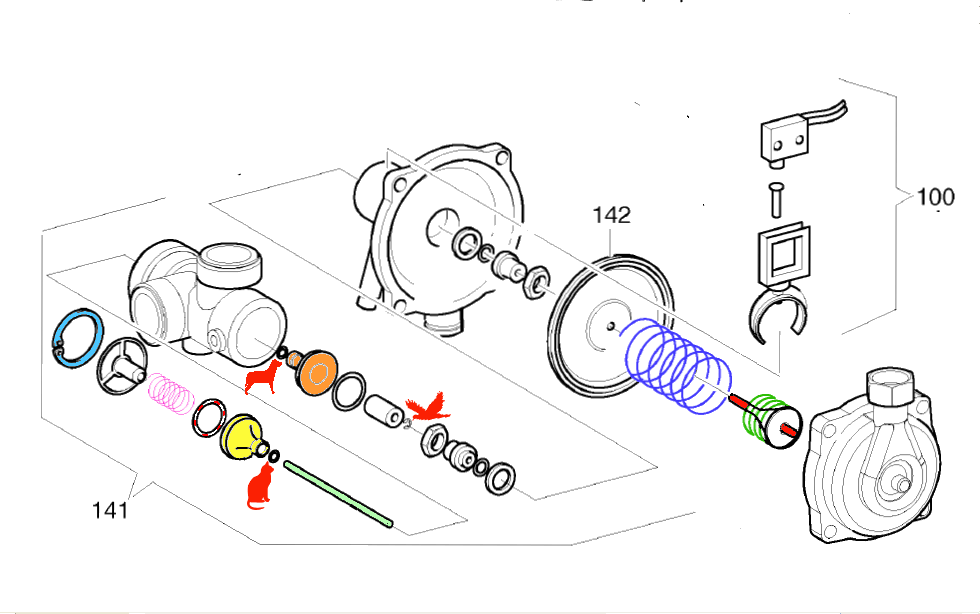
I'm afraid unlike Chris I can't point you to a diagram with salient bits coloured in. Maybe he can find one for this.

I will take you through it slowly.

First the presis

Some parts in a tube on a steel shaft move acording to hot water or heating demand to duct water through two different routes. These get stuck.

Now if you are up to it the full story.

The diaphragm part has a spring which hoilds it in heating mode, running water past the diaphragm has to force the steel pin back using the diapragm against a strong spring. This allows a small join between this section's pin and the other section's pin to line up with the flow switch protrusion so instructing the boiler that the hydrolic conditions are set and the boiler fires for hot water.

However the other section is not pulled across by the diapragm as it's pin is not connected to the water section pin, it is just meant to follow it. If it doesn't followyou are non the wiser because the absense of it still allows the microswitch to sink deeper and so fire the boiler. The mnotive force to move this pin and more importantly the two half cones which duct the water path is another spring at the end of that part. So it is at rest in the heating position and must be forced into the hot water position by a spring. Dirty system water and maybve age of this spring conspire together and the critter gets stuck, in the first place partially but eventually alltogether.

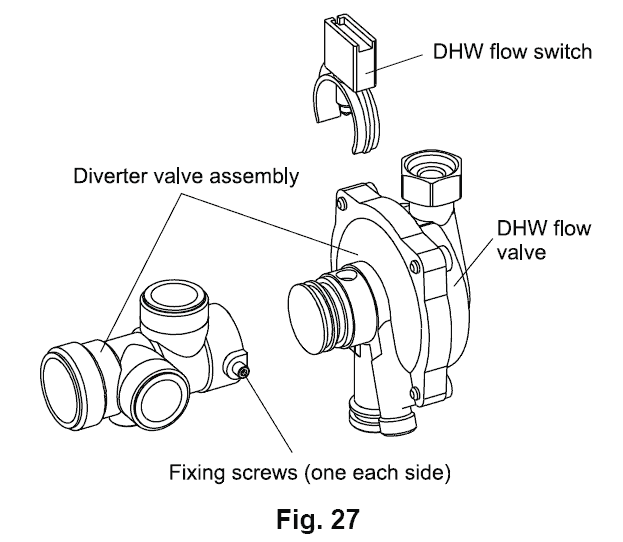
If you split the diverter valve in the middle using an allen key on the two grubscrews in the neck you can get the pin out with one of the cone shaped bits in toe. clean the housing inside the pin and renew the o ring on the cone piece. Though it is the other cone piece which is causing the problem, cleaning and lubricating with silicon grease the pin in your hand might be sufficient to fix things. Your problem is the second half which you haven't got at but the only place it gets stuck is where it slides on this pin. If you want to remove it you have to go into the other end with circlip pliers, catch all the bits as they spring out like zeberdee. Clean and lubricate, new o ring. The critical o ring is the small one which interfaces with the pin, the large one is just there as a seat to seal against a large hole, if you didn't change it you wouldn't notice. Your problem is the lack of movement along the pin under spring power alone.

In all honesty just doing the pin and the first cone piece would in 99% of cases be all that's needed.

It is not easy for ana mateur to get this diverter valve off as I pointed out previously..
 
Just realised yiu're in Sheffield as tronghold of Alpha engineers, if you want to bottle out phone Alpha and ask for their service agent to come over.
 
Agile said:
eccoboy said:
Flow rate is 9 litres per min
Cold water temperature is 10c
Hottest water running at 9 litres per min is just 39c

Cheers Ben

Hang on folks, you have all read this and then gone on to suggest other faults!

A 24 kW boiler can heat 9.3 litres/minute through 35° C.

He has 9 li/min raised 39°C.

In my view this boiler is performing exactly as it should do !

I had exactly the same complaint from a customer today. Its all because the incomming water is colder than it used to be.

Tony

Have you been on the wine again Tony :roll:
 
Blimey Paul, you must have an RSA typing qualification !! Thanks very much for the help and expertise from you all.

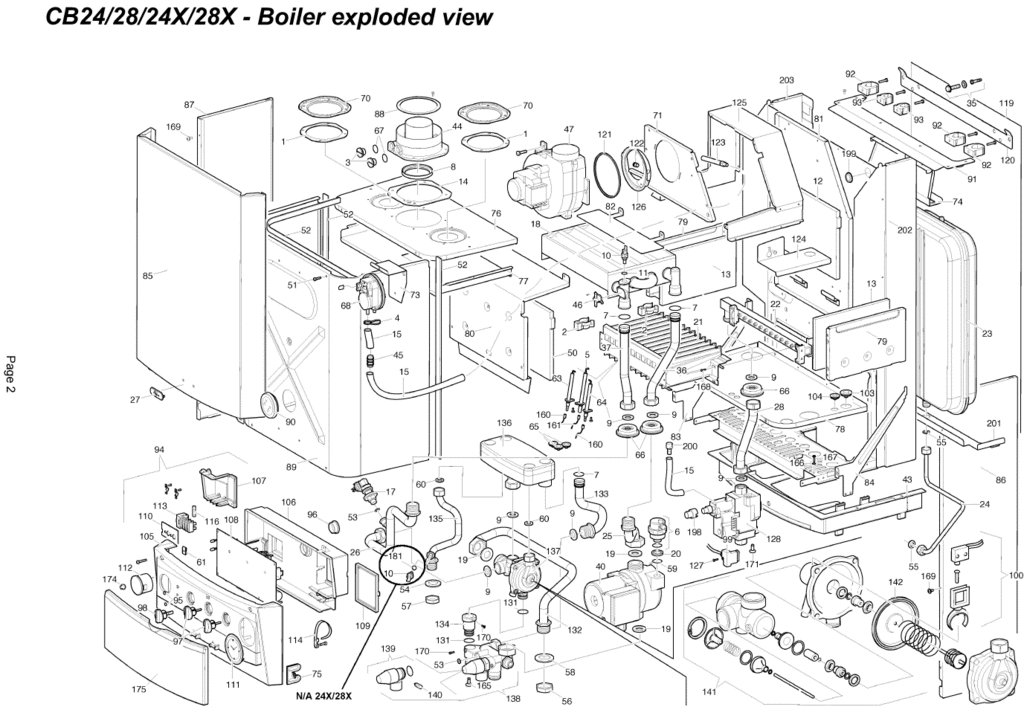
Right then down to business, I've managed to salvage an old exploded diagram of the CB24 boiler, which is complicated but it does help.

Can someone tell me if I have this right in my head before I start work?
1 Turn off water supply, drain pressure off using valve on front of boiler (that's what I did when replacing the thermistors previously)
2 Remove the two grub screws located at the front and rear with allen key
3 Unbolt each of the pipes that are connected to that section of the valve, one to the front, one that goes up to the heat exchanger and the one on the end of the valve (left when looking directly at the boiler)
4 Remove the pin and then clean and grease accordingly
5 The reassemble in reverse order?
6 Turn on water supply, re-pressurize system with filling loop

Is this right or have I missed anything out / misunderstood ?

Cheers BB
[/img]
 
Eccoboy - you need the manual, which I believe is on the Alpha site. Squeek if not.
Paul - something of a master opus. Part numbers for the seal sets would be handy.
I'm puzzled exactly where the awkward no 1 phillips screw is - I must have had it easy because I don't remember it. Does it show on the exploded parts diagram?
Couple of pics which might be handy: (click pic and resulting pic)


If the heating pipe is getting hot during the DHW delivery then the manifold part of the diverter valve is not following the diaphragm section under the action of the spring.

However it is only a maximum of 17% of heat being lost.

Rather than dismantling the diverter I would either replace the whole part or clean the boiler and diverter chemically. If the diverter is not moving fully then there are probably considerable deposits within the boiler and cleaning them will be good.

I would use one dosage of sulphamic followed by two doses of citric.

A few weeks ago I had to do chemical treatment on a Protherm because it was in a cupboard and I could not remove the diverter. It needed a few goes but worked in the end.

Tony
 
Are you sure it isn't only heating the CH pipe AFTER the HW call has finished? That would be normal.

To see the possible benefit of stopping any "leak" to CH during HW, run the HW with the CH flow valve shut. Paul may advise that it will leak for a while afterwards, but they usually stop after a day or so.
 
ChrisR said:
Part numbers for the seal sets would be handy.
I'm puzzled exactly where the awkward no 1 phillips screw is

I'm afraid that I don't have the part no. because we just change the diverter valve as Tony says, but Mike in Sales will know. We do have humungous seal kits which fit everything for £27 plus vat. Something like that.

The awkward screw is retaining the o ring sealed push in part at the bottom of the right hand dhw section where it joins the other manifold to the right of it. Can you make sense of that? You get new screws with the water section seal kit (27 as above) The official thing to do if it breaks off is to fit a new manifold aswell (something like £42 plus vat). Invariably you have to hacksaw a flat in it anyway on an older boiler. On my last training day there was an engineer who said he drills it out and taps a new thread for a larger sized grubscrew, but the Alpha in house man said don't do that we as the water pressure could blow the part off and cause a damage claim. For a non Alpha job I'm sure it is a worthwhile solution for someone with engineering abilities.

In all honesty cleaning the pins lubricating with silicon grease, replacing two very small O rings would get it moving again.
 

If you need to find a tradesperson to get your job done, please try our local search below, or if you are doing it yourself you can find suppliers local to you.

Select the supplier or trade you require, enter your location to begin your search.


Are you a trade or supplier? You can create your listing free at DIYnot Local

 
Back
Top