
A homeowner with a front room controlled by a two-way switching setup – four wall lights and two ceiling lights – wants to swap one of the standard switches for a double dimmer. The dimmer has three terminals marked L1, C, and L2, and there are extra cables in the back box because the lighting circuit loops through the switch position. The old switch has already been disconnected, and no note was made of which wire went where.
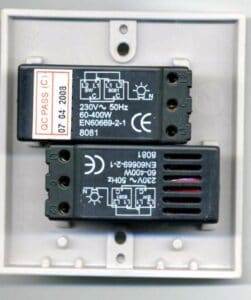
This is one I see fairly regularly, and it trips people up more than it should – mostly because the terminal labels on dimmers don’t always match what’s on the old plate switch, and once the wires are out, it’s easy to lose track of what went where. Let me walk you through what’s actually going on behind that switch plate, because once you understand the principle, the wiring falls into place.
What’s actually happening in that back box
A two-way switching circuit uses three wires (plus earth) running between two switch positions. One switch has the permanent live feed in, and the switched live going out to the light. The other switch just has the three “strapper” wires linking the two switches together. The terminal marked COM (or C on your dimmer) is the common terminal – it’s the pivot point. Depending on the position of the rocker or dimmer knob, COM gets connected internally to either L1 or L2. That’s all a two-way switch does – flips the connection between two paths.
Now, when you’ve got a “loop” at the switch – meaning the mains supply cable loops in and out of the back box on its way around the lighting circuit – you’ll see extra cables that aren’t part of the switching at all. The neutrals and earths from that loop will be joined together in a connector block tucked into the back box. They don’t connect to the switch terminals. They stay exactly where they are. If they were in a connector block before, they go back in a connector block. Don’t touch them. The only wires that connect to the switch terminals are the ones involved in the actual switching function – live feed, switched live, and the strappers to the other switch position.
Checks before you start
- Photograph everything first. Before you disconnect a single wire, take a clear photo of the existing switch with wires attached. If you’ve already pulled them out without doing this, you’ll need to work it out from scratch – which is doable, but slower.
- Identify your cables. Look at how many cables come into the back box. You might have two twin-and-earth (for a simple two-way setup with loop) or a three-core-and-earth (for the strappers between switches). The three-core is your link to the other switch position. The twin-and-earths will be your supply loop and possibly your switched live up to the light.
- Check your lamp types. Not all lights are dimmable. Standard incandescent and halogen bulbs are fine. LED bulbs need to be specifically marked as dimmable, and your dimmer needs to be rated for LED loads – the minimum load matters as much as the maximum. If you’ve got six low-wattage LEDs, you might be below the dimmer’s minimum, and they’ll flicker or not work at all.
- Check the dimmer’s wattage rating. Add up the total wattage of all the bulbs on that gang of the dimmer. A typical dimmer handles 400W for incandescent, but if it says “trailing edge” or “LED dimmer,” the rating will be much lower – sometimes 100W or 150W. That’s usually enough for LEDs, but check.
- Confirm two-way vs one-way. Your dimmer must be rated for two-way use. Most modern dimmers with L1, C, and L2 terminals are two-way compatible, but a cheap one-way dimmer will only have two terminals and won’t work in a two-way circuit.
The proper way to wire it
The principle is straightforward: whatever was connected to COM on the old switch goes to C on the dimmer. Whatever was on L1 goes to L1. Whatever was on L2 goes to L2. Like for like. The labels might vary between manufacturers – some older switches use L1, L2, and L3 instead of COM, L1, and L2 – but the layout on the back of the switch plate or dimmer will show you which terminal is the common.
If you’ve lost track of which wire was where, you’ll need to work it out:
- The permanent live feed (from the supply loop) will show voltage to earth with a tester when the circuit is on. That’s your feed into COM on the switch that has the supply.
- The strappers – usually in a three-core-and-earth cable – connect L1 to L1 and L2 to L2 between the two switches. The common wire of that three-core goes to COM at each end.
- If there are two wires doubled up in one terminal (say, the supply live and the common strapper both in COM), that’s normal. They share the terminal because they both need to be on the common connection.
If you’re not confident identifying which wire is the permanent live versus the strappers, isolate the circuit at the consumer unit and use a continuity tester to trace the cables back. Or get an electrician to sort it – there’s no shame in that, especially if the previous wiring wasn’t done to convention.
Bodges and mistakes to avoid
- Don’t assume wire colour tells you function. In older installations especially, you might find red used for everything, or colours that don’t follow any convention. The only reliable method is tracing or testing.
- Don’t force the loop neutrals into a switch terminal. The neutrals joined in the back box are not part of the switch circuit. Connecting them to a terminal will cause a short or a fault.
- Don’t ignore the earth. The dimmer’s metal mounting plate needs to be earthed. There should be an earth terminal on the plate or the back box – make sure all earths are connected and the dimmer plate is included.
- Don’t mix dimmable and non-dimmable bulbs on the same circuit. You’ll get flickering, buzzing, or bulbs that won’t turn off fully.
When to call an electrician
If you’ve pulled the wires out and genuinely can’t work out what goes where, get a spark in. It’s a quick job for someone with a meter and experience – probably half an hour. It’s not worth guessing and risking a short or a fault that could damage the dimmer or, worse, create a fire risk behind the plate.
If your setup involves anything beyond a straightforward two-way switch swap – say you want to add dimming at both switch positions, or you’re changing from a one-way to a two-way arrangement – that’s a job where the circuit needs altering, and it should be done by someone who knows what they’re doing. Same goes if the back box is crammed, the cables are old and brittle, or you spot any signs of overheating on the existing terminals.
Reality check
This is genuinely a twenty-minute job if you’ve noted the existing wiring before disconnecting it. Without that note, it becomes a diagnostic exercise. The lesson for next time: always photograph the old switch with wires connected before you touch anything. A dimmer swap on a two-way circuit is well within DIY territory for someone who’s comfortable with safe isolation and basic testing, but if you’re unsure at any point, isolate and call someone in. Electricity doesn’t give you a second chance to get it wrong.