
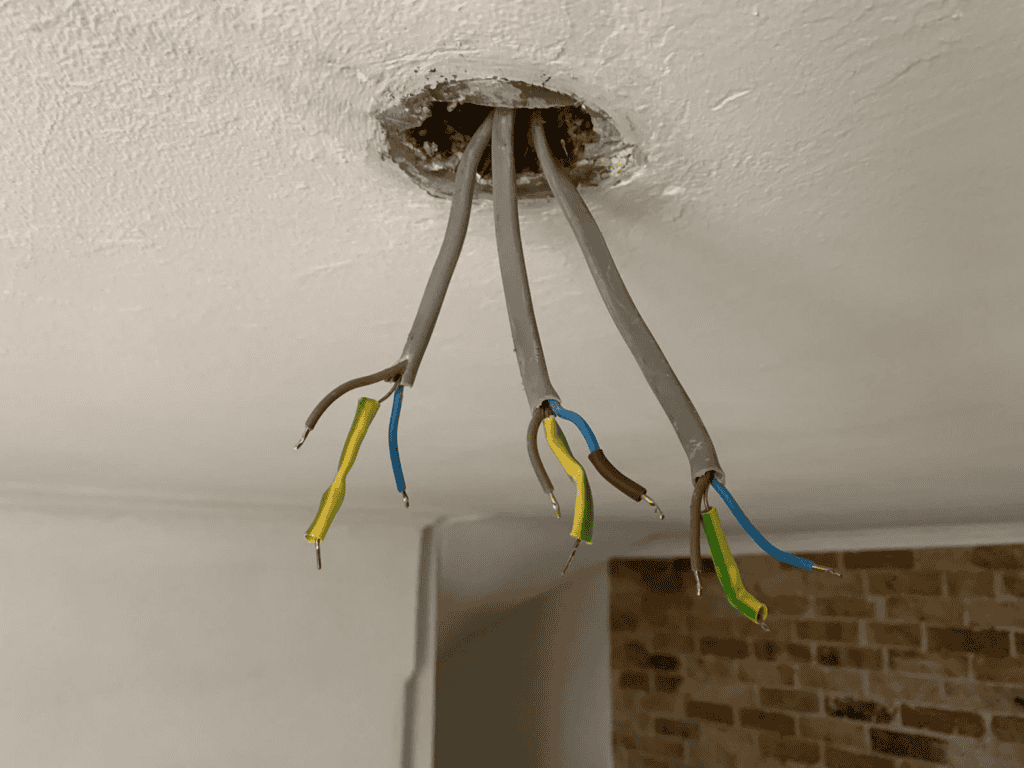
You’ve taken down an old pendant light and found three cables dangling from the ceiling rose, each with its own brown, blue, and green-and-yellow wire. It looks like a mess. You were expecting two wires, maybe three at a push, and now there are nine conductors staring back at you. One of the blue wires even has a bit of brown sleeving on it, which makes the whole thing even more confusing. So what’s going on and can you safely wire up your new light fitting yourself?
Understanding What Those Three Cables Are Doing
First off, don’t panic. Three cables at a ceiling point is completely normal in UK domestic lighting circuits. It doesn’t mean anything’s gone wrong or been bodged. What you’re looking at is a loop-in arrangement, and it’s the standard way lighting circuits have been wired in this country for decades.
Here’s the logic. One cable is bringing power in from the consumer unit (or from the previous light on the circuit). That’s your feed. The second cable is taking power out to the next light on the circuit. That’s your loop. The third cable goes down to your light switch on the wall. That’s your switch drop and it’s the one that matters most when you’re wiring up a new fitting.
In a loop-in setup, the ceiling rose (or junction point) acts as a distribution hub. The live feed comes in, gets sent on to the next light, and also gets sent down to the switch via the switch cable. When you flick the switch on, it sends a live signal back up one of the cores in that switch cable, which then powers the lamp.
Identifying the Switch Cable
This is the critical bit, and it’s where a lot of DIYers come unstuck. The switch cable will have three cores like the others – brown, blue, and green-and-yellow. But in this case, the blue wire isn’t being used as a neutral. It’s being used as a switched live, carrying current back from the switch to the light. That’s why you might see brown sleeving on it – that’s an electrician’s way of marking a blue wire that’s being used as live. If you don’t see any sleeving, mark it yourself before you disconnect anything. Use tape, a bit of Tippex, a permanent marker – anything. If that sleeving slips off and you forget which cable it was, you’re back to square one.
If there’s no obvious marking, you’ll need a multimeter to identify the switch cable. Set it to resistance (the Ω symbol), make sure the power is off at the consumer unit, then test between the brown and blue of each cable in turn. Two of the cables will show a low resistance reading – those are the feed and loop cables, connected through to other parts of the circuit. The third should show open circuit (or very high resistance) when the switch is off, and low resistance when someone flicks the switch on. That’s your switch drop.
A word of caution here: when you’re testing, make absolutely sure the resistance reading changes when the switch is operated. Two of the three cables may show low resistance because they’re connected through to light fittings further along the circuit. You need to confirm the reading comes and goes with the switch. Get someone to stand by the switch for you – it’s much easier with two people.
How to Wire It Up
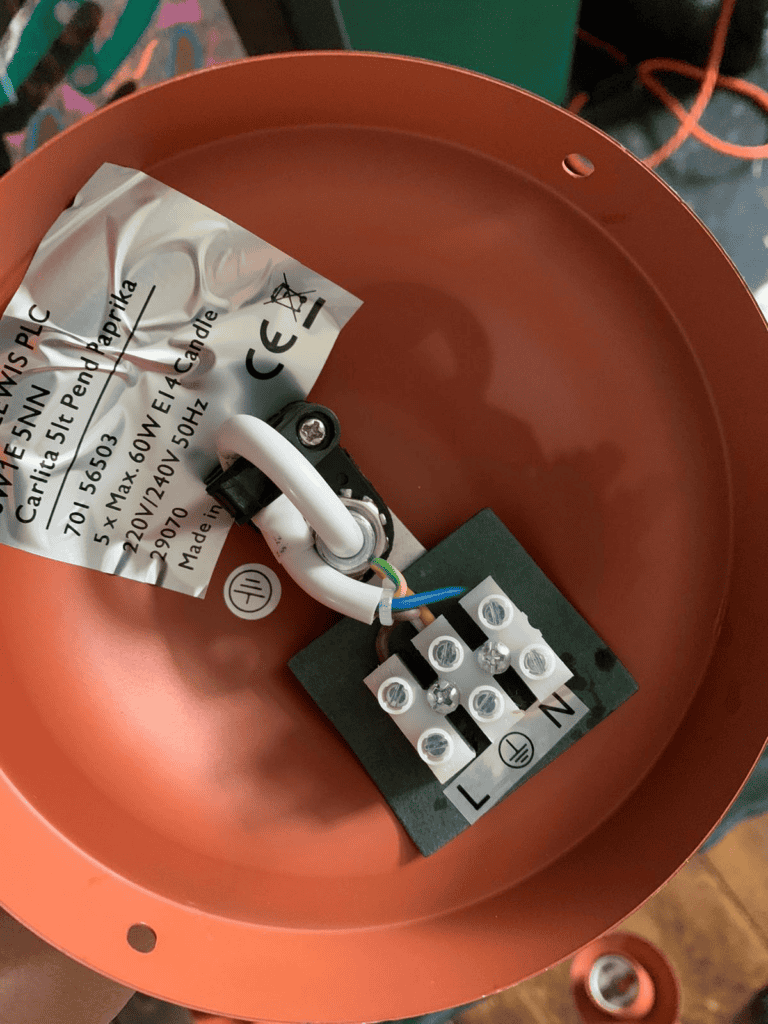
Once you’ve identified the switch cable, the wiring follows a clear pattern. If your new light fitting has its own terminal block with Live (L), Neutral (N), and Earth (E) connections, here’s the approach:
The three brown (live) wires from all three cables get joined together in a separate connector – a 5-amp connector block or a suitable Wago lever connector tucked neatly behind the fitting or inside the ceiling rose backplate. These browns stay permanently live and do not go into the fitting itself.
The two blue (neutral) wires – from the feed and loop cables only – go into the Neutral (N) terminal of your fitting. Do not include the blue wire from the switch cable here.
The blue wire with the brown sleeving – from the switch cable – goes into the Live (L) terminal of your fitting. This is your switched live, the one that actually turns the light on and off.
All three green-and-yellow earth wires go into the Earth (E) terminal. If your fitting is metal, earthing is essential. Even on a plastic fitting, connect the earths properly and leave them accessible.
Good, Better, Best
A straightforward swap where the old fitting had a proper ceiling rose with labelled terminals is the simplest scenario. You note which wires went where before disconnecting the old one, and replicate the arrangement on the new fitting. That’s the good approach, it works, and it’s how most people manage it.
Better is taking the time to identify the switch cable independently, even if you think you know which one it is. Test it. Mark it. Don’t rely on old labels or someone else’s memory. If you trip a breaker while experimenting, you may have shorted something and could damage the switch, I’ve seen people fry a switch internally by connecting wires across live and neutral, leaving the light permanently on.
Best is getting a basic multimeter, you can pick one up for under a tenner and learning to use the continuity and resistance settings. It’s a tool that’ll pay for itself on the first job. Once you can identify cables with confidence, ceiling light swaps become routine rather than stressful.
When to Call a Spark
If none of the cables are marked, you don’t have a meter, and you’re not confident about what goes where – stop. There’s no shame in calling an electrician for this. It’s a small job for them and shouldn’t cost much. What you definitely don’t want to do is start swapping wires around with the power on, or guessing which blue is the switched live. Getting it wrong won’t just blow a fuse, it can damage other fittings on the circuit, fry your switch, or in the worst case create a shock hazard.
Also keep an eye on the condition of the cables while you’re up there. If you see bare copper earth wires without green-and-yellow sleeving, they need sleeving. If there’s exposed copper poking out beyond the terminal screws, trim back and re-strip properly. Neatness isn’t just about aesthetics at a ceiling point, it’s safety.
Three cables at the ceiling is bread and butter for domestic electrics in the UK. Once you understand what each cable does, it makes perfect sense. Take your time, identify the switch cable properly, and connect with care.