
Just bought your first house, the survey flags the electrics as at least 20 years old, and the fuse box is a wooden-backed unit with only a handful of circuits and no obvious RCD protection. The property has been rented out for years, you’ve got a tight budget after the purchase, and you’re trying to work out whether a new consumer unit will do the job for now, or whether the whole place needs ripping out and rewiring. Sensible question, and the right one to ask before you start painting walls.
This is a common one in UK houses, especially ex-rentals that have had bits added over the years. Before you spend money, you want to know what you’re actually dealing with: the board itself, the cables behind it, the earthing arrangement, and the incoming service. I’ll run through what’s likely going on, what can be checked, and what a proper fix looks like.
What’s likely going on
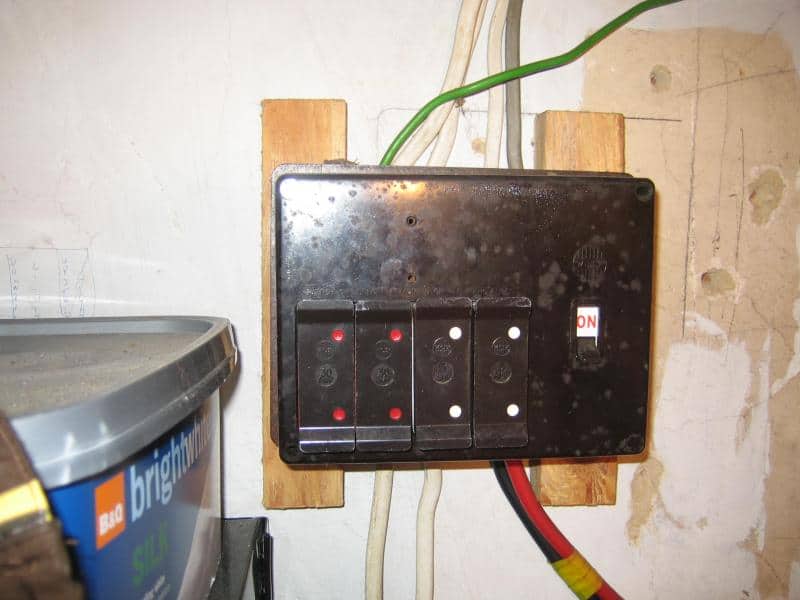
A wooden-backed board with rewireable fuses and only four ways is from a different era. Back then, houses had a fraction of the load we throw at them now. No dishwashers, tumble dryers, microwaves, multiple TVs, chargers, electric showers and so on. The board itself isn’t necessarily dangerous just because it’s old, but a few things tend to travel together:
- No RCD protection, so no quick disconnection if someone puts a nail through a cable or a faulty appliance goes live.
- Undersized main earth conductor and meter tails compared with what’s required today.
- Missing or undersized main protective bonding to the gas and water services.
- A mix of cable types and ages because circuits have been added piecemeal.
- Possible DIY additions: spurs off spurs, junction boxes buried in walls, that kind of thing.
The cables visible at the board may look like modern PVC twin and earth, but what you can see at the board tells you very little about what’s happening under the floors and in the walls. Nine times out of ten, an old board hides a few surprises behind it.
Simple checks first
You can do a walk-round yourself before you get a sparky in. None of this needs you to open anything up, just look and note.
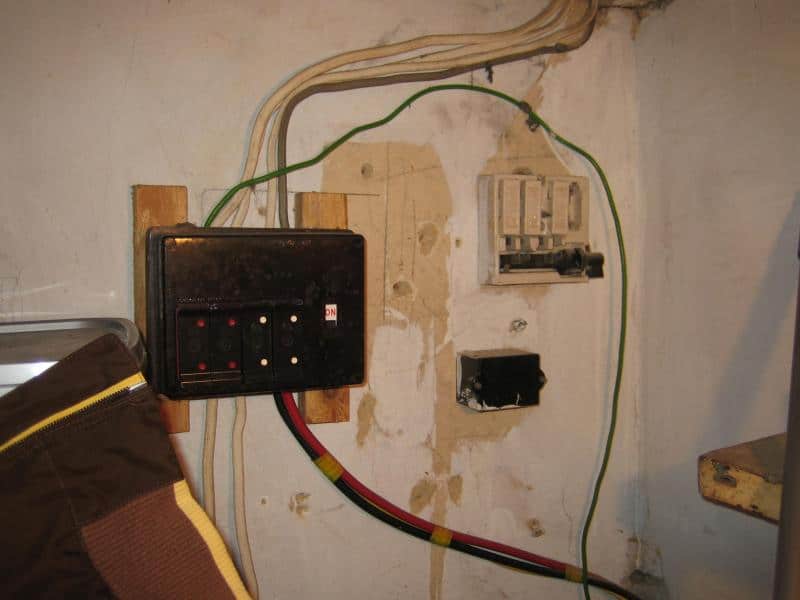
- Count the circuits at the board. Four ways for a whole house is light. A modern small house typically wants separate circuits for upstairs sockets, downstairs sockets, kitchen, upstairs lights, downstairs lights, cooker, immersion, boiler. If everything’s lumped onto a handful of fuses, circuits are likely overloaded or shared.
- Look for RCD protection. If there’s no test button anywhere on the board, there’s no RCD. That’s a big one for safety on sockets and anything taken outdoors.
- Check the main earth and meter tails. The thick cables going to and from the meter should look chunky and modern. Thin, cloth-covered or undersized conductors are a flag.
- Look for bonding clamps on the gas and water pipes where they enter the house, close to the meter and stop-tap. A green/yellow cable with a labelled clamp, “Safety Electrical Connection Do Not Remove”, should run back towards the consumer unit area. Missing clamps means bonding is likely absent.
- Walk the house and look at sockets and switches. Round-pin sockets, brown bakelite fittings, or cloth-covered flex coming out of anywhere = old wiring still in use. Cracked faceplates, scorch marks or warm switches = stop using and get it looked at.
- Lift a socket faceplate or two (power off at the main switch first, and only if you’re confident) and look at the cable. Rubber insulation that’s gone hard, or black rubbery cable, is a rewire job. Modern PVC twin and earth in reasonable nick is a much better starting point.
- Ask the seller or agent for paperwork. As a rental, it should have had an Electrical Installation Condition Report (EICR) within the last five years. If they can produce it, that tells you a lot for free.
The result of these checks tells you whether you’re looking at a tired but salvageable installation, or whether the bones of it are past it.
The proper fix: good, better, best
Don’t guess, prove it. Before committing to either route, get a qualified electrician in to carry out an EICR (sometimes still called a PIR by older sparks). They’ll test insulation resistance, earth fault loop impedance, polarity and continuity on every circuit, and give you a written report with coded faults. That report is the single most useful thing you can buy at this stage. Usually a couple of hundred quid, and many electricians will knock it off the price of any remedial work if you go ahead with them.
Good, the staged approach. If the EICR comes back saying the circuits themselves are basically sound but the board, earthing and bonding are not, you can do the headline job now and live with the rest: new 18th-edition consumer unit with RCD/RCBO protection, upgraded meter tails, properly sized main earth, and main protective bonding to gas and water. That gives you a safe, modern heart to the system. You can then upgrade circuits one at a time as you redecorate room by room. This suits a first-time buyer budget and gets you the biggest safety win for the least money.
Better, board plus targeted rewiring. Same as above, but you also rewire the circuits the EICR flags as borderline, plus the kitchen (which always wants its own dedicated circuits these days). Kitchens tend to be the highest-load area and the most likely to have been bodged over the years.
Best, full rewire now, while the house is empty. If the EICR comes back with multiple C1/C2 codes, rubber-insulated cable, or evidence of widespread DIY, bite the bullet. There genuinely isn’t a better time than before you move in. Floorboards come up easily, you don’t care about the existing decor, and you can put sockets and switches where you actually want them rather than where someone in 1975 thought they should go. A full rewire on a small terrace is disruptive but not the end of the world, and you’ll never have to think about it again.
The order of trades matters here. Electrics, plumbing and any structural work go in before plaster, flooring and decoration. Get that wrong and you’ll be chasing cables through fresh wallpaper, never a good day.
Bodges and mistakes to avoid
- Free electrical checks from utility companies or flyers through the door. They’re a sales lead, not a proper inspection. Pay for a proper EICR from an independent registered electrician.
- Just slapping a new consumer unit on old, untested wiring. A new board won’t fix dodgy cables, it’ll just trip every five minutes once the RCDs see the leakage that the old fuses were happily ignoring. The circuits have to be tested first.
- Adding spurs off spurs, or daisy-chaining extension leads as a permanent fix because there aren’t enough sockets. That’s how kitchens catch fire.
- Decorating first, electrics later. Chasing walls through new plaster and lifting newly laid flooring is heartbreaking and expensive.
- Assuming “it worked for the tenants so it must be fine.” Old installations work right up until they don’t.
When to bring in a specialist
All of it, frankly. Consumer unit changes are notifiable work under Part P of the Building Regulations in England and Wales, and have to be done by a registered electrician (or signed off by Building Control). Same for new circuits. You can change a like-for-like socket or light fitting yourself if you’re confident with safe isolation, but the board, the tails, the earthing and any rewiring are sparky territory. If you see scorch marks, smell hot plastic, or get tingles off taps or appliances, turn it off at the main switch and get someone out the same day.
Reality check
A board swap with bonding and tail upgrade is typically a one-day job and you’ll be without power for most of it. Plan for that, especially if you’ve got a freezer. A full rewire on a small house is more like a week to ten days of mess, with floorboards up, chases cut in walls, and patch plastering to follow. Budget for the making-good as well as the electrics themselves: plasterer, decorator, maybe a bit of carpentry. If it were my house and the EICR came back rough, I’d do the rewire now while it’s empty, get the gas safety check done at the same time, and move in to a place I trusted. The prep is what makes it last.