http://www.diynot.com/forums/electrics/problem-with-dimmable-switch-halogen-lights.297058/
Just a bit of a coincidence,
Just a bit of a coincidence,

Ah, I see. However, as you will understand, my comments related to what I'd been reading in this thread, not that other one which I hadn't even seenhttp://www.diynot.com/forums/electrics/problem-with-dimmable-switch-halogen-lights.297058/
Just a bit of a coincidence,

Is anyone seriously thinking/suggesting that it makes a blind bit of difference which 'way around' an ordinary '1-way' switch (SPST) is wired?
Not necessarily. Depending on the wiring method being used for the 2-way you might want the supply live in the common or in L1 or L2. As it makes no difference which way round the 1-way is connected, it's sometimes a case of doing whatever is easiest to strap across the two switches depending upon the physical arrangements of the terminals (e.g. commons at the top and L1/L2 at the bottom versus one switch having the terminals inverted relative to the other).If there were a two-gang switch on which one of the circuits was one-way and one two-way surely you would put both of the supply lives in the Common terminals.
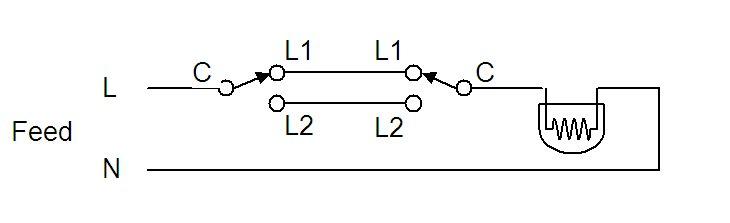
Are they? Think about what happens when you connect L1 & L2 of one switch to L1 & L2 of another in the conventional 2-way arrangement: At one switch you have the live feed on the common and L1/L2 are live out, while at the other switch L1/L2 are live in and the common is live out to the light. Change to the alternate wiring method and which terminals are live feeds to the switch and which are live outputs depends entirely upon which way round the switches are set and changes as the switches are moved.but L1 and L2 terminals are live out terminals!
C or common was used as the common link from switch to switch in 2 way 3 wire circuits as confirmed by that mk wiring diagram,
Change to the alternate wiring method and which terminals are live feeds to the switch and which are live outputs depends entirely upon which way round the switches are set and changes as the switches are moved.
As John says, the terminals are really only marked because it's more convenient to use the same moldings for both 1-way and 2-way types. .
Exactly - you just beat me to that analogy. I was 'brought up' on N-way rotary switches, and the 'rotor' terminal was always called "common" - and I presume that's how the term came to be used with 2-way light switches - i.e. a term relating to the construction/function of the switch, not anything to do with what circuitry was connected."Common" has nothing to do directly with how the circuit itself is wired; it refers only to the fact that the terminal so marked is the one which can be connected to either one of the other terminals depending upon the position of the switch. Something like a 10-way rotary switch also has a common terminal - The one which can be connected to any one of the ten other terminals depending upon the switch position. Whether there are ten separate feeds which can be connected to provide an output on the common terminal or whether there's a feed to the common which can provide an output on any one of the ten other terminals depends entirely upon the application at hand.
) in which the terminals are labelled 'Common', 'Load 1' and 'Load 2' - so I just wonder whether that might possibly have been how 'L1' and 'L2' originated?No they dont unless theres an intermediate switch
Rubish up until recently mk logic one way was totally different to a two way and a lot of makes still are.
Paul is essentially right, and it's irrelevant whether or not there is an intermediate switch .....No they dont unless theres an intermediate switchChange to the alternate wiring method and which terminals are live feeds to the switch and which are live outputs depends entirely upon which way round the switches are set and changes as the switches are moved.
Precisely. I too was brought up on multi-way rotary switches and it seems such a simple concept that perhaps that's why I can't see why there seems to be so much misunderstanding about what "Common" on a simple 2-way light switch means.Exactly - you just beat me to that analogy. I was 'brought up' on N-way rotary switches, and the 'rotor' terminal was always called "common" - and I presume that's how the term came to be used with 2-way light switches - i.e. a term relating to the construction/function of the switch, not anything to do with what circuitry was connected.
Interesting, and the "Load 1" and "Load 2" markings clearly suggest what application was in the designer's mind, when the switch could just as easily be used to connect a single load to one of two different sources.Also, I'm not even sure that the 'L' of 'L1' and 'L2' originated as having anything to do with live/line. I have some old rusty cast iron changeover switches (not in service
... which is/are the 'live feeds' to the right hand switch - 'C' or L1/L2 - and which is the 'live output'??
Paul is essentially right, and it's irrelevant whether or not there is an intermediate switch .....No they dont unless theres an intermediate switchChange to the alternate wiring method and which terminals are live feeds to the switch and which are live outputs depends entirely upon which way round the switches are set and changes as the switches are moved.
... which is/are the 'live feeds' to the right hand switch - 'C' or L1/L2 - and which is the 'live output'??
Kind Regards, John

You seem to be 'wriggling'. Regardless of which method you regard as 'conventional' (today, rather than in the past), and regardless of anything that Paul said ... just answer my previous question, namely:sorry john Thats the conventional way
Either L1 or L2 will be live regardless of switching and the other terminal will always be the switch live
... which is/are the 'live feeds' to the right hand switch - 'C' or L1/L2 - and which is the 'live output'??
Are they? Think about what happens when you connect L1 & L2 of one switch to L1 & L2 of another in the conventional 2-way arrangement: At one switch you have the live feed on the common and L1/L2 are live out, while at the other switch L1/L2 are live in and the common is live out to the light. Change to the alternate wiring method and which terminals are live feeds to the switch and which are live outputs depends entirely upon which way round the switches are set and changes as the switches are moved.


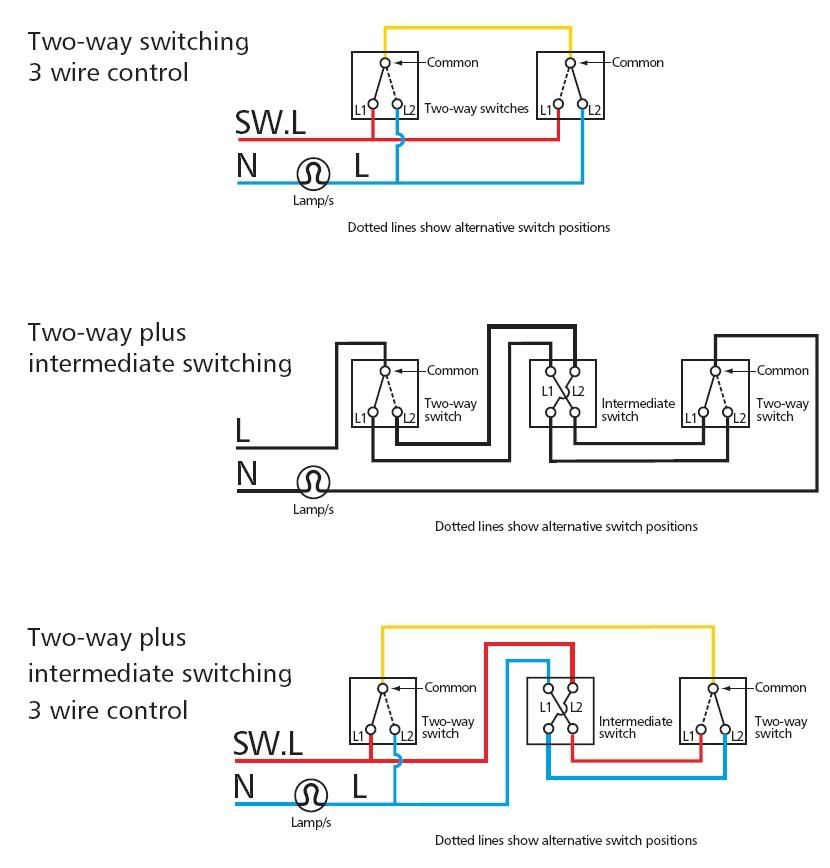
In what way do you underestimate me?Better still, show me a drawing that relates to the alternate wiring method paulc refers to above
Thats a nice drawing of what paulc refers to as the conventional wiring as he has described, im not disputing that, L1, L2 output does alter with switch status.
If you agree and think paulc is right then ive underestimated you john
You slipped this bit in whilst I was drawing/typing!In the bottom diagram, please explain how if the intermediate was removed, L2 could possibly change from being live to a switchlive, regardless of the switch positions

If you need to find a tradesperson to get your job done, please try our local search below, or if you are doing it yourself you can find suppliers local to you.
Select the supplier or trade you require, enter your location to begin your search.
Are you a trade or supplier? You can create your listing free at DIYnot Local