That's exactly the point. It doesn't matter to 50160 what happens within a 10 minute period, as long as it averages out within the limits.

You are using an out of date browser. It may not display this or other websites correctly.
You should upgrade or use an alternative browser.
You should upgrade or use an alternative browser.
Voltage Complaint
- Thread starter Iggifer
- Start date
I obviously realise that. It's the 'statistically unlikely' statement you mentioned that I have been talking about - as I said, without knowledge of the distribution of voltages within a 10-min period, one simply cannot draw such a conclusion. As you will understand, I could very easily produce a 10-minute set of voltages (say every 10 seconds, or whatever) which had an average of 230V, but which would indicate that it was 'statistically very likely' that some individual measurements would be pretty extreme (way outside of the limits for 10-min averages).That's exactly the point. It doesn't matter to 50160 what happens within a 10 minute period, as long as it averages out within the limits.
Kind Regards, John
Of course. I was merely pointing out what the standard states.
Form the Object of 50160: "These characteristics are subject to variations during the normal operation of a supply system due to
changes of load, disturbances generated by certain equipment and the occurrence of faults which are
mainly caused by external events.
The characteristics vary in a manner which is random in time, with reference to any specific supply
terminal, and random in location, with reference to any given instant of time. Because of these variations,
the values given in this standard for the characteristics can be expected to be exceeded on a small
number of occasions.
Some of the phenomena affecting the voltage are particularly unpredictable, which make it very difficult to
give useful definite values for the corresponding characteristics. The values given in this standard for the
voltage characteristics associated with such phenomena, e.g. voltage dips and voltage interruptions, shall
be interpreted accordingly."
From Note 1 to 4.2.2.1 of 50160: "The actual power consumption required by individual network users is not fully predictable, in terms of
amount and of contemporaneity. As a consequence, networks are generally designed on a probabilistic basis."
Form the Object of 50160: "These characteristics are subject to variations during the normal operation of a supply system due to
changes of load, disturbances generated by certain equipment and the occurrence of faults which are
mainly caused by external events.
The characteristics vary in a manner which is random in time, with reference to any specific supply
terminal, and random in location, with reference to any given instant of time. Because of these variations,
the values given in this standard for the characteristics can be expected to be exceeded on a small
number of occasions.
Some of the phenomena affecting the voltage are particularly unpredictable, which make it very difficult to
give useful definite values for the corresponding characteristics. The values given in this standard for the
voltage characteristics associated with such phenomena, e.g. voltage dips and voltage interruptions, shall
be interpreted accordingly."
From Note 1 to 4.2.2.1 of 50160: "The actual power consumption required by individual network users is not fully predictable, in terms of
amount and of contemporaneity. As a consequence, networks are generally designed on a probabilistic basis."
...The characteristics vary in a manner which is random in time, with reference to any specific supply
terminal, and random in location, with reference to any given instant of time. Because of these variations, the values given in this standard for the characteristics can be expected to be exceeded on a small number of occasions. ... Some of the phenomena affecting the voltage are particularly unpredictable, which make it very difficult to give useful definite values for the corresponding characteristics.
That's all obviously very true. In practice, with the exception of truly transient events (which are really a different issue, which needs to be addressed differently), I suppose it's very unlikely that there will be appreciable changes during any 10-minute period, so it's probably all pretty reasonable.
Ideally, the requirements of the supply would reflect the potential susceptibilities of equipment which may be connected to the supply. I'm sure there is some equipment which would suffer (if not be 'killed') by extreme voltages which existed for far less than 10 minutes (hence perhaps a 10-minute average which was 'within limits') - but I think the saving grace is that such a situation probably is very unlikely to arise (although it would be reassuring to see some data to support that view). So, all-in-all, it's probably fairly reasonable. It goes without saying that nothing that involves variability (hence 'probabilistic') is ever going to be 'guaranteed'.
Kind Regards, John

Yes the UK permitted variation is still +10/-6% but I think the stated limits are to allow for EU harmonisation where some countries are +6/-10%
To be honest to go much above about 260V there is going to be a fault on the system which will show itself in other ways.
One of our biggest issues with all this is the automatic assumtion that anything above the upper limit is dangerous and needs immediate rectification.
Particularly if you work for a large gas supplier and use a device that lights up red if the volts are over 253 and you don't actually have a lot of technical knowledge about electricity!
To be honest to go much above about 260V there is going to be a fault on the system which will show itself in other ways.
One of our biggest issues with all this is the automatic assumtion that anything above the upper limit is dangerous and needs immediate rectification.
Particularly if you work for a large gas supplier and use a device that lights up red if the volts are over 253 and you don't actually have a lot of technical knowledge about electricity!
That's what I thought - but that surely makes it a very confusing (basically just plain incorrect) 'factsheet', doesn't it? Headed 'UK Supply' it explicitly says that the limits changed from -6%/+10% to ±10% on 1st January 2003 !!Yes the UK permitted variation is still +10/-6% but I think the stated limits are to allow for EU harmonisation where some countries are +6/-10%
If a limit is stated, I suppose one can't really blame them. It's a bit like trying to argue about doing 32mph when there is a 30mph limit (not that the police would usually try that one, but it's not impossible)! If there is some higher figure at which 'the situation becomes dangerous and immediate rectification is needed, then customers should be made aware of that figure, shouldn't they?One of our biggest issues with all this is the automatic assumtion that anything above the upper limit is dangerous and needs immediate rectification.
Kind Regards, John

- Joined
- 17 Aug 2010
- Messages
- 2,888
- Reaction score
- 506
- Country

That 'factsheet' seems to be a mine of misinformation.
It includes gems such as the reason we still actually get 240V is because the generating companies make 8% more money that way, and goes on to say that an immersion heater will take 8% more power to heat up it water.
I think that the main products of the company producing the fact sheet should lead to people taking the 'facts' with a very big pinch of salt.
It seems, from internet exploration, that the 230V= +/- 10% is an EU long term goal but DECC hasn't yet announced taking it up yet.
It includes gems such as the reason we still actually get 240V is because the generating companies make 8% more money that way, and goes on to say that an immersion heater will take 8% more power to heat up it water.
I think that the main products of the company producing the fact sheet should lead to people taking the 'facts' with a very big pinch of salt.
It seems, from internet exploration, that the 230V= +/- 10% is an EU long term goal but DECC hasn't yet announced taking it up yet.
Indeed it is!That 'factsheet' seems to be a mine of misinformation.
That was my understanding, although I really don't understand what we're waiting for. AFAIAA, most/all EU countries (e.g. UK) are currently working with limits which are within the ±10% range, so all of them would be compliant with ±10%, even if it were to change tomorrow. Are there any EU countries who have a limit >10% in one or both directions?It seems, from internet exploration, that the 23= +/- 10% is an EU long term goal but DECC hasn't yet announced taking it up yet.
I can but presume that some of the countries who (like UK) currently have a limit less than 10% in one direction or the other are unhappy with that limit being increased to 10%, and that 'negotiation' is therefore required before harmonisation (of limits, not any change in the supplies) can happen.
Kind Regards, John
A while ago I was discussing supply voltages with my brother (who works for a DNO, IIRC not a million miles from Westie).
Basically, the network was designed on power flowing from power station to customer - but now there's all those embedded generator changing the current/power flows and in particular reducing the voltage drops. A simple solution would be to change the taps at substations and drop the voltage a bit - but lower voltage means a lot of equipment takes more current. More current means higher I^2R losses in the network, so there's a commercial incentive for the DNO to keep the voltage as high as possible/allowed.
I won't be holding my breath waiting for the renewables lobby to acknowledge the cost of dealing with this as having anything to do with them
One thing that's quite interesting if you have a USP is to start logging it's data. While it's not calibrated, a graph of supply voltage in interesting just to see how much it does vary with time of day/day of week. Here's a couple from work (we're in a mainly industrial part of town) - the first clearly shows the difference between weekend and working days.
The second is over a month, I keep meaning to ask my brother about week 26 - but I assume it's related to the fact that a 132kV transformer is being replaced in our local main substation.
On my graphs, I can even see the variation in current as the servers run the fans up/down in response to temperature changes !
Basically, the network was designed on power flowing from power station to customer - but now there's all those embedded generator changing the current/power flows and in particular reducing the voltage drops. A simple solution would be to change the taps at substations and drop the voltage a bit - but lower voltage means a lot of equipment takes more current. More current means higher I^2R losses in the network, so there's a commercial incentive for the DNO to keep the voltage as high as possible/allowed.
I won't be holding my breath waiting for the renewables lobby to acknowledge the cost of dealing with this as having anything to do with them
One thing that's quite interesting if you have a USP is to start logging it's data. While it's not calibrated, a graph of supply voltage in interesting just to see how much it does vary with time of day/day of week. Here's a couple from work (we're in a mainly industrial part of town) - the first clearly shows the difference between weekend and working days.
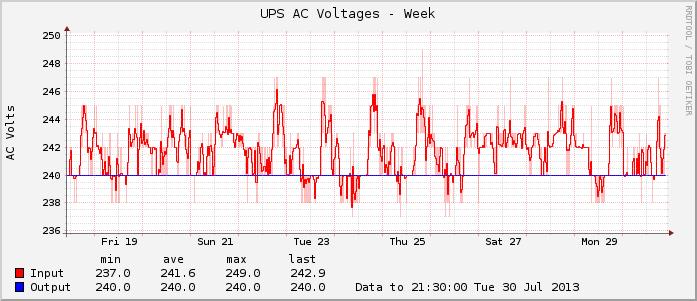
The second is over a month, I keep meaning to ask my brother about week 26 - but I assume it's related to the fact that a 132kV transformer is being replaced in our local main substation.
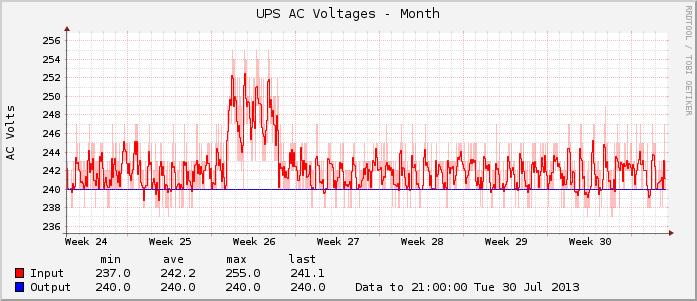
On my graphs, I can even see the variation in current as the servers run the fans up/down in response to temperature changes !
who works for a DNO, IIRC not a million miles from Westie
I will know him and he will know me! (but not by this name)
What sort of equipment did you have in mind? I can think of very few items of equipment likely to be found in domestic settings which have the ability to increase current to compensate for reduced voltage (to maintain power). Nearly all domestic loads are 'passive', such that reduced voltage will result in reduced current - although that current will obvioulsy have to flow for longer to achieve a given amount of energy (e.g. to boil a kettle).... but lower voltage means a lot of equipment takes more current.
Kind Regards, John
You mean, apart from just about every electronic item which these days is universally driven with a switched mode power supply. These effectively exhibit a negative impedance - an increase in voltage results in reduced current, and vice-versa.What sort of equipment did you have in mind? I can think of very few items of equipment likely to be found in domestic settings which have the ability to increase current to compensate for reduced voltage (to maintain power).... but lower voltage means a lot of equipment takes more current.
And CFLs, and LED lights, and incandescent lights driven by "electronic transformers", and ...
I have a suspicion that some motors (such as in fridges) might take more current with a lower voltage - but I've never tested it. They so in extreme reductions, but that's not really relevant. For a fridge compressor, I suspect the power drawn is determined by the load (temperature of evaporator and condenser) - I know when the evaporator of our freezer ices up, the compressor power drops.
So apart from cookers, kettles, electric heaters, and immersion heaters - have I missed anything ?
EDIT - My mates new hob is induction (about 4kW I think) - I bet that's got a fair old switched mode supply in it !
I should have written "... very few items of high-power equipment...". I suppose you may be right that all the switched-mode PSUs around may add up to a significant total, but I was (perhaps wrongly) not consdiering them as representing a large proportion of the load on a network.You mean, apart from just about every electronic item which these days is universally driven with a switched mode power supply.What sort of equipment did you have in mind? I can think of very few items of equipment likely to be found in domestic settings which have the ability to increase current to compensate for reduced voltage (to maintain power).
Probably nothing major - but I was thinking (as I said, perhaps wrongly) that these very 'apart-from' heat-generating appliances accounted for the lion's share of the load on the network. Does anyone know the answer?So apart from cookers, kettles, electric heaters, and immersion heaters - have I missed anything ?
Kind Regards, John

Quite wise. Given that most of them are the sort of scumbags who are happy to see extra old people die during the winter so that they can get their useless vanity projects subsidised, they aren't likely to demonstrate much sense of responsibility for any other consequences of their behaviour.I won't be holding my breath waiting for the renewables lobby to acknowledge the cost of dealing with this as having anything to do with them
Most heating loads are thermostatic, so for an individual heating load a long term voltage reduction would be expected to decrease the peak current but increase the average current. What it does on a large collection of heating loads would depend heavilly on what if any correlation there is between their switch on times.

DIYnot Local
Staff member
If you need to find a tradesperson to get your job done, please try our local search below, or if you are doing it yourself you can find suppliers local to you.
Select the supplier or trade you require, enter your location to begin your search.
Please select a service and enter a location to continue...
Are you a trade or supplier? You can create your listing free at DIYnot Local
Similar threads
- Replies
- 11
- Views
- 2K


