Any doubters out there?

Hi, all.

Good post noseal,

If you do not spill the beans to the rest of the board, I for my sins work in the insurance "Industry" historically I have been in insurance for about 14 years, I am now "freelance" having [Mis] spent my work life since 1970 as a Clerk of Works / project manager / surveyor [with a small "S2]

it is a given that between [generally] late October and early March, your "claims volume" will jump, dramatically!

Claims notified for, storm damage to roofs allowing rain water [or up here snow melt] or the formation of Ice, then thaw, Etc. including [excluded] claims for "CONDENSATION" will fill your day.

During the winter months, as above my workload can at times exceed surveying about 4 / 7 "claims" per day, and during a "Surge" [ the Insurance Industries BUZZ word for periods such as we are experiencing now]

What is of interest is that during the "exceptional" weather conditions we are experiencing today, the Jet Stream having "moved" some 500 / 700 Miles "South" the gale force winds we are all experiencing are making landfall in England, not skirting the North of Scotland. where we generally experience such winds historically on a regular basis.

I digress [as usual]

Main causes of rain water ingress are [in no particular order]
ROOFS
1/. Cement used in place of lead flashings, a particular problem around Aberdeen.
2/. Moss on roof cement tiles
3/. Nail sick slates.
4/. Failure on "older" roofs of old "horse hair felt"
5/. and last general lack of maintenance

WALLS.
1/. Degraded / Perished mortar.
2/. One brick thick solid walls [Thankfully rare in Scotland]
3/. Porous brick. where a developer or builder has used a "brick" that is not fit for purpose in an environment that is subject to a lot of rain.
4/. poor detailing of flashings.

CONDENSATION?
The one thing that is of concern to me [I have seen lots] is the "green industry" of "Loft insulation" where the installers close off the eaves vents with the "government approved, industry funded" race to insulate lofts BUT do not ensure that the loft space is adequately ensured that the cold space above the insulation is vented.

Cheers.

Ken
 
I could come up with different list for timber frame housing ref. balloon framing, western platform framing, and stucco or shiplap coverings.

Wide ranging in what way? These items were carried from the 19th C. into the mid 20th C.

The list refers to the uk.

Industrial terraced housing was a 19th C. developement, and the builders built much in ignorance of the consequences of what they were doing.
In some cases, this ignorance in detail and design carried on into the mid 20th C.

Up to pre 1914, 100,000's of houses were essentially built from pattern books first developed for early 19th C speculators.
Not all were bad, Thos Cubbit built middle class homes to a magnificent standard.


But, usually, in the face of modern building research, it was necessity and profit that carried the bad practices forward. eg. consider what Thatcher did to the Parker Morris Standards to feed her fat cat backers.

Anyhow, thats my unscholarly take on things. Hopefully, others will show me better.
 
Industrial terraced housing was a 19th C. developement, and the builders built much in ignorance of the consequences of what they were doing.
In some cases, this ignorance in detail and design carried on into the mid 20th C.

Industrial workers' housing was being criticised (and in some cases already being demolished) by the late 19th century.
But is easy to condemn these buildings while forgetting that - at the time- they would have been a big improvement on what many people had before.

Workers flocking to the towns would frequently have come from rural slums.
The new housing- even one-up-one down back-to-backs, built in brick and roofed in slate would be a big step up from much older decaying rural buildings in multiple occupation and with little or nothing in sanitary provision.

And to take just one point which seems popular on this forum - rising damp.
In the old days when coal was a few shillings or whatever per ton, working-class houses could be heated upstairs and downstairs by open coal fires. These keep the structure warm and encouraged proper ventilation, which helped to keep damp at bay, even when houses were built without dpcs. In post-War years, when people had to resort to parafin- or (even worse) electric heaters, it's no wonder these old houses became damp.

As for 'Parker Morris and his 'Homes for Today and Tomorrow', that fell foul of one of the usual economic crises which always seemed to kill off each renewed push for improved housing standards. That happened after the Sterling crises in the late '60s, and was nothing to do with Thatcher.
 
tony has hit the nail on the head.

We are now using this type of property but, in the wrong way.

At the time they were constructed and in first use, they were fit for purpose, warm[ish]

Vented, and as stated by tony the dwellings were a quantum leap better than a hovel in a farm somewhere.

Lots of properties from Georgian / Victorian and later times had coal fires in all rooms, heat and ventilation abounds, present day, all chimneys blocked, limited ventilation, CONDENSATION !

Now we have hermetically sealed windows and doors, Radiators that we are scares to use because of the costs? we now have internal sanitary provision, including baths, Showers that produce so much free water, STEAM that condensation will occur

Ken
 
I think the main thing about winter is that we make more moisture inside the house - by being it it more, and drying stuff on radiators - plus we vent less because it's too cold to have windows and doors open.

Make more moisture, don't ventilate as much, end result is increased likelihood of damp problems during winter.

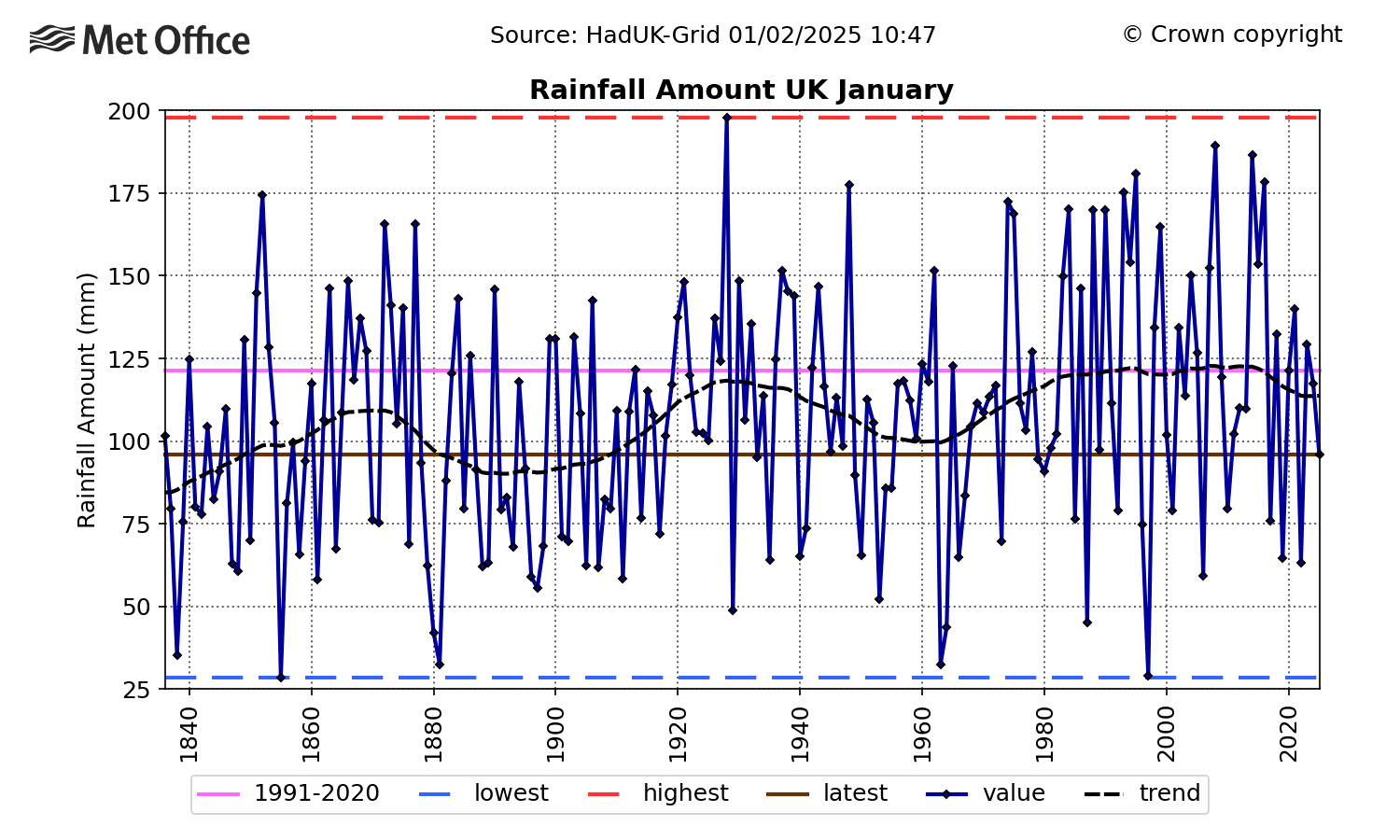
Surprisingly total rainfall in a month like August is actually not far off what it is in say January, I don't therefore think rain is a major contributor, generally.
 
Workers flocking to the towns would frequently have come from rural slums.
The new housing- even one-up-one down back-to-backs, built in brick and roofed in slate would be a big step up from much older decaying rural buildings in multiple occupation and with little or nothing in sanitary provision.
If anyone is ever in Birmingham, I can strongly recommend a visit to the National Trust back-to-back houses.


In post-War years, when people had to resort to parafin- or (even worse) electric heaters, it's no wonder these old houses became damp.
Surely it's paraffin which is worse, given the amount of water vapour produced?
 
Surely it's paraffin which is worse, given the amount of water vapour produced?

Quite; I was thinking in terms of cost but yes, parafin puts vapour into the air. Our local authority has some timber-frame houses and prohibited the use of parafin because of the potential rot problem.
 
Using Greenwich Park as an example (first one i found) according to the met office:

Average January rainfall since 1981: 41mm
Average August rainfall since 1981: 54.3mm

So quite close....
UK.gif


UK.gif
 
But my point was, that in some places in the the UK, including the most dense population center, it rains as much in August.

So saying that it was nonsense, was wrong.

Saying:
"While in certain parts of the UK, that is true, such as London, and the Midlands, the country wide average rain fall total for January and August show that rains more, on average, in January than it does in August"

Would have been a more accurate way of putting it.
 
I could come up with different list for timber frame housing ref. balloon framing, western platform framing, and stucco or shiplap coverings.

Wide ranging in what way? These items were carried from the 19th C. into the mid 20th C.

The list refers to the uk.

Industrial terraced housing was a 19th C. developement, and the builders built much in ignorance of the consequences of what they were doing.
In some cases, this ignorance in detail and design carried on into the mid 20th C.

Up to pre 1914, 100,000's of houses were essentially built from pattern books first developed for early 19th C speculators.
Not all were bad, Thos Cubbit built middle class homes to a magnificent standard.


But, usually, in the face of modern building research, it was necessity and profit that carried the bad practices forward. eg. consider what Thatcher did to the Parker Morris Standards to feed her fat cat backers.

Anyhow, thats my unscholarly take on things. Hopefully, others will show me better.
You have a really good knowledge of construction in the UK ree. Have you worked here?
What part of California are you from?
 
Surprisingly total rainfall in a month like August is actually not far off what it is in say January, I don't therefore think rain is a major contributor, generally.
I think it is at the moment. It's the wind driven rain that's the biggest problem. The eaves, unless they are flush, give some protection to the walls in heavy rain without wind.
 
Surprisingly total rainfall in a month like August is actually not far off what it is in say January, I don't therefore think rain is a major contributor, generally.
I think it is at the moment. It's the wind driven rain that's the biggest problem. The eaves, unless they are flush, give some protection to the walls in heavy rain without wind.

That and the evaporation in August is probably a lot greater!
 

If you need to find a tradesperson to get your job done, please try our local search below, or if you are doing it yourself you can find suppliers local to you.

Select the supplier or trade you require, enter your location to begin your search.


Are you a trade or supplier? You can create your listing free at DIYnot Local

 
Back
Top