Leak at Bottom of Valley

Joined
10 Jan 2017
Messages
1,868
Reaction score
287
Location
Derbyshire
Country
United Kingdom
Hi all, as per title I have a leak at the bottom of a valley between two roof faces. It’s a problem because it’s damaging the bricks and causing problems inside.

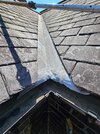
Initially I thought it was a leaking section of guttering, so bought a new 90 degree corner. Then I had the gutters cleaned and when looking at the “after” pictures, considered the possibility that the leak may not be a leak at all.

As seen on the attached, could the rainwater be running down the valley at speed, overwhelming the guttering? I can see water running down the wall (behind the guttering) when it rains hard.

Want to get it fixed soon so just wondering if anybody else has knowledge on this. I’m just about okay at height (recently repaired upstairs window frames), but not mega confident, so would rather make as few trips up there as possible.
 

Attachments

  • IMG_1145.jpeg
    IMG_1145.jpeg
    637.4 KB · Views: 158
Quite possible that you are right with the speed of water down the valley theory and would be worth fixing in an upstand, even just temporary, to check the result next time you get heavy rain. You could use lead if you have some or even just strips of plywood to see if it helps. I would also dress down the lead a little better over the gutter to create a run off point for the water rather than it projecting it outwards as it is now.
 
, could the rainwater be running down the valley at speed, overwhelming the guttering? I can see water running down the wall (behind the guttering) when it rains hard.
Yes. 90 degree corners are an issue, especially as (internal) corners usually means a valley, as this where the running water slows and gathers. A lot depends on the remoteness or distance to the outlet. It's often wise to incorporate another DP drop, where possible.
 
Yes. 90 degree corners are an issue, especially as (internal) corners usually means a valley, as this where the running water slows and gathers. A lot depends on the remoteness or distance to the outlet. It's often wise to incorporate another DP drop, where possible.
This pic shows the nearest downpipe. There was one and the same position but to the right of corner, but I removed it as it didn’t deposit into a drain (and kept flooding the driveway). The issue was still present before the removal.

Next time it rains hard when I’m at home, I’ll stand out there and see if I can see any water coming over the edge. Keen to get it done as this is the damage the inside (excuse the yellow paint, I’ve not yet decorated that room!). It’s worse in the bedroom, underneath the lining paper.
 

Attachments

  • IMG_1160.jpeg
    IMG_1160.jpeg
    539.5 KB · Views: 68
  • IMG_1161.jpeg
    IMG_1161.jpeg
    153.9 KB · Views: 69
Did you have this damp issue before you removed the down pipe?
Yes the issue was present long before then. I bought the house in May with the damage present and the downpipe in place. It used to deposit straight onto the driveway and flood it.
 
Someone must have considered a second down pipe worth having! Next time its raining check if the gutter is reaching capacity and overflowing. Typically your period of property originally would have had O gee guttering which had about twice the capacity of the guttering you have now! possibly why a second pipe was introduced.
 
Someone must have considered a second down pipe worth having! Next time it’s raining check if the gutter is reaching capacity and overflowing. Typically your period of property originally would have had O gee guttering which had about twice the capacity of the guttering you have now! possibly why a second pipe was introduced.
Yes I did think that, as it must have been there for a reason, but it terminated straight on block paving and was causing damage. We considered removing it and having confirmed the rainwater from other remaining downpipe goes into a private drain, decided to remove. That drain has since coped fine with the additional volume.

Since removal the guttering was cleared and there’s no overflow. All the other houses of my type (built 1885-1906) all have modern guttering with no overflow either.

When it is raining next, I do need to keep an eye on this corner spot.
 
Bit of an update on this — all the recent rain gave a great opportunity to stand outside and see what was happening.

No water gushing down the valley and no visible leaks form the guttering. However, there was a long streak of water running down the wall. This was behind the guttering and behind the fascia board it is screwed to, so it must be the lead and/or a defective tile. I’m going to venture up and also take a deeper look into the loft space in that corner.

I’ll update with any pictures if anybody interested.
 

If you need to find a tradesperson to get your job done, please try our local search below, or if you are doing it yourself you can find suppliers local to you.

Select the supplier or trade you require, enter your location to begin your search.


Are you a trade or supplier? You can create your listing free at DIYnot Local

 
Back
Top