• Looking for a smarter way to manage your heating this winter? We’ve been testing the new Aqara Radiator Thermostat W600 to see how quiet, accurate and easy it is to use around the home. Click here read our review.

Sewer pipe air vent question

Time and again on this forum, an AAV is viewed as a tidy and easy solution to disposing of SVPs.
Sewers need to breathe OUT as well as IN!
I have been to hundreds of drainage issue jobs where replacement of SVPs with AAVs has been the cause.
And I'm not a below-ground plumber/drainage expert, like some of my peers on here are.

Often there's no problem. Until the drains block, and/or someone needs to carry out some High Pressure Water Jetting in the vicinity. Happens time and time again, jetting causes pressure fluctuations in the network, where there's an open vent, this pressure happily dissipates, and apart from a little bit of rumbling and/or the water in the WC Pan shaking slightly, no-one is any the wiser.

Cap that run off though with an AAV, and that pressure needs to find another route out. Blowbacks and Internal Flooding are at best unpleasant, at worst can redecorate the bathroom in a rather nasty looking (and smelling) blend of drain content.

Vents are there for a reason!
 
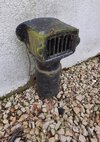
There is one at the top of the street I live on.
1930s built houses.
It's on the footpath outside what used to be my sister's house and is disguised as a victorian lamp post.

This is in addition to those on each house.
 
There is one at the top of the street I live on.
1930s built houses.
It's on the footpath outside what used to be my sister's house and is disguised as a victorian lamp post.

This is in addition to those on each house.

Houses were still being built at that time with Interceptor traps in the last chamber bfore the Boundary, to seal off the house drains from the main sewer in the road. The House Drains were usually ventilated by means of an AAV at low level going into the last chamber, with air passing over the stack, drawing air in via the AAV, through the drains and out the stack.

The often ornate, cast vent stacks in the street were to ventilate the main sewers, and were usually placed at the head of the run. Many have since been removed due to wear and tear. I know of one near me that's been cut off at about 4 ft high and filled with concrete to seal it.
 
Houses were still being built at that time with Interceptor traps in the last chamber bfore the Boundary, to seal off the house drains from the main sewer in the road. The House Drains were usually ventilated by means of an AAV at low level going into the last chamber, with air passing over the stack, drawing air in via the AAV, through the drains and out the stack.

The often ornate, cast vent stacks in the street were to ventilate the main sewers, and were usually placed at the head of the run. Many have since been removed due to wear and tear. I know of one near me that's been cut off at about 4 ft high and filled with concrete to seal it.

Buchans and low level vents?
Seen those a lot further into town.
 
Doesn't mean it will be the same on another property.
Soil vent pipes should go up above the eaves and away from any velux windows.
Building Regs signed it off when the project was complete too!
 
Buchans and low level vents?
Common type used at the time.
Vent.jpg
 
Were they part of Bazalgette's system?
Which would have lasted another 100 years if we'd stuck with high level flushes IMO.
Bazalgette designed/built London's sewers, so if they are around in London, yes!

The biggest issue now is Storm Overflows. The Victorians designed the system so that it got a good flush through every time is pi$$ed down, but back then it all went into the nearest watercourse, downstream of the conurbation. Ours went into the Nene, I often think that may not be entirely unrelated to the Town downstream who would have drawn their water from the River.

Problem is now, the likes of Feargal Sharkey want the Water Companies to capture and treat every last drop, it simply isn't feasible. Only real option would be to sperate storm and foul at source, then the problems arise of where to put all the rainwater, and then the foul sewers choking up as they're not getting the volume of water to push solids through the system....
 
Guess I got lucky then! 4 years is a fair test for a bodge! Lol
A lot will depend on the drainage system it's connected to. If that's been laid to a decent standard, and there is ventilation elsewhere, then you are less likely to experience issues. Much of the issue is with newer builds, where drains are thrown in the ground, with little care or attention to the rules, block more easily and frequently and AAV's fitted which causes the system to vent air where it's not wanted and/or causes a nusiance.
 
A lot will depend on the drainage system it's connected to. If that's been laid to a decent standard, and there is ventilation elsewhere, then you are less likely to experience issues. Much of the issue is with newer builds, where drains are thrown in the ground, with little care or attention to the rules, block more easily and frequently and AAV's fitted which causes the system to vent air where it's not wanted and/or causes a nusiance.
Ah, well in both locations our house has been 50s or 60s built, detached and with designated drains, so maybe that's why I got away with such a simple measure. Good to know!
 
Sorry to kick this off again but I've had my crayons out again and struggling to find a part that'll do the job. I have done an aerial sketch of the new layout from where the new hole is in the floor (currently the female opening of an elbow) and the run along the side wall to the back where it 90's left along the back wall and eventually swings into the pan.

I want to ideally add the old waste pipe with AAV that I kept into the run at the corner of the room so I can box it in neatly, but can't seem to find/work out a way of having a 90 degree bend that'll also allow me to send a 4" upwards.

Any ideas or know of a product that'll do it?

Thanks in advance.
IMG_9247.jpeg
 

If you need to find a tradesperson to get your job done, please try our local search below, or if you are doing it yourself you can find suppliers local to you.

Select the supplier or trade you require, enter your location to begin your search.


Are you a trade or supplier? You can create your listing free at DIYnot Local

 
Back
Top