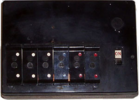
Sorry, when I skimmed through the thread earlier and saw the cutout, I somehow thought it was a large commercial supply, but looking closer it seems to "only" be a regular 100A TP supply.Well, for a start, this is a DIY forum where we are (should!) essentially be talking only about domestic installations. In any event ...
Yes, so 1A with a 50Ω earth or 10A with a 5 ohm earth. No specific maximum, just a matter of what can be justified by your earth electode system.... the effect of which is, when an RCD is used for fault protection in a TT system, to limit IΔn (albeit way above the devices IΔn) - e.g. 500 mA in the case of a 100 Ω TT earth.
My understanding is that the norm on a s TT installation is that you have 30mA RCDs on final circuits which require "additional protection" and then slower/higher trip current RCDs to provide protection to the distribution infrastructure. On a small install that likely means a 100mA or 300mA type S, but there certainly seems to be a market for larger.In practice, of course, the RCD would have an IΔn of 30 mA, in order that it also provided 'additional' ('direct personal') protection, which majorly 'trumps' the much more modest requirement of 411.5.3.
Sometimes you will get a TT install where all the outgoing circuits from the main DB want/need 30mA RCD protection. In such cases some installers may decide to rely entirely on the 30mA RCDs/RCBOs and not have a main RCD.
While I think this just about complies with the letter of BS7671 I don't think it's a particularly good idea for two reasons.
* It provides no protection from faults inside the CU (including potentially faulty SPDs). A RCD upfront minimises the amount of unprotected wiring.
* It leaves you reliant on the correct operation of a single RCD as your only line of defence.
 ) might change that a little. However, although I can see that an L-E fault in a SPD might trip an upstream RCD, I'm not so sure that there would be any significant hazard in the absence of such an RCD, would there?