• Looking for a smarter way to manage your heating this winter? We’ve been testing the new Aqara Radiator Thermostat W600 to see how quiet, accurate and easy it is to use around the home. Click here read our review.

Line Fireplace Opening

Joined
2 Aug 2022
Messages
79
Reaction score
3
Country
United Kingdom
Hi all, old Gas Fire removed, isolated etc.
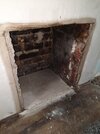
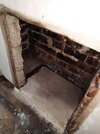
How to I go about lining the opening to take a small free standing electric stove.
To the right of the opening is the brick, to the left there is a recess.
I'd need it covered from above also to stop any existing soot falling.
Was thinking of a vent on the left hand side to maintain the air flow.
Thanks in advance.
 

Attachments

  • 20250814_150819.jpg
    20250814_150819.jpg
    349.2 KB · Views: 25
  • 20250814_150801.jpg
    20250814_150801.jpg
    324.9 KB · Views: 26
Whatever you do, don't line it with something fixed with a water based adhesive - you'll get salts transfer from all the salts in the bricks. Either use board fixed with foam adhesive, or get some top-hat metal channel, fix that to the brick, and fix boards to that. If it's only going to have an electric fire, plasterboard will be fine

Is the chimney capped? If not get it capped with a vented cowl. Vent at the bottom? why? you'll just get nice warm room air going up the chimney and potentially condensing inside the coldest bit at the top. Just leave the top open, and block off the bottom - it'll be fine. Some people insist the bottom should be vented, but it's unnecessary. Even back in the day, when bedrooms had fireplaces, these usually had blanking plates to shut off the chimney completely when not in use - ours still do...
 
Whatever you do, don't line it with something fixed with a water based adhesive - you'll get salts transfer from all the salts in the bricks. Either use board fixed with foam adhesive, or get some top-hat metal channel, fix that to the brick, and fix boards to that. If it's only going to have an electric fire, plasterboard will be fine

Is the chimney capped? If not get it capped with a vented cowl. Vent at the bottom? why? you'll just get nice warm room air going up the chimney and potentially condensing inside the coldest bit at the top. Just leave the top open, and block off the bottom - it'll be fine. Some people insist the bottom should be vented, but it's unnecessary. Even back in the day, when bedrooms had fireplaces, these usually had blanking plates to shut off the chimney completely when not in use - ours still do...
Many Thanks for that, much appreciated.
 
OP,
You need to sweep the flue & have a redundant flue cowl sitting in a chimney pot at the top of the flue.
Box off the fireplace surrounds for the electric stove with backer board on three walls & a top.
And install a 9"x3" Hit&Miss vent on the outside of the chimney breast Left Hand brickwork.
The Hit&Miss will vent the flue.
To experienced workers, Its common knowledge that redundant flues need vents at bottom & top.
Its foolish to suggest otherwise, & such a suggestion will cause future grief & expense.

There's a big difference between flue throat dampers (wrongly called "blanking plates") & H&M vents.
Differences in where they are installed & how they are used.
You do not need any such "blanking plates". FWIW: dampers were used to control heat from solid fuel fires.
 
OP,
You need to sweep the flue & have a redundant flue cowl sitting in a chimney pot at the top of the flue.
Box off the fireplace surrounds for the electric stove with backer board on three walls & a top.
And install a 9"x3" Hit&Miss vent on the outside of the chimney breast Left Hand brickwork.
The Hit&Miss will vent the flue.
To experienced workers, Its common knowledge that redundant flues need vents at bottom & top.
Its foolish to suggest otherwise, & such a suggestion will cause future grief & expense.

There's a big difference between flue throat dampers (wrongly called "blanking plates") & H&M vents.
Differences in where they are installed & how they are used.
You do not need any such "blanking plates". FWIW: dampers were used to control heat from solid fuel fires.
Thanks very much for that.
 
There you have it. My opinion based on my own personal experience working in old houses, and an alternative view. You can pick either.
 
OP,
He has previously claimed that both his wife & himself are some kind of plant biologist's - not many of them in the building trade. Its not "an alternative view" - its a wrong view.
He's also previously claimed, confirmed by his wife, that pics of very obvious dry rot was not dry rot - it was. Bad plant biologists.

FWIW: my working life as a tradesman has been on the tools, much of it in remedial work.
Much appreciated.
 
OP,
He has previously claimed that both his wife & himself are some kind of plant biologist's - not many of them in the building trade. Its not "an alternative view" - its a wrong view.
He's also previously claimed, confirmed by his wife, that pics of very obvious dry rot was not dry rot - it was. Bad plant biologists.

FWIW: my working life as a tradesman has been on the tools, much of it in remedial work.
and he trained as a plumber
 

If you need to find a tradesperson to get your job done, please try our local search below, or if you are doing it yourself you can find suppliers local to you.

Select the supplier or trade you require, enter your location to begin your search.


Are you a trade or supplier? You can create your listing free at DIYnot Local

 
Back
Top