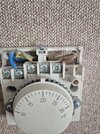
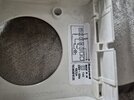
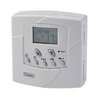
I read that a digital stat is more accurate and efficient than this T40
The thermostat you have is digital, i.e. on/off, the analogue thermostat is seen as being much better, i.e. it turns the boiler up/down. However, the simplest analogue thermostat has no wires and is called a thermostatic radiator valve (TRV) so we start to look at the complete system, and also your final aim at an upgrade, even if 5 years away.
To start with, there are two completely different types of boiler. There is the modulating boiler, which can turn its output up and down, and the on/off boiler. The main reason for the modulating boiler is to use the latent heat from the flue gases, and to do this the return water needs to be cool. So with a modulating boiler the less it is turned off, then back on again the better.
The idea is, each TRV controls the room it is in, and as each TRV closes the pressure differential increases until the bypass opens, this allows warmer return water which causes the boiler to turn down, so the boiler does not in mid-winter even turn off, just up and down.
But Autumn and Spring the boiler can't turn down enough, and unless there is some on/off device it will keep turning off and on, so we look at some way to integrate the on/off thermostat with the TRV.
Theory is we put the on/off thermostat in a room downstairs (as heat raises) which is normally kept cool, so on prospective warm days it will not fire the boiler, with no outside doors, or alternative heating including warming with sun through windows, and not have a TRV in that room.
However, often such a room does not exist, so we need a compromise, for example fit it in the hall, and also have a TRV, so if for example the TRV is set at 17°C and the wall thermostat at 18.5°C since higher it will be warmer, and what should happen is when hall door opened, the TRV opens, and so reheats the hall, but before it gets warm enough to trigger the wall thermostat is closing again, so wall thermostat is only triggered on warm days, and often a large slewing temperature difference is good rather than bad.
Slewing temperature difference is the difference between switching on and off. But setting the TRV and wall thermostat to work together is not easy, and is not helped by marking the TRV head *123456. Although the electronic head is better,
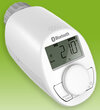
with degrees C marked, and open window detection so after opening the hall door it waits a set time before opening and re-heating the room, it is maybe too accurate. A mechanical head, set at around 2¼ will likely start to close at 17°C but not fully close until 20°C so a wall thermostat will switch the boiler off set at 19°C on warm days.
But in the rest of the house, the electronic TRV can work far better, I have 5 of the ones shown, cost me £15 each in 2019 before Brexit, but now have gone up in price. The blue tooth only seems to work with one device, so either my wife or me has control not both, but the main reason for blue tooth is where two are in the same room, you can pair them together.
Wi-Fi versions have come down in price, I have one Kasa fitted, and three Energenie, these are not linked to the boiler, but show both target and current temperature so make setting the lock shield valve a lot easier, if current exceeds target then open too much. These need a hub, but I have not got them linked to the boiler.
The Drayton Wiser however does connect to boiler, only got one TRV or that type, slight problem with radiators on outside walls, as they can trigger the boiler too early, but only a slight problem.
Theory you don't need a wall thermostat, you can use the linked TRV heads, but would be rather costly. But I have ended up with three hubs, two connected to boiler, (Nest and Wiser) mainly as I thought Nest would link to TRV heads, and it would not, but this is why I say consider what you want in 5 years time, so you don't buy something which latter will not work.