• Looking for a smarter way to manage your heating this winter? We’ve been testing the new Aqara Radiator Thermostat W600 to see how quiet, accurate and easy it is to use around the home. Click here read our review.

Is this buttress big enough?

Joined
8 Jun 2013
Messages
819
Reaction score
134
Location
Gloucestershire
Country
United Kingdom
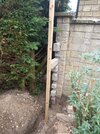
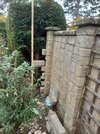
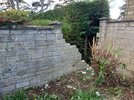
My garden wall had developed some large cracks over the past few years and got particularly bad this year. So much so that we've knocked it down and, once the footings have been dug out, are likely to replace it with a hedge instead. The situation we current have is the existing neighbouring wall that used to tie-in to our wall in the corner (see pics). Without our wall, theirs is susceptible to movement. It's not loose per-se but does flex slightly. I'm sure with a big shove or a gale-force wind, it could be brought down.
I want to support the wall with adding a small buttress in the corner. It will be one brick (stone) thick and extend out about 12". My query is whether this is sufficient to make any difference or am I just wasting my time?
In an ideal world we would demolish and rebuild the whole wall, digging the footings deeper and reinforced and re-doing all of the joints. This option is not possible / not financially viable though.
 

Attachments

  • 20250829_170214.jpg
    20250829_170214.jpg
    691.9 KB · Views: 50
  • 20251012_122637.jpg
    20251012_122637.jpg
    624.1 KB · Views: 50
  • 20251012_122711.jpg
    20251012_122711.jpg
    622.7 KB · Views: 52
The size of the buttress (face width and thickness) mainly depends on 3 things:

1. the height of the wall from ground level;
2. the length of the wall (or length to the nearest buttress;
3. the thickness of the wall (and whether it is solid, or built with separate skins).
 
The size of the buttress (face width and thickness) mainly depends on 3 things:

1. the height of the wall from ground level;
2. the length of the wall (or length to the nearest buttress;
3. the thickness of the wall (and whether it is solid, or built with separate skins).
Thanks. Would you be able to advise if I were to provide this info?
 
yup, we'll give it a try.
Thanks Tony.
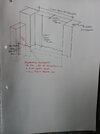
The current wall is 1.6m high from ground level, one brick thick, with pillars (210 square) at 1.1m spacings face to face. Footings are 500mm deep.
My plan is to add an additional one-brick thick wall, 250mm long, 1.4m high, at 90 degs to the end pillar to stop / reduce the possibility of the main wall from toppling over. This 'little' bit of wall I'll be building is in fact the re-building of the previous 90 degs wall which I knocked down in the original pics.
I assume that we we're talking structural mass of any 'buttress' as to whether it will do it's job? I haven't totted it all up but tbh I think it will looks sufficient.
Putting it another way. If it's not then it's one hell of a difficult job to build something bigger, digging out old foundations and re-building etc.
 

Attachments

  • 20251017_105133.jpg
    20251017_105133.jpg
    170.5 KB · Views: 19
My pure instinct, not based on any scientific analysis, is that it looks wide enough but I'd still build it at least 50% bigger. Simply because if that wall does ever fall down then your neighbour could blame you for it.

You're there anyway, you've got the gear and skills, you may as well overdo it just to cover yourself.
 
My pure instinct, not based on any scientific analysis, is that it looks wide enough but I'd still build it at least 50% bigger. Simply because if that wall does ever fall down then your neighbour could blame you for it.

You're there anyway, you've got the gear and skills, you may as well overdo it just to cover yourself.
You say 50% bigger, do you mean higher (the sketch is not to scale btw) or, make it double-skin? The latter would mean adding tie-ins of some sort into the existing pillar for the second skin, presumably using angle brackets etc screwed to the face of the pillar and then bed in each mortar course.
 
Don't know! Just overdo it enough to ensure it can't be blamed on you when it inevitably does fall over. If you imagine the entire wall falling down, would it take your pillar with it or not? I'd argue it probably would at its intended size.
 
Last edited:
A quick way to find the size of a new pier is to work out the horizontal wind load on a portion of the wall and assume the wind is trying to push it over. Then, assume that all the wind load is to be resisted by the pier alone, and then work out the weight of pier required to more than counter-balance the horizontal wind load - if that makes sense?! This is a conservative way and would give a safe size of pier.

1. work out the area of 2/3 of the length of wall between the end and the first intermediate pier (including the width of the pier itself). This would be approx. 0.8m? x by height of 1.6 m, = 1.28 m2.

2. Assume all the wind load on this area is taken by the pier alone (the thin 100mm thickness of the main portion of the wall provides very little resistance).
You could safely assume a wind load of - say - 0.6 kN/m2 assuming you are in a suburban- and not exposed area or near the coast. (1kN is approximately 0.1 tons in old money).

Therefore total wind load on your pier would be 1.28 x 0.6 = 0.76 kN. This will produce an overturning moment at the base of the pier, which = 0.76 x (half height of pier) = 0.76 x 0.8 = 0.6kNm.

A quick back-of-fag-packet calc. suggests that your existing pier (0.21m x 0.21m) plus your new pier (0.1m x 0.25m) would not have sufficient mass to counter the wind load in a once-every-five/ten year gale. I'd be inclined to make your new additional pier at least 450 and preferably 500mm long to be safe. It should also be well-attached to the existing pier (say, with at least 4 decent stainless steel brackets) otherwise that itself could be blown down sideways.
 
Last edited:

If you need to find a tradesperson to get your job done, please try our local search below, or if you are doing it yourself you can find suppliers local to you.

Select the supplier or trade you require, enter your location to begin your search.


Are you a trade or supplier? You can create your listing free at DIYnot Local

 
Back
Top