
Is this caravan, by any chance, at the far end of a very wet muddy track?



I do happen to have a solar charger (think it is what they calll it)It, like all such system, will need a charge controller. You need to learn some basic maths, to be able to calculate how long a battery might last, and how long it might take to charge up.
just a thought do you have the expected consumption figures for that set up in use ??I have 3 motion detector cameras to run off of it. Though there will not be much motion detected where the caravan is going. I plan to have the cameras switch on when I am away and switched off when I am there
Someone told me that they are all the same these days, the plates insider are the same thickness anywayYou need a deep-discharge battery, not a car starter battery. I bought one from BMS recently on special offer.
They are Tapo camera that have a memory card insert. The internet is a mobile wifi dongle typejust a thought do you have the expected consumption figures for that set up in use ??
also do you have requirements for use and storage from third party items like hard drives and expected power consumption in connection to the cameras from the connected items at the caravan that need powered including internet requirements ??

I do know the diesel heaters you are talking about, common in narrow boats, but in winter solar panel output is rather low, and you need some other method when the panels can't cope, be it a small generator, or taking the batteries somewhere to charge, that's up to you, but you need a back-up plan.
 so the battery size to even out the supply would be huge, so I don't even try, I know some days I need to buy power.
This is the one I gotSomeone told me that they are all the same these days, the plates insider are the same thickness anyway
BMS?

 www.bmstechnologies.co.uk
Brilliant post!I started around 1965 looking at caravan electrics. At that time, all the battery did was work the water pump, replacing the rubber dome in the floor that I pressed with my foot, lighting was with gas, so was heating, the latter making the caravan very wet.
As times has gone on, we have moved from a 7 pin plug and socket to either a pair of plugs and sockets, or a 13 pin version, we have seen the blocking diode come and go, the split charge relay come and go, the charge inverter is now how we move the power from car to caravan, and we have seen tungsten then fluorescent then LED lights, the carver water and central heating unit which can use 12 or 230 volts, use gas or electric for the heating, and now the move to lithium batteries.
Solar panels have gone from simple zenor diode to MPPT controllers, and the homemade wind charger from a converted bicycle hub dynamo has moved to the Rutford units. We have seen the Wispergen and the like external combustion engine to allow generators to run 24/7 without waking the neighbours, and the more basic inverter generators which can drop to tick over with low load.
What as the user, we need to consider is running cost v installation cost v noise, and how far to go, and we can't do that without knowing the whole story, we can only put forward ideas.
In the 70's we went for the battery in a bread bin, in the boot of the car. Lucas made a unit designed to do it, but some tie down straps in the boot, and split charging allowed us to swap batteries every few days, so the battery was charged every time the car was used, not just when towing the caravan. These old simple ideas went out with the stop/start system used in modern cars, we can't connect relays and blocking diodes like in the old days any more. In fact, it caused danger, when the car stopped charging and the anti-snake device was disabled, so today we use charge inverters, and mobus systems which I have not kept up with.
But in general, the size of solar panels and wind generators required to live off grid are far too big, so somewhere, somehow, we need to supplement the power by taking batteries to be charged, or running a petrol generator, or plugging into some other power supply, and a caravan in the main weight matters, a narrow boat can have a bank of lead acid batteries 120 amp hour each, and once a month plug into a shore supply, with a caravan they would be far too heavy. So the portable power bank is more useable with caravans.
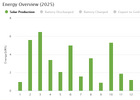
So we start with working out what we need, be it a tent, boat, caravan or house, we look at items used, an easy way is simple measure it, I have a smart meter, and solar software, both tell me how much I am using, I use around 12 kWh per day of electric, so armed with that figure I can start to work out what I need. There are the odd items, in my case the electric shower, which my inverter could never supply, so I know I can never run without mains input, and I also know solar production is eristic, View attachment 401981 so the battery size to even out the supply would be huge, so I don't even try, I know some days I need to buy power.
So if I was living off grid, I would need either power from a stream or river, or an engine of some sorts, to bridge the gap, with are returning to the industrial revolution where the mill owners realised even water power could fail in a dry summer, and moving to a steam engine removed this problem, nothing has changed, we can't store enough power to bridge the lean times, the large batteries in the UK like electric mountain (Dinorwig Power Station in Snowdonia, Wales) were designed to work with other power stations, not on their own, so you're looking at a package, rather than just solar, or just wind.
So the big question is voltage. 12, 24, 56, 230, AC or DC, what ever you have likely you will need something to convert one voltage to another, but what is the base voltage going to be? I have a large 5 kW inverter to change between 56 volts and 230 volts, and a much smaller one 300 watt and 150 watt to convert 12 volts to 230 volts, I have nothing which can use 56 volts direct, but loads which can use 12 volts direct, so I can have a 12 volt battery directly power lights, no inverter involved. With the modern lithium battery pack, it needs an inverter running to convert from around 50 volts to 12 volts or 5 volts if using USB.
In the caravan even a simple bulb has an inverter built in, caravan LED bulbs typical 10 - 30 volts, the only way to get that range is an inverter built into the bulb. But changing voltage uses energy, so it's a balance, and you need to consider all the factors, and decide what will suit you best.
so best forget about that one thenThe likes of the Rufford wind generator uses furlmatic design to bring it out of the wind when wind get too strong, so don't produce either with no or very high winds, they were used on the Falklands which is known for being windy, but to run an electric fence back in late 80's early 90's when I was there, the solar panel did a better job.
To be honest Im not that bothered because if there is not enough battery to power it then i will just come back homeI do know the diesel heaters you are talking about, common in narrow boats, but in winter solar panel output is rather low, and you need some other method when the panels can't cope, be it a small generator, or taking the batteries somewhere to charge, that's up to you, but you need a back-up plan.
I was on a caravan forum before, but very little info. I am surprised with the lack of knowlage they had (on terms of group think) they could manage 1 night parked up in the frost. Either that or they payed some kind of rip off Halfords to do it all for themI would go to a narrow boat forum, they use generators, wind chargers and solar panels, both lead acid and lithium batteries, and can likely help better than on here. I have when using my e-bike gone to pubs and railway stations to recharge the batteries, there is normally somewhere you can take them.
That is why i am hear! as i dont have a SpackerBook account, i dont have access to there numberuss s@@t! on thereYou really need to be doing some research into it all. It isn't as simple as just connecting a panel to a battery. Have a look at the Facebook group:
Campervan Electrics
https://www.facebook.com/groups/3682684575132280

If you need to find a tradesperson to get your job done, please try our local search below, or if you are doing it yourself you can find suppliers local to you.
Select the supplier or trade you require, enter your location to begin your search.
Are you a trade or supplier? You can create your listing free at DIYnot Local


