Any of those, depending upon what you want. I imagine that you would want it to be able to start under any likely conditions, so you would presumably want the battery to be able to do the 'cold start' - in which case it would obviously also be OK in the other situations you mention.But what is start up?
1. cold start -18C
2. When it has not been used for 1/2 hour
3. When it ran 5 minutes ago

You are using an out of date browser. It may not display this or other websites correctly.
You should upgrade or use an alternative browser.
You should upgrade or use an alternative browser.
size of battery needed for my solar panel
- Thread starter muckington
- Start date
Caravan and motorhome people tend to have more money than sense and throw thousands at huge power setups that seem to serve little purpose other than running a stinky air fryer and giving them bragging rights on the internet.
Unless you want to do the same, you'd be better with an LPG setup for heating/cooking/hot water etc.
I'd stop trying to "science" the electric, you have little idea of the heater consumption (if you chose to use it over a gas heater), or what your panel will produce in your location in winter - the typical start point for a caravan is (was) a 100w panel and a 110ah lead acid battery - start with that. As you aren't going to be there you should buy a cut off device that will monitor your battery and cut the power to protect it from excessive discharge. You will get a good idea from when you cameras shut down as to where you are and if you can monitor the battery voltage/charging time you can assess whether the panel will power a second battery or whether the battery needs a second panel etc.
The best leisure batteries I ever had were ex UPS batteries where someone was selling them off a pallet for £20 each, but that was before the off grid craze started.
Unless you want to do the same, you'd be better with an LPG setup for heating/cooking/hot water etc.
I'd stop trying to "science" the electric, you have little idea of the heater consumption (if you chose to use it over a gas heater), or what your panel will produce in your location in winter - the typical start point for a caravan is (was) a 100w panel and a 110ah lead acid battery - start with that. As you aren't going to be there you should buy a cut off device that will monitor your battery and cut the power to protect it from excessive discharge. You will get a good idea from when you cameras shut down as to where you are and if you can monitor the battery voltage/charging time you can assess whether the panel will power a second battery or whether the battery needs a second panel etc.
The best leisure batteries I ever had were ex UPS batteries where someone was selling them off a pallet for £20 each, but that was before the off grid craze started.

Unless you want to do the same, you'd be better with an LPG setup for heating/cooking/hot water etc.
Even those, need some 12v power - my heating system, needs power to ignite, then power for the blown air distribution, cooking needs power for ignition, hot water needs power for the ignition, and pump.
Even those, need some 12v power - my heating system, needs power to ignite, then power for the blown air distribution, cooking needs power for ignition, hot water needs power for the ignition, and pump.
Of course, but tiny amounts - which he has. My caravan must be old - stove lit with match, fridge piezo, trauma heater I think has a 9v battery but yes, the blown air operation and water pump needs a bit of juice (it's too new for an old foot pump although I have considered fitting one).
I was on one of those forums the other day - poor bloke couldn't understand what had happened to his £900 Jackery after plugging his fan heater into it.

- Joined
- 27 Jan 2008
- Messages
- 29,249
- Reaction score
- 3,588
- Location
- Llanfair Caereinion, Nr Welshpool
- Country

First time I came across the diesel cab heater was 1980, seem to remember a Hunter make, fitted as standard to a Grove crane, mainly as too hard to get cooling water to the cab. The Eberspacher seemed to be the industrial standard, but Webasto is a close second, however there must be hundreds of models each slightly different, heating water or air, some with more or less features as others, and some do have an under voltage cut out, and also different methods to atomise the fuel and ignite it.
Also, there are many different types of lead acid battery, roughly we have the traction battery, and the engine start battery, the traction is designed to deep cycle, and low amps, and engine start not deep cycle that can damage it, but high amps, and the leisure battery was a halfway between the two. There are also gel batteries, often used for the heaters on radio valves, and the valve regulated lead acid (VRLA) similar to the absorbed glass mat (AGM) which were originally used like the traction battery, alarm back-up, emergency lights, mobility scooters etc. But are now used with cars using the stop/start technology. The AGM does seem better with deep cycle to the flooded car battery, but one can't group all lead acid together and make comments like over discharge will damage them, as it does depend on the type, however, lead acid in general is damaged if left in a discharged state.
Also, the charge rate of lead acid is slow, even with flooded traction batteries where slight over charging does not matter, we look at 8 to 12 hours to recharge, and it depends on how long they have been left discharged, I found a pair of VRLA used with a stair lift took around 10 days to charge, and was monitoring with an energy meter, and was as if someone had flicked a switch, 9 days nothing, then charged on day 10 and seemed as good as new, but in the past I would have scrapped the battery before that time had elapsed.
Back in the 60's and 70's before the car alternator had hit the scene, we would give batteries an equalising charge around every two months, we would use a trickle charger overnight to ensure battery fully charged on all cells, and top up the cells, this also helped stop the sulphur going hard on the plates, and this is the problem when using a charging system which may not fully recharge the battery every day.
If I look at my solar panels, every night they are recharged using off-peak, but during the day, solar this time of year sometimes fully recharges them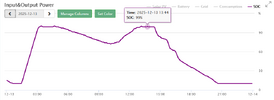 but
but  some days the solar only slows the discharge rate, so I could go a week or more without fully recharging the batteries if using solar only. With lithium not a problem, but this is a problem with lead acid. Using a solar panel to counter self discharge with a caravan battery in winter may work well, but to put enough in it for daily use, is really not going to happen.
So the battery will likely need charging from a mains supply from time to time, so looking at what size battery can be transported with ease, I have three sizes here, 12 Ah, 35 Ah, and 90 Ah I can carry them all, but would not want to carry the 90 Ah far, the 35 Ah scooter batteries are about the largest I would want to move regularly, but since the 12 Ah will start a petrol car, it would also fire up a heater, and as a battery pack, easy to carry.
If we look at solar panels, 100 watt = 650 watt/hours height of summer on a bright day, about 55 Ah so having a battery over 35 Ah it is unlikely to be fully charged even in summer, winter again on a good day 9.6 Ah so even the 12 Ah battery is more than it could recharge in a day, in fact a lot less, as just not enough time, so using solar and lead acid 100 watt panel and a 10 Ah battery would allow lights to be used but would not run a heater for a reasonable time, you will need to charge battery from mains at some point, using lithium which can be charged faster you have a chance.
The Tan-y-Llyn railway use diesel heaters for their coaches, the battery does not last out the day, it needs charging each night, our railway uses steam to heat carriages, and should we have to diesel haul then no carriage heating, so we have looked at diesel heaters for the Santa specials, we have the annual get together on 29th this month, where all the North Wales heritage railways join for a day of drinking and merriment on the train, this year at Llanfair, so I will ask the guys from Tan-y-Llyn what size battery they use. In the main, steam is better, as it gives some ambiance, but diesel would be a good back-up. We have larger carriages to the others, as no cliff faces, or bridges to restrict the width, the new to us observation carriage, will likely need some heating, so it needs thinking about.
Also, there are many different types of lead acid battery, roughly we have the traction battery, and the engine start battery, the traction is designed to deep cycle, and low amps, and engine start not deep cycle that can damage it, but high amps, and the leisure battery was a halfway between the two. There are also gel batteries, often used for the heaters on radio valves, and the valve regulated lead acid (VRLA) similar to the absorbed glass mat (AGM) which were originally used like the traction battery, alarm back-up, emergency lights, mobility scooters etc. But are now used with cars using the stop/start technology. The AGM does seem better with deep cycle to the flooded car battery, but one can't group all lead acid together and make comments like over discharge will damage them, as it does depend on the type, however, lead acid in general is damaged if left in a discharged state.
Also, the charge rate of lead acid is slow, even with flooded traction batteries where slight over charging does not matter, we look at 8 to 12 hours to recharge, and it depends on how long they have been left discharged, I found a pair of VRLA used with a stair lift took around 10 days to charge, and was monitoring with an energy meter, and was as if someone had flicked a switch, 9 days nothing, then charged on day 10 and seemed as good as new, but in the past I would have scrapped the battery before that time had elapsed.
Back in the 60's and 70's before the car alternator had hit the scene, we would give batteries an equalising charge around every two months, we would use a trickle charger overnight to ensure battery fully charged on all cells, and top up the cells, this also helped stop the sulphur going hard on the plates, and this is the problem when using a charging system which may not fully recharge the battery every day.
If I look at my solar panels, every night they are recharged using off-peak, but during the day, solar this time of year sometimes fully recharges them
but some days the solar only slows the discharge rate, so I could go a week or more without fully recharging the batteries if using solar only. With lithium not a problem, but this is a problem with lead acid. Using a solar panel to counter self discharge with a caravan battery in winter may work well, but to put enough in it for daily use, is really not going to happen.So the battery will likely need charging from a mains supply from time to time, so looking at what size battery can be transported with ease, I have three sizes here, 12 Ah, 35 Ah, and 90 Ah I can carry them all, but would not want to carry the 90 Ah far, the 35 Ah scooter batteries are about the largest I would want to move regularly, but since the 12 Ah will start a petrol car, it would also fire up a heater, and as a battery pack, easy to carry.
If we look at solar panels, 100 watt = 650 watt/hours height of summer on a bright day, about 55 Ah so having a battery over 35 Ah it is unlikely to be fully charged even in summer, winter again on a good day 9.6 Ah so even the 12 Ah battery is more than it could recharge in a day, in fact a lot less, as just not enough time, so using solar and lead acid 100 watt panel and a 10 Ah battery would allow lights to be used but would not run a heater for a reasonable time, you will need to charge battery from mains at some point, using lithium which can be charged faster you have a chance.
The Tan-y-Llyn railway use diesel heaters for their coaches, the battery does not last out the day, it needs charging each night, our railway uses steam to heat carriages, and should we have to diesel haul then no carriage heating, so we have looked at diesel heaters for the Santa specials, we have the annual get together on 29th this month, where all the North Wales heritage railways join for a day of drinking and merriment on the train, this year at Llanfair, so I will ask the guys from Tan-y-Llyn what size battery they use. In the main, steam is better, as it gives some ambiance, but diesel would be a good back-up. We have larger carriages to the others, as no cliff faces, or bridges to restrict the width, the new to us observation carriage, will likely need some heating, so it needs thinking about.

- Joined
- 7 Sep 2025
- Messages
- 305
- Reaction score
- 18
- Country
But a typical starter motor dose not have a voltage feed cut off sensor when it drops dose it? it just turns slower and sower until the solinoid just clicksI didn't really need to 'work it out'.
When you talk of a "100 amp" or "100 amp/hr" battery, I presume you mean 100 amp-hour (100 Ah). A typical car battery is about 50 Ah, and a typical car starter motor draws 100 - 300 amps (sometimes more) - so even a 50 Ah battery (let alone a 100 Ah one) would be more than able to provide 10-20 amps to a glow plug.
Sure, but the battery voltage doesn't fall substantially until it is heading towards 'being flat'. In any event, I was talking only about how much current the battery could supply, which is likely to be a magnitude or more greater than your glow plug needs.But a typical starter motor dose not have a voltage feed cut off sensor when it drops dose it? it just turns slower and sower until the solinoid just clicks
- Joined
- 27 Jan 2008
- Messages
- 29,249
- Reaction score
- 3,588
- Location
- Llanfair Caereinion, Nr Welshpool
- Country
We don't know exactly what heater you are using, so wild guesses as to the load and cut off point. My inverter was below 12 volts when it cut off, seem to remember 11.5 volts, so a car battery would need to be nearly fully discharged, or excessive cable, and volt drop on the cable, or a traction battery which is not designed for high current.
When an Ah rate is given, there are two standards, the 10 and 20 hour rate. So a 100 Ah battery at 20 hour rate will give 5 amps for 20 hours, at 10 hour rate could be classed as 90 Ah so 9 amps for 10 hours, and try drawing 100 amps and one is looking at a few minutes.
I think a 35 Ah AGM is likely going to do what you want, and be light enough to take home to charge, and if it fails to give you enough time, then to carry two 35 Ah batteries is easier to carrying one 70 Ah, so still seems the way to go, but cost is the problem, I think the pair I got were £70 they are the size used with mobility scooters, personally I would be looking at a small petrol generator, mainly as it would have so many other uses as well.
When an Ah rate is given, there are two standards, the 10 and 20 hour rate. So a 100 Ah battery at 20 hour rate will give 5 amps for 20 hours, at 10 hour rate could be classed as 90 Ah so 9 amps for 10 hours, and try drawing 100 amps and one is looking at a few minutes.
I think a 35 Ah AGM is likely going to do what you want, and be light enough to take home to charge, and if it fails to give you enough time, then to carry two 35 Ah batteries is easier to carrying one 70 Ah, so still seems the way to go, but cost is the problem, I think the pair I got were £70 they are the size used with mobility scooters, personally I would be looking at a small petrol generator, mainly as it would have so many other uses as well.
personally I would be looking at a small petrol generator, mainly as it would have so many other uses as well.
I wouldn't, not for this - Charging batteries, is a long, slow process, the OP's instantaneous power demand is quite minimal, it is just a long slow discharge. A generator would be fine, for a short term, high demand, like a microwave.
An adequately sized storage battery, plus adequate solar, and adequate wind generator, is much better suited.
- Joined
- 7 Sep 2025
- Messages
- 305
- Reaction score
- 18
- Country
that is hypothetical and not practicalSure, but the battery voltage doesn't fall substantially until it is heading towards 'being flat'. In any event, I was talking only about how much current the battery could supply, which is likely to be a magnitude or more greater than your glow plug needs.
- Joined
- 7 Sep 2025
- Messages
- 305
- Reaction score
- 18
- Country
it is one of theseWe don't know exactly what heater you are using, so wild guesses as to the load and cut off point. My inverter was below 12 volts when it cut off, seem to remember 11.5 volts, so a car battery would need to be nearly fully discharged, or excessive cable, and volt drop on the cable, or a traction battery which is not designed for high current.
Links in this post may contain affiliate links for which DIYnot may be compensated.
- Joined
- 27 Jan 2008
- Messages
- 29,249
- Reaction score
- 3,588
- Location
- Llanfair Caereinion, Nr Welshpool
- Country
* Power Converter Output Voltage: 12V
* Power Converter Output Current: 25A
So if the mains to 12 volts unit is 25 amps, then it can clearly run with a battery able to deliver 25 amps.
Rated Power 12~45W
And run amps of around 4 amps, so if wanted for 8 hours, then 32 Ah so a 35 Ah AGM battery as used with mobility scooters seems to be around the smallest battery you could get away with, for an 8-hour day. If only wanting to spend a couple of hours then down to around 12 Ah. Deep cycling, a car battery, is not recommended, the active material will fall off the plated, so looking at a traction battery which in the main today are AGM (VRLA).
* Power Converter Output Current: 25A
So if the mains to 12 volts unit is 25 amps, then it can clearly run with a battery able to deliver 25 amps.
Rated Power 12~45W
And run amps of around 4 amps, so if wanted for 8 hours, then 32 Ah so a 35 Ah AGM battery as used with mobility scooters seems to be around the smallest battery you could get away with, for an 8-hour day. If only wanting to spend a couple of hours then down to around 12 Ah. Deep cycling, a car battery, is not recommended, the active material will fall off the plated, so looking at a traction battery which in the main today are AGM (VRLA).
it is one of these
Take notice of where the say you can fit the unit, at your peril. The exhaust, and combustion air, need to be both have a direct connection to outdoor atmosphere, so no risk of leaks, and CO poisoning.
Links in this post may contain affiliate links for which DIYnot may be compensated.
And run amps of around 4 amps
Much less than that, around 1amp.
- Joined
- 27 Jan 2008
- Messages
- 29,249
- Reaction score
- 3,588
- Location
- Llanfair Caereinion, Nr Welshpool
- Country
Watts = Volts x Amps x power factor, the latter in DC is 1, so amps = watts/volts so 45/12 = 3.75 amps. It is just simple maths now we know the unit being used.Much less than that, around 1amp.

DIYnot Local
Staff member
If you need to find a tradesperson to get your job done, please try our local search below, or if you are doing it yourself you can find suppliers local to you.
Select the supplier or trade you require, enter your location to begin your search.
Please select a service and enter a location to continue...
Are you a trade or supplier? You can create your listing free at DIYnot Local

