Blind routing network cables from MF wall to ceiling

Joined
16 Jan 2009
Messages
106
Reaction score
2
Location
Avon
Country
United Kingdom
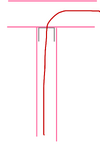
I’m trying to work out how to route some network cables from a socket in a metal framed plasterboard internal wall into the ceiling above. There’s another floor above but it’s in the middle of the room and I can’t disturb that floor so I need to do it from below. Is there any technique for breaking through from the wall into the ceiling without opening up a hole in the plasterboard at the top of the wall? I already have a hole low down in the wall for the network socket. Crude diagram attached!

What’s the best way to do this? If I have to open up the top of the wall, so be it.

 

Attachments

  • IMG_1709.png
    IMG_1709.png
    137 KB · Views: 20
Wouldn't there be timber (or a metal channel) at the top of the wall?

Is it a single skin of PB or a double skin?
 
Wouldn't there be timber (or a metal channel) at the top of the wall?

Is it a single skin of PB or a double skin?
Forgive me, my crude diagram was too crude! I’m ill in bed so am using notes to draw

Does this diagram make more sense? Plasterboard is pink, metal framing is grey and cable is red. The wall separates two rooms so has two faces of plasterboard and yes, the metal framing channel on all of its edges. It’s a 15 year old house and it’s not a familiar construction technique to me so I’m gradually working out how to navigate it. Most of my understanding of the construction is from poking about with a cheap boroscope
 

Attachments

  • IMG_1710.png
    IMG_1710.png
    82.5 KB · Views: 10
I’m trying to work out how to route some network cables from a socket in a metal framed plasterboard internal wall into the ceiling above. There’s another floor above but it’s in the middle of the room and I can’t disturb that floor so I need to do it from below.

Assuming you succeed, what happens with the cables when they emerge above the ceiling of the room below, and under the floor you can't disturb in the room above?


Most of my understanding of the construction is from poking about with a cheap boroscope

Has this poking about told you whether there are noggins or not?
 
Assuming you succeed, what happens with the cables when they emerge above the ceiling of the room below, and under the floor you can't disturb in the room above?
That’s not an issue, I can fish for the cable from another location in the ceiling void. It’s just the transition from internal wall to ceiling that’s foxing me.
Has this poking about told you whether there are noggins or not?

No noggins, effectively just rectangular panels with the metal framing on the four edges. I have a clear path from the socket to the top edge of this wall section.
 
Forgive me, my crude diagram was too crude! I’m ill in bed so am using notes to draw

Does this diagram make more sense? Plasterboard is pink, metal framing is grey and cable is red. The wall separates two rooms so has two faces of plasterboard and yes, the metal framing channel on all of its edges. It’s a 15 year old house and it’s not a familiar construction technique to me so I’m gradually working out how to navigate it. Most of my understanding of the construction is from poking about with a cheap boroscope

You could use a very long drill bit, drilling up at a steep angle through the metal channel, but how will to feed the com cable upwards?

I would use an oscillating saw to cut a square in the plasterboard and then cut a smaller square in the plasterboard behind it. That will help you drill up through the metal channel. Additionally, it will enable you to fit some kind of gromit/etc so that sharp metal edges do not damage the cable as you pull it horizontally.

If the wall has rockwool, the cut out will help you guide the cable up and through the hole.

I am not sure if the following advice adheres to fire regs- I would glue the smaller cut out to the larger one and glue them back in at the same time, then sand the top layer, fill the gap, sand the filler and paint.

I would make the inner hole large enough to get my hand into, the outer hole would be about two inches larger all around.
 
The way I've got around this in the past is to use a starratt cutter on a long arbour and drill diagonally through the PB and steel frame, the tricky bit has been adding some protection in the cut hole which I've done with a larger size of conduit, slit it to roll it into a smaller size and force it into the steel hole which it expands into or same size tube and add some glue (silicon seal/CT1/expanding foam) but that has to be done in ones best gynaecological fashion once the tube is right inside the wall.
1785191259137.png
=
 
The way I've got around this in the past is to use a starratt cutter on a long arbour and drill diagonally through the PB and steel frame, the tricky bit has been adding some protection in the cut hole which I've done with a larger size of conduit, slit it to roll it into a smaller size and force it into the steel hole which it expands into or same size tube and add some glue (silicon seal/CT1/expanding foam) but that has to be done in ones best gynaecological fashion once the tube is right inside the wall.
View attachment 419351=
Your must be a surgeon in your day job? Thanks for the tool tips, that could make all the difference.
 
I was thinking that the OP should cut a back box sized hole in the wall near the ceiling then drill upwards , then use a back box and blank to cover the hole
 
Your must be a surgeon in your day job? Thanks for the tool tips, that could make all the difference.
I got to do similar in business properties -offices, meeting rooms etc and such work was usually negotiated in advance. What I've described isn't easy but it was always easier when there was a dropped ceiling grid and this could be done above the tiles.
 

If you need to find a tradesperson to get your job done, please try our local search below, or if you are doing it yourself you can find suppliers local to you.

Select the supplier or trade you require, enter your location to begin your search.


Are you a trade or supplier? You can create your listing free at DIYnot Local

 
Back
Top