Heat Loss - Pen & Paper Check

Joined
15 Feb 2008
Messages
171
Reaction score
3
Country
United Kingdom
I’ve been having some mixed results with the various on-line radiator sizing tools.
Appreciate it’s not an exact science - but they seem a bit inconsistent and a leap of faith.
So I thought I’d attempt a manual check to give me a bearing (or even use as an alternative if it works ok).
I’d be very grateful if someone that’s done this before (I haven’t) could take a look / give me a steer or two.

The property is an old bungalow; pitched roof / 50mm insulation / sparking felt / solid floors without insulation.
External walls are 200mm / 270mm thick with small / poor cavities (gaps are probably breached, so I’ve assumed ‘solid’ U value).
Windows are single glazed hardwood with some secondary double glazing (I’ve assumed single glazed U value).
The room I’ve tried this on is a bedroom with one external wall / one window; adjacent to another bedroom / hall / bathroom.

My workings out are attached - thanks in advance.

D

 

Attachments

  • IMG_6026.jpeg
    IMG_6026.jpeg
    154.6 KB · Views: 28
1. Looks good to me. Except that:
1.1 You have not made provision for heat loss through internal walls. There will be some if abutting rooms are expected to be cooler than the room you are measuring.
1.2 There is no allowance for doors.
2. Your "allowances / assumptions" otherwise are all on the generous side. May result in a slightly oversize radiator. You can always turn a too large radiator down. You can't turn a too small radiator up.
3. Don't forget you may have to adjust for the "delta T" temperature (usually 50 degrees Celsius) quoted for radiators and your actual average of flow and return temperatures.
4. If you have thoughts of a heat pump in the future, you might want to consider sizing the radiators for this rather than for a boiler.
 
I’ve been having some mixed results with the various on-line radiator sizing tools.
Appreciate it’s not an exact science - but they seem a bit inconsistent and a leap of faith.
So I thought I’d attempt a manual check to give me a bearing (or even use as an alternative if it works ok).
I’d be very grateful if someone that’s done this before (I haven’t) could take a look / give me a steer or two.

The property is an old bungalow; pitched roof / 50mm insulation / sparking felt / solid floors without insulation.
External walls are 200mm / 270mm thick with small / poor cavities (gaps are probably breached, so I’ve assumed ‘solid’ U value).
Windows are single glazed hardwood with some secondary double glazing (I’ve assumed single glazed U value).
The room I’ve tried this on is a bedroom with one external wall / one window; adjacent to another bedroom / hall / bathroom.

My workings out are attached - thanks in advance.

D
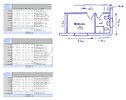
Have a watch of this, it explains it all very clearly
 
Thank you @oldbuffer & @Mister Banks.
I will definitely watch recommended video when home. I’m pleased to read that I’m not far off mark.
Q: Would you advocate this approach rather than an online tool; it wouldn’t be too difficult to apply this to each room.

You have not made provision for heat loss through internal walls.

I did consider the internal walls but then deleted them as I convinced myself that the adjacent rooms would be broadly the same temperature.
Where might I find the +/- temperatures for domestic room types.

There is no allowance for doors.
For internal ones - I assumed they’d be considered part of the wall. So I take it you mean search out a
U value and treat separately ?

Your "allowances / assumptions" otherwise are all on the generous side. May result in a slightly oversize radiator.
Perhaps so - would you suggest I dial any down ?

Don't forget you may have to adjust for the "delta T" temperature (usually 50 degrees Celsius) quoted for radiators and your actual average of flow and return temperatures.
I’m afraid I’ve no idea how to do this.
I’m assuming T50; brand new combi.
What would I be adjusting?

For completeness; I used same parameters for some online estimators

STELRAD (basic) 873W / 2981BTU
Uk Radiators 585 W / 1995 BTU
Home Supply 675 / 771 W & 2304 / 2633 BTU

Best D
 
I’ve taken onboard the previous comments watched recommended video - thank you @oldbuffer / @Mister Banks.
I’d be very appreciative if someone would be kind enough to take a look and confirm I’ve got things correct.

Mindful of a previous observation ……
Your "allowances / assumptions" otherwise are all on the generous side.

I’ve assumed a U value (2.2) for a solid external brick wall as I suspect the wall cavities are far from modern standards. The newest wall (built in 1957) and is about 270mm thick and has a cavity of maybe 50mm that is likely breached with debris / mortar / headers / lintels. The older walls (>200yrs old) are 200mm thick with maybe a small ‘gap’ of 25mm; I’ve no idea the state of the internals. Should I split the difference between U value of 2.2 solid wall and a U value of 1.0 for an un-insulated cavity wall ?

The windows are hardwood single glazed - some windows (North side) have a secondary Crital sliding Double Glazing. I’ve assumed worse case and ignored this; it’s far from modern standards.

If I carry on like this for all rooms, will it give me a reliable specification for my replacement (T50) radiators.
As I previously mentioned, I’ve found the accessible on-line tools a bit of mixed bag.

Best D
 

Attachments

  • IMG_6041.jpeg
    IMG_6041.jpeg
    214.8 KB · Views: 14
1. Built in 1957 a wall will almost certainly be a cavity wall, of the type you have used. While there will likely be some bridging with debris, this is most likely to be at the base of the wall, and given that heat rises, will have little effect. I'd use the normal uninsulated cavity wall U value, reduced by 10% to allow for bridging. Say U = 1.1
2. For solid walls, use 2.2. You can usually tell if a wall is solid by looking at the brick bond. If, in each row of bricks, there is a long brick followed by a half brick, followed by a full brick etc. it is almost certainly solid. If in each row there are all long bricks (except at corners) it is likely to be a cavity wall.
3. I think your treatment of the windows as single glazed is correct, although there is some benefit from the secondary glazing. I've never been able to find a reliable U value for secondary glazing.
4. You need to add a certain amount to the total heat loss (fabric loss plus ventilation loss) to allow for initial heat up. The total loss figure is a "steady state" figure to maintain a temperature. It is normal to allow 10% for initial heat up.
5. You are on the right lines for your calculations. As a secondary check:
5.1 Measure each existing radiator, determine what type it is (Type 11, 21 etc).
5.2 Look up the heat output of similar modern radiators and see if it is the same as your calculated value. I usually use Myson radiators as a comparison.
5.3 If the values are equal, and the room achieves adequate heat, then fine. Otherwise adjust as necessary.
 
Thank you @oldbuffer - that’s very helpful and generous of your time.

As you suggested……

- I’ll add +10% for intermittent heating.
- I’ll dial back the U value on the 1957 walls too.
- I’ll have a look at the ‘brick bond’ on the older walls to see if I can get a better read out on the existence or not of a cavity.

A quick check against existing rads is a good shout. Unfortunately, I can’t vouch for how well they work (as they’ve gone), but I did note sizes and types as I pulled them out.

D
 
I’ve had a look at my brick bond on older (200mm) walls of house.

The oldest part follows the bond pattern you describe:
If, in each row of bricks, there is a long brick followed by a half brick, followed by a full brick etc. it is almost certainly solid.

It then transitions to a newer (still old) bond of 2x long bricks followed by a half brick - would this be solid too ?

Thanks D
 

Attachments

  • IMG_5128.jpeg
    IMG_5128.jpeg
    672.8 KB · Views: 9
  • IMG_5127.jpeg
    IMG_5127.jpeg
    648.7 KB · Views: 10
It then transitions to a newer (still old) bond of 2x long bricks followed by a half brick - would this be solid too ?

Neither of those photos, suggests a cavity. An alternative way to determine, is to measure the wall thickness, at a door, or a window.
 
Note that it's not out of the question to directly measure the heat loss. You could do this in one or two of your rooms to compare with your calculated values.

You need an electric heater with a thermostat and a plug-in power meter. Run the heater until you have a steady state, then measure the power consumed over a few hours. You'll also need to measure the outside temperature, and ideally do it when that is reasonably stable. Keep doors closed and the room unoccupied as much as possible (your body heat could be significant, if it's a small room).

Knowing that you have a steady state is the hard part; the room may feel like it has reached a stable temperature, but if the room has been cooler in preceding days or weeks then the temperature in the brickwork won't have reached an equilibrium.
 
Thank you for the advice….
- I’ve added a 10% weighting for intermittent heating
- I’ve assigned different temperatures based on room type
- I’ve included heat losses to adjacent internal rooms
- I’ve identified solid / cavity walls (from advice on brick bonds)
- I’ve dialled back the U value where I have a cavity wall (albeit a thermally sketchy one)

I prefer this approach than the various on-line tools
Am I missing anything - am I good to go and use this to spec my rads

All best

D
 

Attachments

  • IMG_6047.jpeg
    IMG_6047.jpeg
    286.2 KB · Views: 13
I’m working through my rooms; one by one.
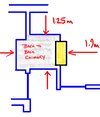
The internal wall of two rooms is largely made up of fireplace / double chimney breast.
I’ve peered in from loft - it’s a single course of bricks with about 300mm of ‘in fill’ in the void between chimney.
Would someone be kind enough to suggest a U value and likely temperature differential.
It’s a fairly big lump of masonry.

I’ve removed one of the fireplaces and bricked up the hole (leaving letterbox vent).
On the other side (yellow box) - I’ll fit a log burner.
It won’t be on all the time but it will close the open chimney.

Thanks D
 

Attachments

  • IMG_6051.jpeg
    IMG_6051.jpeg
    141.3 KB · Views: 16
Temp difference between internal rooms = small
Therefore U value = doesn’t matter much.
 

If you need to find a tradesperson to get your job done, please try our local search below, or if you are doing it yourself you can find suppliers local to you.

Select the supplier or trade you require, enter your location to begin your search.


Are you a trade or supplier? You can create your listing free at DIYnot Local

 
Back
Top