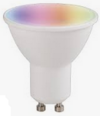
5w 700lumens Vs 7w 720lumens

Joined
14 Sep 2021
Messages
24
Reaction score
2
Country
United Kingdom
If a LED down light states the same (or very similar) lumen level, but one is 5w and the other is 7w.. is it a no brainer to go for 5w?

Or would the 7w still have better light for any other reason?

2 in question are the 4lite down light from Screwfix or the JCC x50
 
If a LED down light states the same (or very similar) lumen level, but one is 5w and the other is 7w.. is it a no brainer to go for 5w?

Or would the 7w still have better light for any other reason?

It’s possible that they have different colour temperatures, or different spectra.
 
If a LED down light states the same (or very similar) lumen level, but one is 5w and the other is 7w.. is it a no brainer to go for 5w?
If that is the only difference then obviously get the more efficient version which is the 5W.

However there are many other things to consider with lighting such as colour temperature, colour quality, beam angle and so on.
 
4-lite
Variable White, 4 selectable, 2700-6000K / 640-730lm / Aluminium Body / Up to 54,000 Hours Life / Dimmable / Fire Rated to 30, 60 & 90mins / 70° Beam Angle / 7 Watts / CRI 80

JCC x50
Two wattage and three colour selectable from beneath the ceiling
60° Beam Angle / 3 Watts 480 lumen / 5 Watts 720 lumen / 88000 Hours Life / 3000, 4000, 5700 K / CRI 80 / Triac Dimmable

3/5W is narrower beam angle which may or may not matter (depending on ceiling height and spacing). But FWIW those are both stupidly bright in my opinion. (Unless it's an extremely high ceiling).

I've just fitted some smart Philips Hue Essentials GU10s in my vaulted ceiling kitchen. Their spec is up to 340 lumens, 90 degree beam angle, 2200 to 6500K fully variable white (plus 19 million colours), 15000 hours life, 4.7 Watts 0.5W in standby. Those are more than bright enough and I can now just light up fewer lamps when not food prepping/cleaning/reading and can do all the colour temperature and brightness adjustment remotely.

The downlights were there when we moved in 12 of them one row of 3 and the other 9 on the two switches. Originally used 50W halogens (judging by the scorch marks on the GU10 holders and the EPC) but had been replaced with LEDs around the 7W, 3000K, 480 lumen mark from B&Q.
 
4-lite
Variable White, 4 selectable, 2700-6000K / 640-730lm / Aluminium Body / Up to 54,000 Hours Life / Dimmable / Fire Rated to 30, 60 & 90mins / 70° Beam Angle / 7 Watts / CRI 80

JCC x50
Two wattage and three colour selectable from beneath the ceiling
60° Beam Angle / 3 Watts 480 lumen / 5 Watts 720 lumen / 88000 Hours Life / 3000, 4000, 5700 K / CRI 80 / Triac Dimmable

3/5W is narrower beam angle which may or may not matter (depending on ceiling height and spacing). But FWIW those are both stupidly bright in my opinion. (Unless it's an extremely high ceiling).

I've just fitted some smart Philips Hue Essentials GU10s in my vaulted ceiling kitchen. Their spec is up to 340 lumens, 90 degree beam angle, 2200 to 6500K fully variable white (plus 19 million colours), 15000 hours life, 4.7 Watts 0.5W in standby. Those are more than bright enough and I can now just light up fewer lamps when not food prepping/cleaning/reading and can do all the colour temperature and brightness adjustment remotely.

The downlights were there when we moved in 12 of them one row of 3 and the other 9 on the two switches. Originally used 50W halogens (judging by the scorch marks on the GU10 holders and the EPC) but had been replaced with LEDs around the 7W, 3000K, 480 lumen mark from B&Q.
Thank you so much for the kind of response I was seeking.
So thorough.

I love Philips Hue - I have a the bridge and some colour bulbs around the house. I May get the strip as part of my extension false ceiling too. I use them mainly for security when I'm not home lol.

the beam angle part of your response has got me contemplating between the two. I'll see.

And i dont get the comments about 'dont get downlights'. If they offered an alternative that would be helpful. but i have some already, and for a consistent light across a living room, bathroom, kitchen - I know nothing better. and it beats the standalone lamps I have. I wouldnt pick them for a bedroom or landing - but they seem so good these days. can even remove the bezel and switch colour temp. and from what sparkies tell me, they dont even recommend getting spares as they dont see them ever go wrong.
 
My fave are 120 beam 65000k Gu10 LED in a light fighting that allows me to angle 4 of them at each corner / ceiling of the room. bounces off as an even diffused light.
As for direct down light then the same 120 degree but a lower lumen but more of them in the ceiling -- so little and often and fitted with a dimmer.
 
And i dont get the comments about 'dont get downlights'. If they offered an alternative that would be helpful. but i have some already, and for a consistent light across a living room, bathroom, kitchen - I know nothing better.

But it’s not a consistent light, is it? It’s a spot of light below the lamp. You would need loads of them to get something approaching uniform illumination. For a consistent light, fit a more conventional ceiling lamp of a style that you like. Then add spots of some sort where you need additional light, e.g. kitchen worktops, stove etc.

I think the main benefit of downlighters is that they result in specular reflections. If you have lots of chrome or glass, e.g. in a bathroom or possibly a kitchen, then you get sparkly reflections that make the place look cleaner than it would with more diffuse illumination.
 
Please explain.
My old house had a fluorescent tube in kitchen extension, started with 65 watt fat tube, then 58 watt, and then 22 watt LED, the LED lumen output was half the fluorescent tube, but never really needed 5000 lumens, the 2400 lumens were ample, it was the length of the tube which was required to give the spread of light.

Son bought my old house, and swapped the LED tube for down lights, 14 of them, and the room I admit looks better, and more modern, but no improvement to how well it is lit, around the same, 4 watts each I think, so 56 watts v 22 watts, and quick look at 4 watt GU10 Phillips, and I see lumen stated is 270, so 3780 lumens v 2400 lumens. But the direction is the problem, they are aimed at the floor, my new house kitchen has 4 x GU10 pods which can be aimed, nowhere near good enough, on my to-do list, but aimed at the areas needing light they work, and to make a cup of coffee often say hey google turn on sink, and just use one of the four lamps.

My wife wanted a chandelier for the stairs and landing, I refused to fit it, felt it was stupid, but my son fitted it, and yes looks good, lamp-landing_1.jpgand I can select outer, inner or all bulbs, so can have it dimmer in the middle of the night, but as far as lighting the area, 25 watt total GU10 or 12 watt BA22d, other end of the landing I have a plug in emergency torch which has a built-in PIR detecting light level and movement, which at night lights as we pass it, as light levels from the chandelier are not high enough.
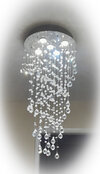
There are two problems with the down light, one is the direction of the light, and the other is the intensity of the light. How this
1762078180109.png
can be called MR16 I don't know, as the outer part of the bulb is cooling fins, it also does not have a multi faceted reflector as well as not have a 16/8ths of an inch illuminated area. The spread of light from a MR16 compatible bulb varies a lot, I like my Energiser smart bulbs, ⁣but1762078773538.pngthey are not an efficient way to light the room, but loved to wind up my wife turning the kitchen green for Halloween. I would not entertain any lamp where you can't change the bulb unless being sold off super cheap. I got an outside carriage lamp for £5 which is integral, and it lights the entrance very well, but had to buy a smart socket adaptor to control it, so another £10 where had it used a bulb, the smart bulb is only £5, and it is far easier swapping a failed bulb to swapping a whole lamp.

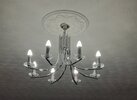
Shinning a light up to a white ceiling spreads the light far better than the same bulb facing down, so this Ceiling light.jpg works well, why the builders considered a room this size only needed one light I don't know, with a 150 watt BA22d tungsten bulb it was OK, but a 15 watt LED did not light the room, it was like a tocH lamp. So even 6 x 8 = 48 watt LED is not really enough, but it is a lot better.

 
Please explain.
I don't like them.

I suppose that's it really but:

they are a pain to fit, spacing neatly while avoiding joists, running cables across joists,
they ruin the ceiling with large holes all over the place,
they spoil and negate some of any insulation,
etc.
 
But it’s not a consistent light, is it? It’s a spot of light below the lamp. You would need loads of them to get something approaching uniform illumination.
Yep thats why I said little and often and get the 120 beam angle - standard is 60 degree
 
I had 6 adjustable (eyeball ) ceiling downlights in my kitchen pointing at the opposite work top - so getting light under the wall units. They were in a false ceiling covering a manky plasterboard ceiling with numerous bad repairs which I ripped out and re-plastered.
Instead of downlights again I went for 2 surface mount LED panels I used the 18W ones - these https://www.tlc-direct.co.uk I was going to fit some under cabinet lights but with these flat panel lights I don not need to and they give out an almost shadowless even light I would 100% fit these in a bathroom. I say bathroom because they are not a feature as you might put in a living room.
The good thing about them is you can change the colour and the fitting adjusts to any size hole so when i fitted i only had to make a 55mm hole.
 

If you need to find a tradesperson to get your job done, please try our local search below, or if you are doing it yourself you can find suppliers local to you.

Select the supplier or trade you require, enter your location to begin your search.


Are you a trade or supplier? You can create your listing free at DIYnot Local

 
Back
Top