Hello,
We live in a 1930s house that has several rooms downstairs and has been adapted a lot over time. We are slowly doing renovations room by room.
We are currently working on a room downstairs that is between the hall and the kitchen. I suspect this room used to be the kitchen.
At some point it has had a small extension, approx 0.8m x 1.6m.
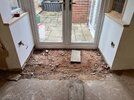
We took the carpet up and discovered lovely herringbone quarry tiles in the main, with square quarry tiles around the edge of the room. The extension had been done in the same square quarry tiles. Unfortunately these were all too uneven to keep and so have all been taken up ready for new floor to be laid.
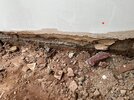
In the extended part of the room, we have an issue. Below the thin layer of cement that had been used to bond the tiles, there is nothing but sand and rubble.
We now need to do something with this bit of floor so that we can lay new flooring on top.
What do you recommend?
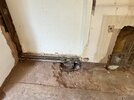
I haven’t dug down in the sand yet incase there is any benefit in keeping this. I did discover a capped off end of what I think is an old water pipe protruding up. I don’t think there is anything under the row of bricks holding the patio doors up.
There’s no damp course either that I can see. There is a suggestion of damp course on the outside of the house, but I think this may just be for aesthetics…
When we get there, the floor we are having is a Ardex NA / Ardex DPM / Ardex A45 under LVT
On Saturday we are now tackling this floor. I’m looking for recommendations of what to do (how deep to dig etc) and what mix of products to fill the gap.
We’ve had to put a couple of trades off now till this gets sorted, and everything that was in this room is now scattered across the house, so products that dry quickly, can be laid upon quickly without weeks of drying time, would be a bonus.
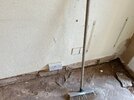
Final thing is there’s a bit of levelling to do around the edges. Why I’ve got the cement out, if there’s a cheaper way of doing this than using Ardex to fill, let me know.
Thanks
Ben
We live in a 1930s house that has several rooms downstairs and has been adapted a lot over time. We are slowly doing renovations room by room.
We are currently working on a room downstairs that is between the hall and the kitchen. I suspect this room used to be the kitchen.
At some point it has had a small extension, approx 0.8m x 1.6m.
We took the carpet up and discovered lovely herringbone quarry tiles in the main, with square quarry tiles around the edge of the room. The extension had been done in the same square quarry tiles. Unfortunately these were all too uneven to keep and so have all been taken up ready for new floor to be laid.
In the extended part of the room, we have an issue. Below the thin layer of cement that had been used to bond the tiles, there is nothing but sand and rubble.
We now need to do something with this bit of floor so that we can lay new flooring on top.
What do you recommend?
I haven’t dug down in the sand yet incase there is any benefit in keeping this. I did discover a capped off end of what I think is an old water pipe protruding up. I don’t think there is anything under the row of bricks holding the patio doors up.
There’s no damp course either that I can see. There is a suggestion of damp course on the outside of the house, but I think this may just be for aesthetics…
When we get there, the floor we are having is a Ardex NA / Ardex DPM / Ardex A45 under LVT
On Saturday we are now tackling this floor. I’m looking for recommendations of what to do (how deep to dig etc) and what mix of products to fill the gap.
We’ve had to put a couple of trades off now till this gets sorted, and everything that was in this room is now scattered across the house, so products that dry quickly, can be laid upon quickly without weeks of drying time, would be a bonus.
Final thing is there’s a bit of levelling to do around the edges. Why I’ve got the cement out, if there’s a cheaper way of doing this than using Ardex to fill, let me know.
Thanks
Ben