
They are triplets.I should have qualified that with "... until the new-fangled ones with Wago, or Wago-like' terminals recently appeared - but I think they they also only have 'pairs' (not 'triplets') of terminals.
Kind Regards, John

You are using an out of date browser. It may not display this or other websites correctly.
You should upgrade or use an alternative browser.
You should upgrade or use an alternative browser.
2 ring finals on one RCBO
- Thread starter SUNRAY
- Start date
No, rings are peculiar to the UK and some other countries using BS 1363 sockets.I read on FB today that in Canada/Aus there should be no more than 1 wire per terminal.
So they don't do rings then.

I should have qualified that with "... until the new-fangled ones with Wago, or Wago-like' terminals recently appeared - but I think they they also only have 'pairs' (not 'triplets') of terminals.
Kind Regards, John
mk
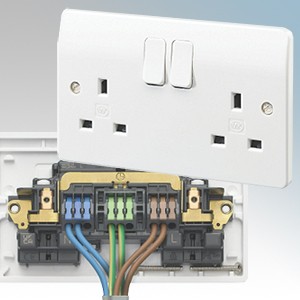
They are triplets.
OK, I stand corrected. That's a step in the right direction, then!mk <piccie>
Kind Regards, John

My ten pennorth. One two or three rings in one fuseway is still just one ring final circuit. The considerations of loading, volt drop and Zs still apply. All other things being equal, one example I gave was say you do one ring in one house and the house next door is almost identical except it has solid floors so all your cables are drop fed therefore increasing length and therefore in order to keep ring length down you do two rings one one fuseway then what is the difference? Providing the terminals are mechanically and electrically sound to take either two or four or whatever conductors there is no issue. Circuit loading will be the same for each house and your two ring circuit probably has less Zs and volt drop values than the identical one ring circuit which is no bad thing. Permitted by the regs, just slightly more difficult to test. Could catch the unwary but they should have no business touching it if they are not competent to do so. It is still one circuit by definition
Agreed, a circuit in BS7671 is defined as "an assembly of electrical equipment supplied from the same origin and protected against overcurrent by the same protective devices" so yes it's one circuit by definition.It is still one circuit by definition
The question is whether two rings of cable fed from the same breaker constitute a ring circuit and hence whether they benefit from the dispensation for ring circuits to use lower-rated cable than would normally be required for a given rating of breaker.
Indeed - as plugwash has said, the totality of any number of 'ring finals' protected by the same OPD constitute 'a circuit' by BS7671 definition.My ten pennorth. One two or three rings in one fuseway is still just one ring final circuit.
Kind Regards, John
I see no reason, why not, since the considerations for each of the two 'sub-rings' are identical for the two rings - and, indeed the risk of "...the load current in any part of the circuit [being] unlikely to exceed for long periods the current-carrying capacity (Iz) of the cable." (as required by 433.1.204) is actually less with the 'two rings' than if the same sockets were all supplied by a single ring.The question is whether two rings of cable fed from the same breaker constitute a ring circuit and hence whether they benefit from the dispensation for ring circuits to use lower-rated cable than would normally be required for a given rating of breaker.
As above, it would have no basis in terms of electrical common sense, but the only scope for pedantic argument I can see is that whilst 433.1.204 says "Accessories to BS 1363 may be supplied through a ring final circuit, with or without unfused spurs, protected by a 30 A or 32 A protective device complying with BS 88 series, BS 3036, BS EN 60898, BS EN 60947-2 or BS EN 61009-1 (RCBO)." (without saying that other things can't be protected by the same device), a pair of rings would, strictly speaking, constitute a "ring final circuit" per BS7671 definition "A final circuit arranged in the form of a ring and connected to a single point of supply", given that some people with nothing better to do with their time might argue that two rings are not "a ring"! However, I would personally leave them to worry about that!
Kind Regards, John
I must admit, that like most folk, If I saw a 2,3,4, 999, ringed ring final circuit I would initially look and think "What!" . But it is not precluded by the regs providing all other considerations are met. Some think that something not listed in the OSG is automatically wrong, no it is not, the On Site Guide is just a list of a few simple ways of achieving what`s required using minimal calculations. There are often umpteen ways of achieving things to BS7671. We might however be inclined to look at something so unusual and start to wonder "what else has been done and has it been done correctly?". I know some NICEIC folks think that say having two radials in one fuseway say for a lighting circuit is "having two lighting circuits in one one fuseway and is not allowed" for example. Well no it isn`t 2 circuits it is one circuit. It might have initially been two circuits and it has been modified to become one circuit in order to free up an existing fuseway, so someone has redesigned things. It may well still be OK but perhaps often not the most elegant solution although still permitted if all other relevant conditions are met. A radial may branch off several times to become tree circuits including at the origin i.e. at the fuseway. If we see a twin socket radial with 2.5/1.5 T&E cable on a 32A RCBO then does that make it unsafe? No. If we see a simple ring with a spur at the origin we would accept it, if we then remove the ring and just leave the "spur" it has not become any worse for overload or short cct etc. In fact if we saw such a radial with say 6 T & E cables each to one twin socket the considerations would be pretty much the same, we would not be concerned about overload. But again we would be inclined to look twice and think "What!"

This is one of those points I've personally never understood: a DSSO on 2.5mm² installed directly from the MCB is:... No. If we see a simple ring with a spur at the origin we would accept it, if we then remove the ring and just leave the "spur" it has not become any worse for overload or short cct etc.
Perfectly safe and acceptable within the regs if there is something else connected to it but
Is not perfectly safe and acceptable within the regs if there is nothing else connected to it.
Both are perfectly safe

433.2.2This is one of those points I've personally never understood: a DSSO on 2.5mm² installed directly from the MCB is:
Perfectly safe and acceptable within the regs if there is something else connected to it but
Is not perfectly safe and acceptable within the regs if there is nothing else connected to it.
Presumably you mean from a ≥32A MCB, yet that is a rather strange thing to say.
"You have never understood why something perfectly safe and acceptable in the regs is not perfectly safe and acceptable in the regs."
What led you to that misunderstanding?
433.2.2
Presumably you mean from a ≥32A MCB, yet that is a rather strange thing to say.
"You have never understood why something perfectly safe and acceptable in the regs is not perfectly safe and acceptable in the regs."
What led you to that misunderstanding?
Indeed. I think you might mean that so long as the MCB/Cable combination is protected by short cct and Earth Fault then it could be and number of socket outlets totalling the full rated conductor current, so you could run a 6.0 or a 10.0 conductors , say T & E and go over 32A to whatever the method type gives you, so long as your MCB rating does not fall below N (number of outlets) X 13A you would be OK provided the socket terminations were rated for the current received via ring/radial/joint box combination. Hence the lollipop (or Lassoo) circuit which some frown on but perfectly acceptable, often a result of creating a new kitchen ring from a redundant cooker circuit
Indeed.This is one of those points I've personally never understood: a DSSO on 2.5mm² installed directly from the MCB is: Perfectly safe and acceptable within the regs if there is something else connected to it ...
Who/what said that? As far as I can see, 2.5mm² (Method C, hence CCC=27A) protected by a B32 (which will inevitably provide adequate 'fault' protection) is OK per BS7671 if it is protected, at worst, with 26A worth of downstream fuses (2 x 13A plug fuses).... but ... Is not perfectly safe and acceptable within the regs if there is nothing else connected to it.
Kind Regards, John
agreed.
PS those death cubes each have a 13A fuse on the 2way variety
PS those death cubes each have a 13A fuse on the 2way variety

DIYnot Local
Staff member
If you need to find a tradesperson to get your job done, please try our local search below, or if you are doing it yourself you can find suppliers local to you.
Select the supplier or trade you require, enter your location to begin your search.
Please select a service and enter a location to continue...
Are you a trade or supplier? You can create your listing free at DIYnot Local

