You need a land area around your house that is larger than most people's houses have, to use a ground source heat pumpIf I did consider a heat pump, then it would have to be ground source and not air for the extra efficiency. Although at 82 I would not live long enough to reap the long-term benefits.

You are using an out of date browser. It may not display this or other websites correctly.
You should upgrade or use an alternative browser.
You should upgrade or use an alternative browser.
Air source Heat Pump
- Thread starter motorbiking
- Start date

Not with the ground deep boring method I won't, but yes, if I did opt for one the land my property sits on would be more than sufficient.You need a land area around your house that is larger than most people's houses have, to use a ground source heat pump

A bore hole being drilled for a Ground Source Heat Pump went through a pocket natural gas,

 www.bbc.co.uk

 www.richardfuller.co.uk
A gas reservoir was discovered in July 2024 during the drilling of a 100m+ borehole for a ground source heat pump in a back garden in a residential neighbourhood. Drilling such a hole for a heat pump or other reason is deemed “permitted development” so there was no requirement to get a permit and no requirement to notify.
Cleat Hill explosion: Borehole filled with cement
The HSE confirms the sealing of the borehole is now complete and that the cement has cured.
www.bbc.co.uk
Cleat Hill Gas Explosion
Following the tragic gas explosion in Cleat Hill on 19 October 2024, in which two residents lost their lives, Richard has been actively working to address the issues raised by this devastating event.
A gas reservoir was discovered in July 2024 during the drilling of a 100m+ borehole for a ground source heat pump in a back garden in a residential neighbourhood. Drilling such a hole for a heat pump or other reason is deemed “permitted development” so there was no requirement to get a permit and no requirement to notify.
Last edited:

Deep boring method has its own issues. It was attempted at a property in Bedford last year, and went disastrously wrong, resulting in 2 deaths. The boring Crew hit a pocket of Methane, which built up in the nearby house, causing an explosion. The house was destroyed, costing the life of one person, and a second who was seriously hurt, didn't survive the injuries. Surrounding area had to be evacuated, Police had to guard the site for weeks, and the Neighbours as I understand it, all have Gas Monitoring equipment in their properties in case of further gas escapes. https://www.bbc.co.uk/news/articles/cvgxdnlzkjzo

- Joined
- 31 May 2016
- Messages
- 28,747
- Reaction score
- 7,628
- Country

But as a rule of thumb I need 50% more rad capacity?Absolutely makes sense to explore ASHP options if you are replacing the gas boiler anyway- even more so with solar albeit granted you won't see much benefit in the winter months.
UFH not required and probably unlikely you need to double capacity of all of the radiators.
My concern is the old parts of the house. Hardwood floor on a bitumen base on concrete. Does get cold in the winter.
Maybe just move the meter and replace the boiler.
I can always add more aircon modules.
My Partner and her Mother had an ASHP fitted to replace a solid fuel fire and back boiler a few years back, they have one of the early Misubishi units. Its doesn't work very well. All the radiators were replaced and upsized, however the house struggles to get warm, and it seems to cost more to run the ASHP than it does to heat the property with Portable Electric heaters/radiators.
The Landlord's Agent attended yesterday to do the annual check, even he said they are 'crap, and don't work very well when retrofitted to older properties.' My understanding is, the property needs to be designed with ASHP in mind, insulated and heating fitted to suit the setup.
The Landlord's Agent attended yesterday to do the annual check, even he said they are 'crap, and don't work very well when retrofitted to older properties.' My understanding is, the property needs to be designed with ASHP in mind, insulated and heating fitted to suit the setup.
It depends. A lot of radiators in your house may be perfectly sufficient to meet heat loss. We ended up upgrading just under a third- mostly K1s to K2s (one K3).But as a rule of thumb I need 50% more rad capacity?
My concern is the old parts of the house. Hardwood floor on a bitumen base on concrete. Does get cold in the winter.
Maybe just move the meter and replace the boiler.
I can always add more aircon modules.
Doesn't make sense imo to replace boiler and not at least explore an ASHP and get heat loss calcs/quotes. Just don't believe the myths would be my advice- such as they are only suitable for well insulated houses, you need UFH etc.
We just kept it set at 20/21 all day every day in winter and so nice not coming back to a house set back at 15/16 waiting for it to warm up.
Our ground floor is suspended, no insulation. Part tiled, part wooden floor, part carpet. Our kitchen just has bare floorboards above the cold void, and has done all of last winter as I'm in the process of renovating. It was fine though.
@motorbiking "But as a rule of thumb I need 50% more rad capacity?" I replaced my heating system 12yrs ago and as I run my flow temp at 50-55c absolute max due to Mrs Scally often holding them as she moves around the house, all of my rads are sized for a max flow of 50c. This means that if I did opt for a heat pump, my rads would be still sized correctly.
- Joined
- 31 May 2016
- Messages
- 28,747
- Reaction score
- 7,628
- Country
My boiler is so old it just has numbers on a wheel. I’ve no idea what the rad temp is unless I use an infrared thermometer

- Joined
- 17 Aug 2010
- Messages
- 5,148
- Reaction score
- 2,155
- Country
I certainly have; 20 years ago power cuts were common for us during the winter, 12v inverter plugged into the van for an hour at a time worked well just to power the CH and HW - Pump was noisy with the square wave, but it didn't break it (lasted another 20 years)You’ve tried the battery and Invertor idea I take it ? Lol
I sort of cured the regular power cuts - I bought a proper petrol generator, the day after Scottish Power announced an upgrade to our local power lines, we have never had a power cut since - seriously I have never once needed to run that genny, they put up proper pylons and they stopped collapsing every windy night

- Joined
- 27 Jan 2008
- Messages
- 29,470
- Reaction score
- 3,621
- Location
- Llanfair Caereinion, Nr Welshpool
- Country
Yes, it was expensive, and I will admit that, but not fitted solely to power the central heating and freezers, there are other benefits as well, and it does depend on when we get a power cut, time of day and summer or winter. The software holds 10% of the battery back for the UPS function, and the battery is 6.4 kWh so 640 watt/hour at worse point. So around 5 hours it will keep heating running.You’ve tried the battery and Invertor idea I take it ? Lol
Should the power cut be when the battery is fully charged, then likely the solar will keep it topped up for weeks, clearly any repeat of winter of discontent, and we can change how much is held back.
A petrol inverter generator would be the best idea to keep heating running, and with that in mind better if the boiler is plugged in, not connected with a FCU. The generator does not need to be big
 so that one would do.
 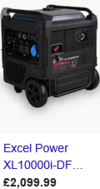 at nearly 9 kW, still not sure if that would run a heat pump, likely you would need to use convector heaters in key rooms, so in real terms it would need to be one of these
 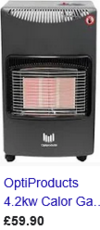 which to be fair is not too expensive, also need to rent the bottle of course, but they do make the home damp. Last house, something more like this,
- Joined
- 31 May 2016
- Messages
- 28,747
- Reaction score
- 7,628
- Country
Got a quote on something called a cosy turbo. Looks like a rubbish bin with a fan on top.
@motorbiking "But as a rule of thumb I need 50% more rad capacity?" I replaced my heating system 12yrs ago and as I run my flow temp at 50-55c absolute max due to Mrs Scally often holding them as she moves around the house, all of my rads are sized for a max flow of 50c. This means that if I did opt for a heat pump, my rads would be still sized correctly.
To get the best possible Heat pump efficiency (COP), you run the HP output/rad temperature as low as possible. 50C would be considered high, if you assume a rad dT of minimum 5C then that (those) rads will give a output of 46% of its (T50) rating so a oversizing factor of slightly over 2 (2.2) required to give a room temperature of 20C, 45C rad temp gives a output of 35.4%, oversizing factor of 2.8. There are times obviously when the heat required is far lower in the relatively mild winters we get around here, so oversizing by a factor of 2 to 2.5 combined with weather compenation should give a reasonable COP.

DIYnot Local
Staff member
If you need to find a tradesperson to get your job done, please try our local search below, or if you are doing it yourself you can find suppliers local to you.
Select the supplier or trade you require, enter your location to begin your search.
Please select a service and enter a location to continue...
Are you a trade or supplier? You can create your listing free at DIYnot Local
Similar threads
- Replies
- 40
- Views
- 7K

- Replies
- 3
- Views
- 6K
