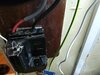
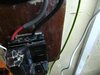
The tails from the main fuse have always been like this and I have never queried it. It looks as if the insulation was trimmed away at some point to reveal the red and black colours. Been like this for 30+ years but should they be brought up to date?
Looks alright, but has the installation been upgraded and tested over the last 30 years, or are there still mcb's or even fuses? The tails could be dealt with as part of an upgrade, perhaps it's time for an EICR.
Strictly speaking - the grey outer should protect the red, all the way into the item it is connected to, but be cut back a little from the terminal. The grey is mechanical protection, the red is the insulation.
Blup....I had a new dual RCD board fitted in October. My electrician updated the CU tails and fitted an SPD. He did mention the other tails in my photos and said that he wasn't allowed to touch those - he said that they were OK but could be better done. I told him that UKPN were coming to do a survey with a view to updating my main fuse and he said that they would almost certainly replace those tails any way.
Under current editions of BS7671 primary insulation is not supposed to be exposed outside of an enclosure. People will argue about whether something like a meter box constitutes an enclosure, but that doesn't seem to make a difference in your case anyway since there doesn't seem to be an enclosure of any kind.
It used to be common practice to leave a small amount of primary insulation exposed at the ends of meter tails, so it was clearer which wire was which. Your tails have rather more exposed than I would think is typical though. Nowadays it seems to be more common to use cable ties to mark the wires or to use tails where the sheath is the same basic color (though often a slightly different shade) as the primary insulation.
My understanding is that the service head is the responsibility of the DNO, the meter is the responsibility of your supplier and is maintained by a metering operator under contract to them. I'm not 100% sure about the official position on the tails between them, I suspect they are technically the responsibility of the supplier but in practice if the DNO is on site anyway and thinks they need replacing then they will just replace them.
If you need to find a tradesperson to get your job done, please try our local search below,
or if you are doing it yourself you can find suppliers local to you.
Select the supplier or trade you require, enter your location to begin your search.
Please select a service and enter a location to continue...
Are you a trade or supplier? You can create your listing free at DIYnot Local