• Looking for a smarter way to manage your heating this winter? We’ve been testing the new Aqara Radiator Thermostat W600 to see how quiet, accurate and easy it is to use around the home. Click here read our review.

Balancing radiators and lockshield valve

Joined
5 May 2004
Messages
123
Reaction score
0
Country
United Kingdom
I'm trying to get my head around the principle of the lockshield valve when balancing radiators.

All of the research and googling seems to imply that this valve controls the amount of water returning into the system, but in order to control this it suggests that those nearest the boiler, typically those which heat up first, should have the valve open only a quarter turn, with this gradually increasing until the furthest away radiator has it's lockshield valve fully open.

What I'm struggling to understand though, is that this seems to me to be the wrong way around, as wouldn't this mean that hardly any water would exit the first radiator, so this would therefore be the hottest one, with hardly any water reaching the subsequent ones. It makes more sense to me to have the ones nearest the boiler to be fully open, to allow more hot water to reach the further away radiators.

What am I missing here?
Thanks in advance.
 
I'm trying to get my head around the principle of the lockshield valve when balancing radiators.

All of the research and googling seems to imply that this valve controls the amount of water returning into the system, but in order to control this it suggests that those nearest the boiler, typically those which heat up first, should have the valve open only a quarter turn, with this gradually increasing until the furthest away radiator has it's lockshield valve fully open.

What I'm struggling to understand though, is that this seems to me to be the wrong way around, as wouldn't this mean that hardly any water would exit the first radiator, so this would therefore be the hottest one, with hardly any water reaching the subsequent ones. It makes more sense to me to have the ones nearest the boiler to be fully open, to allow more hot water to reach the further away radiators.

What am I missing here?
Thanks in advance.
no because on a standard system each rad has its own flow and return leg , its not a case of flowing into one then out and into the next .
 
What I'm struggling to understand though, is that this seems to me to be the wrong way around, as wouldn't this mean that hardly any water would exit the first radiator, so this would therefore be the hottest one, with hardly any water reaching the subsequent ones. It makes more sense to me to have the ones nearest the boiler to be fully open, to allow more hot water to reach the further away radiators.

What am I missing here?

Most systems, these days, have the radiators plumbed in parallel. Only older systems, had all the radiator in a single loop, in series.

Radiators, nearest the boiler, will offer less resistance to the flow and so, will heat up sooner than the ones further away, in pipe length. The idea of balancing, is to balance the resistances equally, so they all get warm quickly.
 
The idea of balancing, is to balance the resistances equally, so they all get warm quickly.
Is it? I am sure it is part of the reason. But also it controls the speed it heats up at, so the TRV has enough time to close, before it gets stinking hot and causes the room to overheat and start a hysteresis.
should have the valve open only a quarter turn
I found it depends on the make of the valve, I start by opening ¼ turn at a time, until a little heat is felt then stop.

This gives me a good starting point, in theory I should use a differential thermometer and set the difference between in and out at 15°C, the problem is I don't have two sensors to use with my differential thermometer.

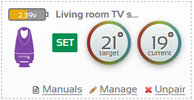
But my programmable TRV head shows on the PC target and current. Flat Battery TRV.jpgSo turning up the wall thermostat, so the boiler is not going to switch off, I watched the report, and if the current exceeds the target, I closed it a bit. And in parent's house with a modulating boiler, it worked A1, each room within 0.5°C of setting.

However, tried the same in this house, on/off oil boiler, and it failed. I think due to the boiler being designed not to re-fire within a set time. But also the use of micro bore pipes. I do not bother adjusting the lock shield valve, I leave them wide open.

Since the boiler does not modulate, the rooms will heat in the order the TRV heads are set, so an hour before due home, the kitchen TRV head opens, 10 minutes latter the dinning room one opens, and then the living room one opens 10 minutes latter, and so on. But this would not work with a modulating boiler, as the boiler would close down.

So the basic answer is, there is no one method to set up the lock shield valve. The big problem is when the TRV is marked *123456, and you're left with two valves to set.
 
Is it? I am sure it is part of the reason. But also it controls the speed it heats up at, so the TRV has enough time to close, before it gets stinking hot and causes the room to overheat and start a hysteresis.

Not exactly, no - but it gets the OP understanding part of the reason.
 
Not exactly, no - but it gets the OP understanding part of the reason.
Agreed, boilers and heating has moved on, where I work we still have a one pipe system, the boiler sends steam to the radiators, and at the last carriage it is vented to atmosphere, gives a great ambiance, but not that efficient. However, it is supplied from a real boiler, not just a water heater.

But we have kept so many of the old ideas, and I question if they are any longer valid. When we went from the old water heater to the new type which could gain the latent heat from the flue gases, the whole concept changed. Under the old system, I mixed control methods, in some radiators the output was controlled by how much water flowed through it, others by the speed of the fan, the latter had a high flow at all times, and the result was hot water returned to the boiler. This messed up the boiler's in built control, the boiler shut done prematurely, and the by-pass valve will never lift, as the water always flows, so the fan assisted radiator works better with a series system.

So some old ideas are no longer valid. The idea of one radiator without a TRV in the room with the thermostat, for example, the idea is now as each room is satisfied the pressure differential increases as each TRV closes, until the by-pass valve lifts, and hot water is returned to the boiler which in turn causes the boiler to modulate (turn down) its output.

If we did not have a lock shield valve, the rooms would be heated one at a time. The water would flow through the easiest path, until that radiators TRV starts to close, and then to the next easiest path, the returning hot water would cause the boiler to turn down its output, and it would seem the boiler was undersized, when in real terms most are well oversized.

I know a 2 kW electric fan heater will heat any room in my house, on the coldest day to well over 24°C, it is the emergency method used if the boiler fails, so 11 rooms, so 22 kW I know is well over the requirement for the whole house, 10 of the 11 rooms would only need 1 kW setting, so 12 kW would be ample to heat all rooms.

But I don't heat all rooms, I only heat to 20-22°C rooms in use, rooms not in use kept at around 17°C, to reduce recovery time when wanted, so a 10 kW boiler would be ample for my three-story house. But it has a 20 kW one fitted. OK, mine not a modulating type, but with a modulating type I would want it to modulate down to at least 5 kW, most of the time the heating is running a lot less.

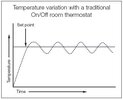
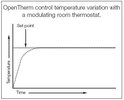
So my boiler uses a mark/space control, it fires up for ½ an hour, then sits there with just the pump circulating the water for an hour and a half, then fires up for another ½ an hour, this causes a hysteresis, Temp_variation_on_off.jpg where with the modulating boiler this is much reduced Temp_variation_TPI.jpg we are told OpenTherm can reduce it further Temp_variation_OpenTherm.jpg but only if the boiler has not been oversized. I had two boilers in the last house, fitted before the combi boiler came out, one for central heating and one for domestic hot water, the latter was 18 kW and other than filling a bath, it was ample. Very few homes need a boiler over 20 kW, and the heating of a large boiler to just wash one's hands, clearly does not make sense.
So we see the heat pump being fitted, it runs cooler, and we are forced to have stored hot water, if we reduced the gas boiler to the same output as the heat pump, and reduced its circulating temperature to the same as the heat pump, then the gas boiler would also use far less energy.

We have to compare like with like, I had a tumble drier vented type running with just one element in use, so 1 kW, it would take 95 minutes to dry the clothes, new heat pump drier is 650 watt, and it takes 150 minutes to dry the clothes, both approximate, but that means vented 1.5 kWh and heat pump 1.625 kWh, what has not been factored in is the heat pump drum is larger so dries more clothes per load, and the heat pump does cycle on/off near the end of the drying time, plus not pumping central heated air out of the house, so all in all the heat pump does use less, but if I could have run the vented at 500 watt, then I think there would be very little between the two, and likely the vented would win.

With condenser driers, we have no option to reduce the heat used, be it water cooled, air cooled, or heat pump cooled, we have a fixed heater and cooler size. It was only the vented where we could select the heater size.

It is the same with central heating, if we fitted 10 kW gas boilers, and domestic hot water storage, the heat pump would not stand a hope of heating the house for under twice the price of gas.

 

If you need to find a tradesperson to get your job done, please try our local search below, or if you are doing it yourself you can find suppliers local to you.

Select the supplier or trade you require, enter your location to begin your search.


Are you a trade or supplier? You can create your listing free at DIYnot Local

 
Back
Top